22. April 2015 · Comments Off on The Camellia Collector’s Garden · Categories: Memoir

In an upscale neighborhood halfway between Redwood House, and Granny Jessie and Grandpa Jim’s tiny white house on South Lotus, there was a magical place tucked into a dell of huge native California live oak trees. Looking back, we— my brother JP, my sister Pippy and I— seem to have spent an inordinate amount of time there, in those lovely leisurely days when mothers were expected to stay at home with children, but not to spend every waking minute ferrying them frenetically from scheduled amusements, playdates and lessons, with barely time for a snatched meal from drive-through or take-out.

Compared to our peers in the 1960ies, Mom may have been a bit of an overachiever, with Cotillion on alternate Tuesdays, Girl Scouts on Wednesday, and Confirmation on Thursdays. That was during the school year, though… in the summers, we three had swimming lessons at the house of a woman in La Crescenta who had, like her mother before her— been on the American Olympic swim team in their respective days. Mom sat with half a dozen other mothers on the deck in back of the house, while the two women dragooned a dozen tadpole children through their paces: diving, back-stroking, holding our breath and diving down to the bottom of the nearly Olympic-sized pool, treading water. It must have been rather boring for her, I imagine. Mom must have enjoyed the time during our lessons in nature appreciation at Descanso Gardens more, because she could walk around the acres of Manchester Boddy’s landscaped estate.

He was a newspaper publisher in the 1920ies and 1930ies, an aesthete with a mad passion for camellias, and a lovely chunk of property, close against the hillside and thickly grown with huge native oak trees. His house was still there, back against the first rise of the hillside, a large, graceful white house with the hollow and institutional feel common to a mansion that has once been a great home, but now full of empty, or nearly empty rooms, given over to official enterprise. Owing to a number of business reversals, the estate and garden wound up being in the public domain, but unlike the house, the gardens were burgeoning, enchantingly full of life… and flowers.

As children, we loved the camellia woods, but Mom loved the rose garden, two acres of roses, Grandpa Jim’s tiny formal garden expanded exponentially. Like his garden, it was for roses and roses alone, bare thorny stems rising up out of carefully tended weedless ground, planted in curving beds, and straight disciplined lines, trained over arbors and pergolas, every selected bush lovingly tended and encouraged to bloom, bloom and bloom again, encouraged with every atom of the gardeners’ art and skill with water, and application of clippers and fertilizer. Under the hot spring sun, the scent of acres of roses in bloom was intoxicating… but the rose garden was baked and bleached by sun, shimmering off the gravel paths, and we preferred the cool green shades of the camellia grove and the pond with the ducks. The gardens seem to have been much improved upon, since we were there so often, and even since I took my daughter in the early 1980ies, perhaps the large artificial pond, just inside the old main entrance is no longer there, or in the same form, but the gardens that I remember was threaded with artificial, but skillfully built watercourses, and the main catch-pond was the home of a flock of tame ducks. There was a coin-op dispenser that for a nickel, administered a handful of cracked corn— so very clever of the garden administrators to charge the public for expense of feeding the tame resident waterfowl. By afternoon, the ducks would be lethargic, sleeping off their orgies of gobbling corn from the hands of small children, but in the morning hours, when the garden had just opened, they would throng hopefully towards anyone approaching the main pond, and the ever-bountiful coin-op dispenser.

On the other side of the pond there was an oval lawn, shaded by towering oak trees, and groves of shrub camellias, acres of cool and misty green paths planted with Manchester Boddy’s pride and joy, all dark glossy green leaves and pale pink and white or magenta flowers. We loved the camellia groves, and the tangle of green paths threading the dell: we knew the chaparral hillsides, and the open, sun-blasted acres of rose garden— it was what we lived our lives amongst— but acres of cool green woods, and stone-trimmed water-courses, that was something rare and exotic and special.

Bearing to the left of the duck pond was another bit of exoticism; along about in the late 1960ies, they built a Japanese tea-house, a lovely little tile-roofed pavilion, led to by a series of bridges, walkways and a carefully clipped landscape of bamboo and azaleas. The watercourse was extended into a lagoon around the tea-house foundations, and stocked with fat golden carp. The teahouse served tea, of course, courtesy of a concessionaire who was in the good graces of the Japanese-American organization who had funded construction. The tea was clear greenish-golden liquid, served in handle-less cups and accompanied with fine-grained, soy-salt tasting crackers. We sipped it, looking out into the serene green depths of the camellias and the sheltering oaks, and thought there was nothing more restful, nothing more peaceful in all of the world, than Manchester Boddys’ wonderful gardens.

20. April 2015 · Comments Off on Sunset and Steel Rails – Chapter 7 · Categories: Chapters From the Latest Book

Sunset and Steel Rails Mockup Cover Pics with titles(Another half chapter of the work in progress. Sophia Brewer has escaped from her sociopathic brother, who has coldly contrived to drive her — if not insane — then to confinement in the local asylum. She is being helped by the family of Agnes Teague, the Brewer household maid of all work … and the Teagues have a plan.)

Walk Away and Never Look Back

Of course, the nightmare came that night – the horrific dream where Richard struck her and she cowered under the blows, relieving the feeling of suffocation under the weight of something heavy pressing her down, down, down, until she couldn’t breathe, the pain of that weight forcing her legs apart, a new stabbing and intimate pain that spun away as the opium took her down even further…
“Miss Sophia,” a tremulous voice breathed in her ear, and there was a hand on her shoulder, which she batted away until she realized it was only Agnes, and that she lay on a pallet on the floor of the tenement room where the Teagues lived. “Miss Sophia … y’r crying out… is it the nightmare again? O’ course it is. Wake up no – ye are safe with us, and soon to be far away, where he can no’ harm ye again…”
“I know,” Sophia gulped, still half-paralyzed by the ragged shadows of the dream. Her heart pounded so hard, she feared it would burst in her chest, and her shift seemed to be drenched in her own clammy sweat. “I am awake, Agnes. I am sorry that I have disturbed your own rest…”
“No,” Agnes demurred, “I sleep light, Miss Sophia – and easily. Dinna regret … an’ I am accustomed to being around folk with night terrors. Da an’ Declan, they both awake shouting, still. Go back to sleep, Miss Sophia.” Agnes’s voice sounded ever more musical, with the Irish lilt to it. “I can sing a lully-bye to ye, as Ma once did, if ye think that it would help.”
“Do not threaten me, Agnes,” Sophia was recovered enough to be humorous. “I have heard you try to sing – you cannot carry a tune in a bucket.”
“I know,” And at her side in the darkness, Agnes giggled. “I canno sing – it will be a cross to bear when I take the veil…”
“Agnes!” Sophia was diverted from contemplating her own miseries. “You are thinking of becoming a nun?”
“Aye,” Agnes replied, in tranquil confidence. “’Tis a thing I have felt a calling for … oh, the last year or so. Da an’ the boys, they think it a girlish thing, an’ a matter for teasing. But I take no mind. It will be so, an’ I will be guided. Just so are you guided, Miss Sophia – I have a sense of such things, y’see. But a bad dream as you had just now – there was something that Mrs. Garrett said to me. You cried out Mr. Richard’s name, crying no, no! just now, and it reminded me of what she said.”
“What did she say, Agnes?” Sophia now felt cold, the sweat-damp shift clammy against her skin. “And when?”
“When you had been carried upstairs, the evening of the day when Mr. Richard locked you in the strong-room.” Agnes ventured. “Mrs. Garrett and I – we came running from the back o’ the house. Miss Vining an’ Miss Phelps, they were there, too. When Mr. Richard went for Dr. Cotton, Miss Vining and Mrs. Garrett and I took off your clothing … soaked in blood, they were. Oh, Miss Sophia…” and Agnes’ arm tightened around Sophia in a comforting embrace. “I thought it so fortunate that you were not aware. Miss Phelps went quite faint, she were that distressed, but Miss Vining, she were very brave, an’ sent for Miss Phelps to bring hot water and cloths… bruised from head to toe ye were. We took off your dress an’ underthings … an’ that was when Mrs. Garrett said, straight out – that it looked as if you had been …” and Agnes’ voice dropped, hushed with embarrassment, “Interfered with … bruises, y’see. An’ bloody matter on your under-drawers an’ Miss Vining, she turned white an’ then red, an’ said that Mrs. Garrett should shut her mouth before speaking such vileness. Mrs. Garrett, she said straight out, she may ha’ been born at night, but it wasn’t last night, neither, an’ there were no man in the house save Mr. Richard. That were when Miss Vining said that such an evil-speaking woman ought to be sacked, an’ Mrs. Garrett said that she wouldn’t stay a minute longer in a house where such goings on were countenanced. That were when Mrs. Garrett gave her notice.” After a long moment, Agnes said, “I were not certain of what they meant, Miss Sophia. But when I asked Miss Vining later, she were angry. So I said nothing more. Was that the right thing, Miss Sophia?”
“Yes,” Sophia answered; sunk in misery and doubt, for she could not truly remember anything past a certain moment in that dreadful evening. But … something awful had happened to her, which her mind quailed from contemplating, even acknowledging. “I truly cannot recall anything, after my brother forced the syrup of opium down my throat. My brother beat me savagely, all but murdered me. That is enough for me to know, Agnes. I had always assumed that he loved and wished the best for me … just as your brothers do for you. It is a hard burden to bear – knowing that his actions demonstrated otherwise. You are fortunate in your family, Agnes – if not in those worldly and material things. I shall try to go to sleep now.”
“You do that, Miss Sophia,” Agnes embraced her again, which Sophia found comfort in; but why were her true friends now revealed as the humble and down-trodden, when everyone else had turned away? How very complicated her life had become; perhaps it was a good thing to go away from Boston and start on it again, free from familial connections and interference.

Still, she could not sleep, for the tumult in her mind and heart: So much to consider and worry over – would she journey safely to Chicago? What refuge would she find there? If this slightly mysterious Mr. Harvey would not hire her, what would she do then? At her shoulder, Agnes breathed slow and regular, deep in slumber. At last, Sophia slithered out from under the blankets on the pallet, and from Agnes’s light embrace. The girl obviously slept sounder than she had said, or else she was tired. There was a faint light in the room, on the other side of the makeshift curtain which sheltered the pallet. By that light, Sophia rose, changed her shift for a clean one and resumed the dress that she had worn that day – and which she would wear when Declan came for her – and that, by the distant sound of the bells from the old North Church – would not be very much longer. She wrapped the coarse countrywoman’s woolen shawl around her, for the night was still chill, from the wind blowing off the harbor, and the windows of the Teague tenement apartment leaked all the way around. She may as well sit by the fire which warmed the small place. She stepped around the edge of the curtain, and saw that Tim Teague had installed himself in his armchair – or perhaps he had never abandoned it, after allowing it to Sophia for a short while.
“Ye canna sleep, I see,” he said, as she stepped around the curtain. He was awake, his old eyes gleaming in the slight firelight. What an odd conversation; she may as well indulge him, for he was kindly and his daughter was comforting, and after all – he remembered her father.
“No, I cannot,” She replied, settling on the little three-legged stool which Agnes had sat upon the night before. The fire had had burned down very low – there was very little warmth in it at all. “I am setting out on a long journey, Mr. Teague, and there are things which I cannot stop thinking of …”
“Tim … call me Old Tim,” he answered readily, grinning as she answered,
“I cannot be so familiar, Mr. Teague. You are very much my senior in age, and it is just not proper … even if you were a servant. My mother was always very particular about courtesy and respect.”
“So was your father, if I remember,” Tim Teague acknowledged. “He had such a way with him to all.”
“I did not know him, and you did,” Sophia asked, on impulse and felt suddenly shy. “He was killed about the time that I was born, so I never knew him at all. All I know is what my mother and Great-aunt Minnie said of him … and they knew him only as family. Not as a man – a soldier – would.”
“The Major,” Tim Teague settled with a reminiscent sigh deeper into his battered armchair. Sophia hugged her knees to her chest, like a small child and listened hungry for every word.
“He was not what you would think of when you think of a hero,” Tim Teague began. “No’ at first. He was a quiet man, soft-spoken … sometimes I think he held his sword in leading a charge as if he were surprised to find such a thing in his hand. He did not give orders as if he were giving orders. He spoke as if asking a favor, but such was his manner an’ intent that … men obeyed on th’ instant. He were never familiar, as if he were seeking to ingratiate wi’ us, but always courteous … an’ he had a notion always of when someone told him a lie. Which was a recommendation if you came up before him on charges.”
“He had trained early in law,” Sophia said, and Tim Teague grinned again, obviously relishing the memory.
“An’ that was my good fortune, I tell ye, Miss Sophia. It was some small matter … th’ provost-sergeant – an evil man! – he told a lie about me. An’ so I were brought up before the Major. He, bless the man, saw how it were a lie wi’ a shrewd question ‘r two, an’ I had my liberty at once. He was always,” and Tim Teague’s eyes were remote, as if looking into the far distance beyond the tiny room in an upper-floor tenement in North Town, back to a world of blue uniforms, banners floating above and before them, and grey clouds of rebel gun powder smoke over a hard-held position, “an officer we could trust, y’ see. He were a good ‘un …”
Sophia rested her chin on her knees, and listened intent, as old Tim recalled her father in memory, a well that she could only dip into this once. She thought that she had a better picture of him than she had ever gleaned from her mother, whose memories of Richard Brewer were hazed by a veil of bridal silk.
After a time, Tim Teague’s reminiscences went wandering – as Great-Aunt Minnie’s were also wont to do; Sophia listened, lulled by the musical bent of his speech – why was it that it sounded to her almost like poetry? He talked of how he had departed starving Ireland as a young man, the misery of an immigrant ship – how he had finished up in Boston, working as a laborer on the docks, how he had met and married the mother of his children. That was before the war came, and he had enlisted … Sophia wondered if she had at least dozed a little, for she wakened with a bit of a start. Tim Teague was patting her shoulder, under the woolen shawl.
“Close the door and walk away. Walk away, niver looking back. Do ye no good, cailín daor. There’s nothing good for you, remaining. Na deamhain – demons will haunt ye anyway, so don’t give them a chance to get their claws into you any deeper. Faugh a Ballagh! – That was our battle shout. ‘Clear the Way!’ for the 28th … We marched in the Grand Review, ye know. But for me, there were a stone in m’ heart an’ demons haunting m’ soul for a’ that I had seen. The Major was no’ with us. He should ha’ been, but f’r a damn dirty sniper at Petersburg …”
There came a quiet tap on the door to the room in which they sat, and a mumble of a voice whose words Sophia could not quite catch. Tim Teague lifted his head, alert as an elderly hound. “Ah … ‘tis Mendelson. Ye had best ready yourself, cailín daor. Declan will be by wi’ the wagon, any moment now. Remember what I said – close the door, an’ walk away, niver look back.”

19. April 2015 · Comments Off on The Smell of Chili in the Morning · Categories: Old West

(This is a slightly reworked piece I did for a local real estate blog, which alas seems to have gone dormant – enjoy! CH)

For much of the 19th century and into the early Twentieth, it was a popular San Antonio custom. Various of the public squares, notably Military Plaza and Market Square were the domain of the Chili Queens who established a custom of setting up tables and benches along the edges of the squares, in the early evening and selling chili-by-the-bowl to all comers. They would bring huge kettles of chili which they had made over their own home cook-fire during the day, and keep it warm through the evening and into the wee hours over an open fire. The chili vendors would entice customers to their own particular stands by hiring musicians to entertain diners. There are some splendid descriptions of how marvelous this would have appeared – lantern and starlight shining down on the tables, gleaming on glass soda bottles, while the scent of the chili and the mesquite smoke from the fires which kept it warm hung on the night air. (I used this scene several times in Lone Star Sons, and in Adelsverein – The Sowing.) During South Texas summers before the invention of air conditioning, this likely would have been about the most comfortable dining venue for working men, for those out for an evening of gambling and drinking in the various saloons … and in later decades, for those visiting from the North or the East, desirous of absorbing a little exotic local color.

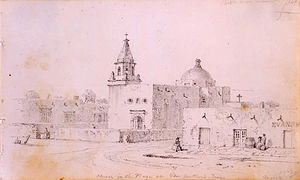
Historic San Antonio Main Plaza, with San Francisco Church

Historic San Antonio Main Plaza, with San Francisco Church

Chili was a very local delicacy in those years. Texans took readily to a venison or beef stew highly spiced with local chili peppers (with or without beans, with or without tomatoes), especially in the borderlands. But it was also a seasonal dish – generally only served in the spring and summer when the fresh peppers ripened and were available in the market. Air-dried whole chilies were available, of course – but they just didn’t provide the same flavor-punch. There may have been many local gourmands who adored chili and wished to eat it year round, but only one of them did anything about it.

This was a German-American, Willie Gebhardt, who got his start in food entrepreneurship by owning a beer-garden and restaurant in New Braunfels in the 1890s. It’s often said among the Irish that there was an Irishman at the start of any interesting cultural, technological or scientific effort, but in Texas in the late 19th century this role most usually fell to a German. Willie Gebhardt, like many other local cooks, developed his own special recipe for chili, and served it often in season – but on the side, he began experimenting with a means of preserving the essential chili pepper flavor. Eventually he hit upon a means of soaking ancho chili peppers, garlic, oregano and cumin in a water-alcohol mixture, then grinding it into a stiff paste, which was dried under low heat. When dried, it was further ground into a powder using a coffee-grinder, and packed in air-tight glass bottles. It was immediately popular; Willie Gebhardt took out a patent, calling it Gebhardt’s Eagle Brand Chili Powder. By the turn of the century, he had opened a factory – patenting a number of machines to expedite the manufacture of chili powder, which became and still is insanely popular. Eventually his factory, under the direction of a brother-in-law branched out into providing ready-made canned chili, and other staple Tex-Mex foods. Since this cuisine was largely unknown outside of the southwest, Gebhardt’s company published a cook-book instructing American cooks how to use chili powder – the first nationally-distributed cook-book on Mexican food. The original recipe for Eagle Brand Chili Powder is still available, supposedly unchanged, although the company was sold to Beatrice Foods following on the death of Willie Gebhardt in 1956. (It’s available on Amazon – so is a facsimile of the original Gebhardt’s Mexican cookbook.)

11. April 2015 · Comments Off on From the Next book – Sunset and Steel Rails · Categories: Chapters From the Latest Book

Chapter 7 – Walk Away and Never Look Back

Sunset and Steel Rails Mockup Cover Pics with titles (From one of the current works in progress – Previous chapter here  This will be an adventure about a proper young lady who winds up going west under … well, interesting circumstances.)

“Lock the door after us, Phelpsie,” Sophia gasped. “And if Richard comes here tonight, you don’t know where I am. You haven’t seen us at all. Tell Aunt Minnie that I am well only when she is better … goodbye, Phelpsie – don’t open the door for anyone tonight!”

“I won’t,” Phelpsie gabbled, distraught, and Sophia thought that Phelpsie – aghast at the thought of having to face an angry Richard alone – for a moment was about to beg them all to stay. But the door opened in Declan’s strong hand and closed with a thud after them, and with some distant sense of relief, Sophia heard the sound of the lock falling to. Dark had fallen entirely now, save for only a pale pink smear in the western sky.

            “Where are we going?” Sophie struggled for breath and against her own weariness; Declan went ahead, a strong wide-shouldered man, her carpetbag in one hand, his stout watchman’s cudgel swinging in the other, as they hurried up Beacon Hill in the direction of the golden dome of the state house, still gleaming faintly in the last light of day. Agnes had her arm around Sophia’s waist – and unexpectedly strong arm from her short lifetime of hard work. Sophia was grateful for the support, and that they were heading in the opposite direction of the Brewer house and unlikely to encounter Richard in the tangle of narrow old streets in the waterfront district.

            “To our home,” Agnes replied. “See … Declan an’ I, we’ve an idea to help you escape for good…”

“If you have the mettle for it, see,” Declan threw over his shoulder as he hurried ahead. “But ‘t would mean leaving Boston, so it would, Miss Brewer.”

“I’d go out to the frontier and beyond, among all the wild Indians,” Sophia answered, without thinking. “As far as it would take that I’d never have to fear my brother again?”

“Out west?” Declan grinned over his shoulder. “Among the wild Indians and gunslingers? Our Seamus can’t get enough of those tales, but you might have your chance, Miss Brewer, with pluck and luck.”

“What do you mean?” Sophia gasped; she felt as if she were being swept along by an irresistible tide. Now they had left the lights of Beacon Street, plunging into the depths of the old North Town, which had been abandoned by people of quality decades since, and left to the poor, the recent immigrants from Ireland and elsewhere. The streets were narrow, the ancient brick buildings shouldering close against each other, the smells – of privy, waterfront, and cooking almost nauseating in intensity.

“Carry this, no’,” Declan passed the carpetbag to his sister. With the faint scritch of a Lucifer against the nearest wall, Declan had lightened a lantern. “’tis safe enough now for a light – his bully lordship will no’ be looking for us here, Miss Sophia.” Declan Teague sounded most particularly satisfied about that.

“I cannot help but fear that there might be others in these streets,” Sophia had recovered something of her composure, after several twists and turns, each one into a street darker and narrower than the last. “Posing even more of a danger than my brother to us all…”

Declan Teague let out a rich chuckle, “Aye, so you might think, Miss Sophia. But this is where we live, and among folk who know us and protect their own kin an’ kind. You are safer here, amongst us than you have been for a while among your kin. I am thinking. Here – this is the place, above the shop of old Mendelson the Jew. Mind the steps, then …” He held up the lantern courteously; yes, there was a narrow alley between one tall brick tenement and the next, an alley which led to a door – one which might once have been fine, when it was the house of a merchant-prince of the last century. Declan had a key for that door, and Sophia mentally blessed him for the lantern, for the hallway inside was Stygian-dark, the flight of stairs to the next floor and the one above that even darker. At the top of that flight there was another short hall, with a doorway on either side. Declan turned and made a short and awkward half-bow before the door on the right-hand side. “Our home, our fire an’ our salt, Miss Sophia. Ye are welcome, indade. I mus’ be at my place of employment. Aignéis – for that is her right name here – she will explain to you the solution which I ha’ mentioned. Sorry – I am already late. There is one thing, Miss Sophia; gi’ me your hat and mantle.”

“I cannot think why it is necessary for me to give up my clothing,” Sophia protested, although at her side, Agnes whispered,

“Do what he says, Miss … we have worked out a means of laying a false trail.”

Declan opened the door saying only, “Aignéis, she will explain, with Seamus in chorus. Y’r hat now, and be quick about it. I’ll be back in t’ morning.”

“Do as he says,” Agnes whispered at her side, “The mantle, too … oh, dinna fuss, Miss Sophia – I will explain, sure an’ I will. Ye will be safe indade – for we hae planned it all out f’ ye, an’ ye’ will ne’re fear your brother again. Do ye no’ trust us?” Agnes sounded so doleful that Sophia was moved instantly to reassurance.

“I have, all this time – and now I trust to whatever scheme you have concocted … especially since I have no better choice in the matter.” She pulled the pins out of her hat, holding them briefly in her mouth as she handed her hat to Agnes’ brother, then shrugged out of her mantle.

“Good,” Declan grinned again. He leaned down, not so very far, and kissed his sister on the forehead, as he deftly bundled up hat and garment into a small bundle under his arm. “No fear, Aignéis – I’ll be back at sunrise. You an’ Seamus explain it to her, then.”

He was gone down the stairs with his comforting cudgel and lantern, even as Agnes opened the door into a dim apartment which must once have been a generously appointed room, when it was a single chamber and not sliced up into a parlor, kitchen, and sleeping quarters for a family, even one as small as that of a widower with four grown children. There was a tiny iron stove set into the hearth of a stopped-up fireplace, a stove which obviously served as a cook-fire and to warm the premises. A single kerosene lamp provided illumination, to a cot where a boy a few years older than Richie sat cross-legged, reading from a book, which to Sophia’s eyes – in the dim light – looked like some kind of Wild West blood-and-thunder tome.

A pile of ragged clothes and blankets was piled up in the single tattered armchair, drawn close to the fire, and as the door opened and closed, the ragged pile bestirred itself, and an aging and cracked voice inquired, “Aignéis – cailín daor – is that you?”

“’Tis, Da – and I have brought Major Brewer’s daughter with me,” Agnes replied.

“To this house?” the cracked voice broke with astonishment, and the pile of old clothing convulsed. “Aignéis, why did ye do that? ‘Tis not a fitting place for her ladyship …”

“I’m not a ladyship,” Sophia protested, and Agnes answered in placating tones,

“No, Da – but she has no other place to go for this night … and wicked man that he is, Master Richard has brought the doctor at this very hour, to carry her away to the asylum … an’ she is no madder than Siobhan or I.”

The clothes and blankets heaved and reshaped themselves, becoming in the faint light, the figure of a man, bent with age and with one arm so crippled and shortened as to be strapped immobile in a sling on his chest, saying with the courtesy of a lord. “Ye are welcome to share our salt and the shelter of our roof, Miss Brewer – ‘tis little enough, but it is our honor.” So this was Declan and Agnes’ father, Sophia realized: she had often heard of him, in Agnes’ daily conversation – that he had been a soldier in her father’s regiment, and how he had been crippled for life in an accident on the docks when Agnes was little more than a baby. Now he took her hand in his good one, and inclined his head in rough courtesy.

“I thank you for it, Mr. Teague,” Sophia swayed, suddenly faint with exhaustion. “And I am more grateful for your hospitality than I can …” The wave of dizziness threatened to overwhelm her, and Mr. Teague chided his daughter.

“Call me Tim Teague, now, will ye? Settle her in my chair now, Aignéis … the poor lady is no’ well, no’ well at all. Sit there, Miss Sophia – rest ye now …”

So grateful for the consideration that she nearly wept, she sank into old Tim Teague’s chair – the only padded and comfortable chair in the room, if so shabby and broken that even thrifty Great-Aunt Minnie would have relegated it to a bonfire. Tim Teague hovered at her side, patting her hand in a way meant to be comforting, until Agnes brought another simple straight chair from the corner of the room for her father. Agnes herself settled onto a low three-legged stool at Sophie’s knee, and young Seamus set aside his book – thriftily dimming the lamp-wick by which he was reading it.

“Is it true that your brother was feeding you opium and trying to drive you mad so that he could steal your money?” he asked with intense interest.

“Seamus, be hushed!” his sister cried, in an agony of embarrassment, adding as an aside. “Forgive him, Miss Sophia – but ‘tis true that I have talked of your situation… amongst the family, mind – only with Da an’ Declan at the first. Siobhan an’ I – we have always talked about folk we were in service to. It’s an amusement, y’see. It’s one of the only ones we have, a good gossip; sometimes like a play, or the old stories.

“No, Agnes – do not chide him,” Sophia answered, around a lump of grief in her throat. Grief for the lost life she once had, grief for the illusion of the fond and protective brother, grief for herself, lost and forlorn, taking refuge in a boarding house in old North Town. “It is true, every word that your brother and sister have said. And now I have nowhere to go and no friends to turn to, aside from yourselves – is that not as dramatic as one of your books, Seamus?”

“Oh, aye,” Seamus breathed, while Agnes cleared her throat – she sounded at least as tentative and uncertain as her young brother.

“But, Miss Sophia – we have a way for ye to escape, for good an’ all – if, as Declan said – ye have the mettle.”

“She does, indade,” Old Tim Teague assured them all, patting Sophia’s hand again. “She is th’ daughter of Major Brewer o’ the 28th Massachusetts! Never was an officer cooler under fire! Nay, he were not of my company, but all knew of him. The hotter the fire again’ us, the cooler he were, striding up and down along our line, w’ lead shot fallin’ like hail from a summer storm! An’ he would say a few words to every man – humorous-like, as if on a stroll through the Common, as if he had all the time in the world, an’ no other worries than a drink in the next tavern …”

“Yes, Da,” Agnes interjected. “But we came away in such a hurry that Declan had no time to explain. She does no’ know the plan.”

“There is a plan?” Sophia still felt rather faint, considering this unexpected chance. Likely any plan was Declan – or perhaps Seamus’ notion. Agnes was as guileless as a small child. To credit her with a stratagem of any complexity was to think that Richie could suddenly emerge as a captain of industry.

(To Be Continued …)
 

09. April 2015 · Comments Off on The Door Prize · Categories: Domestic
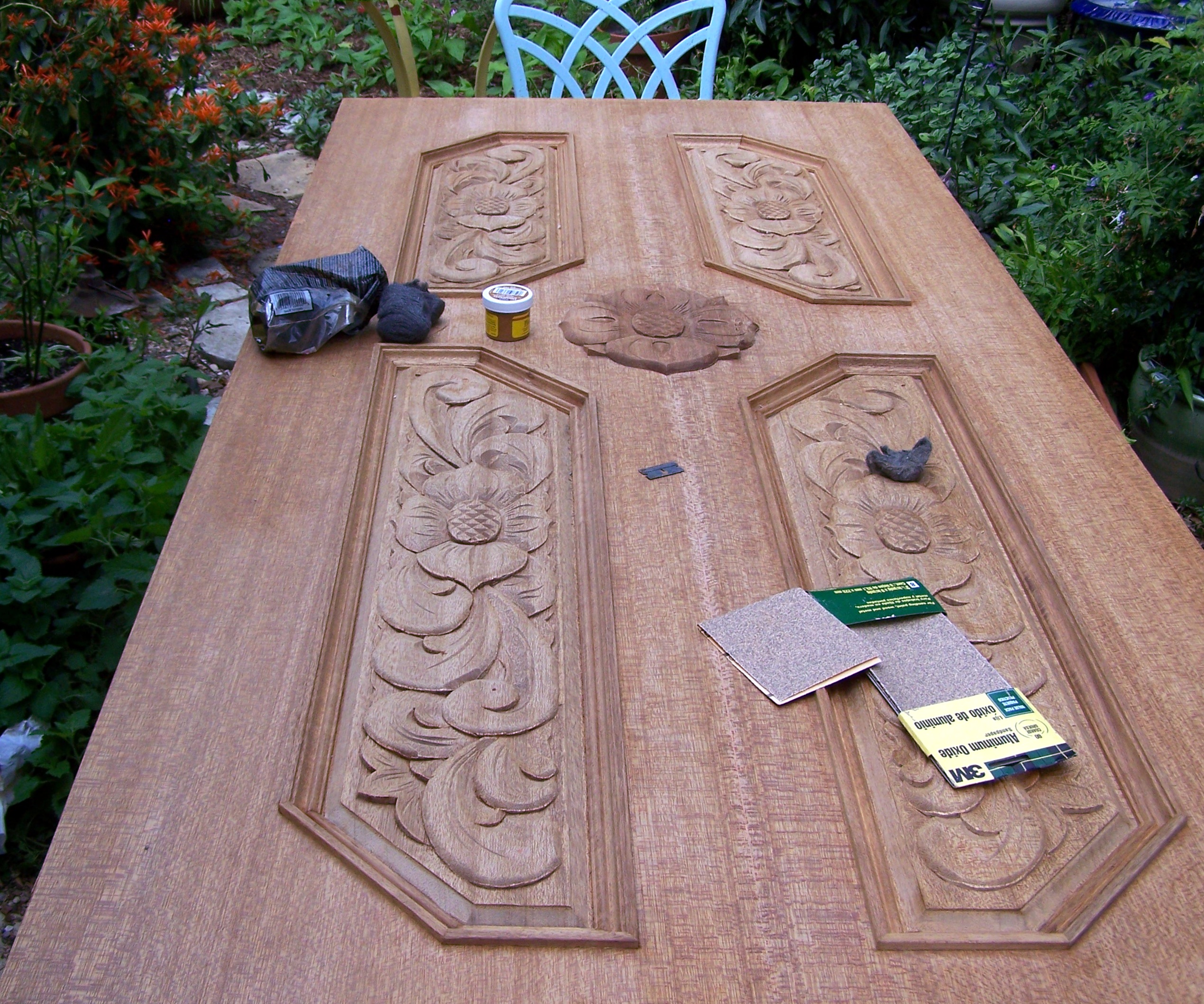
How we all started on The Door

How we all started on The Door

This is, of course, the carved, solid-wood front door that I bought at the Daughter Unit’s urging last weekend at the neighborhood estate sale. Said door was one of the items crammed into the house formerly owned by an elderly couple with hoarding issues. The estate sale managers told us that they had to fill and empty an industrial dumpster three times, just to get to the sellable stuff. Which, as it was all crammed together in a dingy, airless and dark house, did not show off at it’s very best; honestly, there were some rather nice items available, but a lot looked like several aisles worth of the Dollar Store jumbled in with random contents of the marked-down shelves at Walmart. The blanc de chine lamp was one of the random nice ones – the door was another. It’s some kind of oriental sycamore wood, with four inset panels carved with a sort of lotus and leaf design. It was completely unfinished, and never had been installed.

The center ornament of The Door

The center ornament of The Door

My daughter called our next-door neighbor as soon as I had paid for it: he has a pickup truck, and I think feels rather guilty about how his basset hounds sometimes start barking in the middle of the night. Anyway, he came at once – so did the guy who does all kinds of neighborhood handiwork. All agreed that it was a very nice door – albeit heavy enough to require two or three persons to lift and carry. Well, we had planned and budgeted to replace the front door this year, but some piece of contractor  leftover from the Habitat for Humanity retail store was what we originally had in mind. The day after we bought it, the Daughter Unit and I set to with steel wool and a bucket of polyurethane varnish; three coats to the front, two on the back, and oh, my – did it come out well. There is a thin veneer front and back, which looks very much like something called ‘lacewood’ – a kind of rippled gold and brown effect. The Daughter Unit fears that someone will break into the house someday and steal nothing but the door.

One of the carved panels

One of the carved panels

We did source a latch set from Habitat, anyway – I am almost certain that much of what we use for renovating and replacing certain elements of the house will come from there, if not the marked-down section from Home Depot or Lowe’s. A small bit of panic upon trying to assemble the latch set, when we realized that it was set for a left-hand side opening and not a right-hand one, which was what we needed. Nothing about this in the box, and instructions were there not: It also wasn’t returnable. The three of us – me, Daughter Unit and the neighborhood handyman finally figured out that we could disassemble the latch mechanism itself and convert it to what we needed.

The Door - Nearly done!

The Door – Nearly done!

Oh, and the existing threshold needed to go, as well as the inside door trim, but we had pretty well written that off. Of course now the danger is that this bit of renew-replacement will make everything else look tatty. I’m almost a hundred percent certain that we are due for another inside paint job…