10. May 2015 · Comments Off on This Chicken Outfit · Categories: Domestic
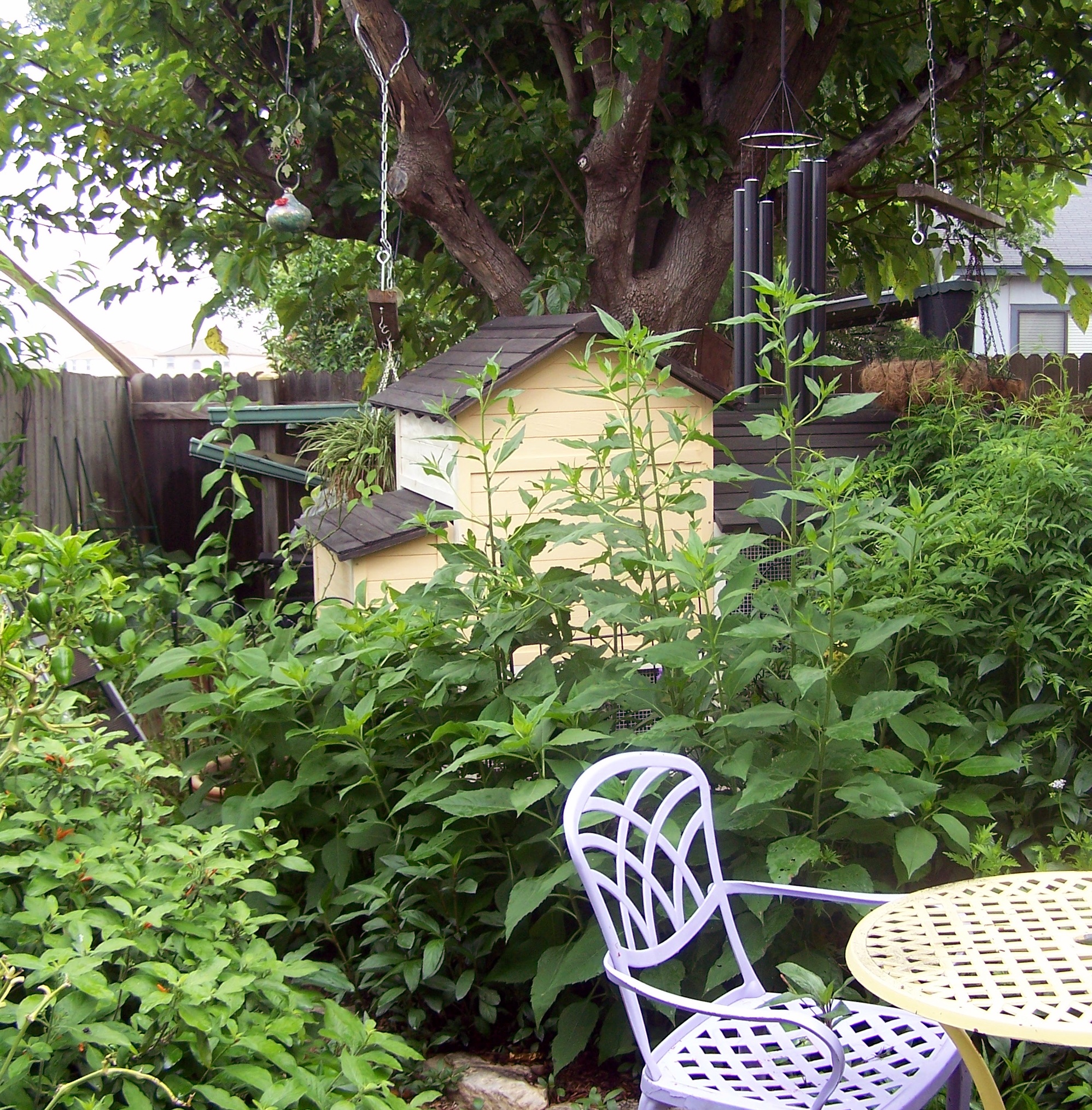
The chicken run end of the coop.

The chicken run end of the coop.

One of the things that my daughter and I have considered – now and then, and in a desultory manner – is the matter of keeping a handful of chickens. For the fresh eggs, mostly; I suppose this is a natural development to having a vegetable garden, and to experiment with home-canning, home cheese-making and home brewing. Likely it is all of a part with keeping the deep-freezer fully-stocked, and having a larder full to the brim with non-perishable food supplies; beans, rice, flour, sugar, bottled sauces, milk powder and the like. In the event of an event which keeps the local HEB/Sam’s Club/Trader Joe’s from being stocked … we will have our own food-banked resources to rely on.

But having only a sliver of suburban paradise acreage and an 1,100 square foot house taking up at least three-quarters of it, means that mini-farming can’t go much farther than chickens. No, not even a goat; which one of our neighbors did have, back when I was growing up in a very rural southern California suburb. They had chickens, too … and the people across the road kept domestic pigeons – but these suburbs also featured half-acre to acre-sized lots and the biggest of them corrals for horses.

And then, three things happened: several weeks ago, we made the acquaintance of a neighbor who does have a small flock of chickens – and a rooster, too – which is how we knew they kept chickens for months before we actually met up with them. They showed off their flock, and the morning harvest of fresh eggs … and we began to think of it as a possibility for ourselves. The fact that the local HEB is now carrying sacks of chicken feed in the pet-food section is an indication that other people are keeping chickens. If anything, I imagine that the great brains at HEB who decide what local demand is and stock the outlets have twigged the popularity for keeping backyard chickens, and that our neighbors with the flock are not the only ones.

Behind a screen of Jerusalem artichokes and a small fence

Behind a screen of Jerusalem artichokes and a small fence

This very spring, Sam’s Club added a chicken coop to the aisles with the seasonal merchandise; the tents, barbeque grills, camping gear and gardening supplies. My daughter looked upon it wistfully, whenever we went into Sam’s: it was an attractive thing, with a gabled roof, and a lower gable-roofed enclosure with hardware cloth sides, so that chickens could be somewhat sheltered. We talked about it, each time – but the price of it always put us off the notion. Until the first of May, when we noticed that the coop had been marked half-off. Yes – that was doable. We bought the coop, and a sturdy box-boy helped us stuff all 150 pounds of the box that it was in into the back of my daughter’s Montero. (We had a hand-truck at home, so it wasn’t necessary to beg for any help in getting the box around to the back of the house.)

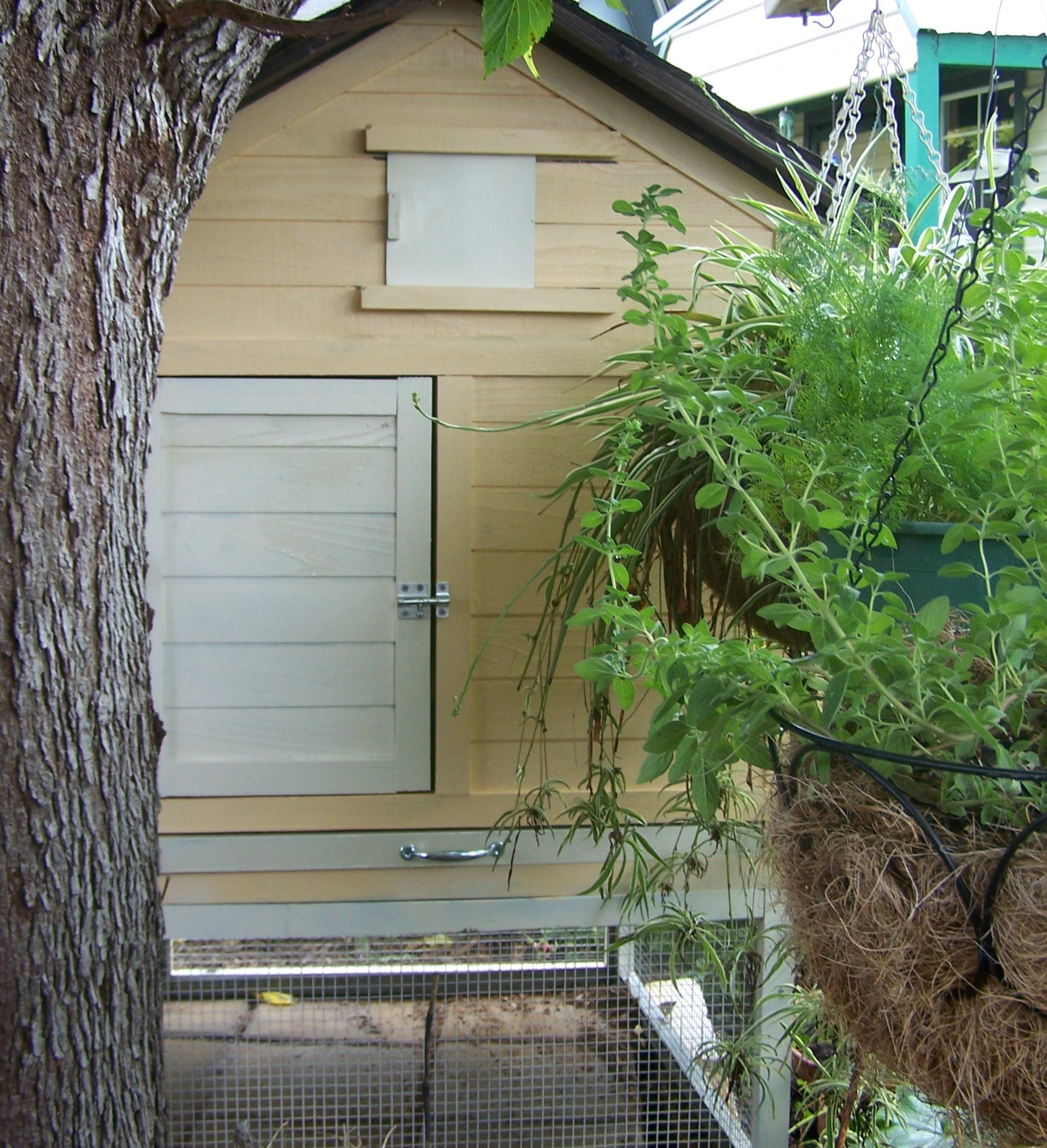
It was in my mind to site the coop under the mulberry tree, where the soil is so intermixed with roots it is difficult to plant anything there in the first place. It’s also so shaded in the summer that anything sun-loving which can be planted has a tough time. It was also my notion to paint the coop the same color as the house: a sort of primrose-orange with cream trim. That was what took the most time – painting twelve out of the sixteen panels that made up the coop and run and letting them dry. The wood was lightly stained a dusty green, and it took two coats to really cover adequately. Well – that and setting out the concrete pavers to set the whole thing upon, and filling the interstices with decomposed granite. I really should have unleashed the screw-driver attachment for my electric drill earlier on: that would have saved some time and sweat. (The whole thing is held together by more than 70 Phillips-head screws of various lengths.)  I did the touch-up paint work this morning, and re-sited some plants – and all but finished. The roof will have to be painted with waterproof varnish, but I have half a gallon left from doing the front door, and tomorrow is another day.  And doesn’t it look simply palatial, as chicken coops go?


The door side of the coop

The door side of the coop

Next week – the chickens: the Daughter Unit has pretty much decided on Orpingtons, since they are good layers, friendly and fairly mellow.

01. May 2015 · Comments Off on Sunset and Steel Rails – Yet Another Chapter · Categories: Chapters From the Latest Book

Sunset and Steel Rails Mockup Cover Pics with titlesChapter 9 – The Harvey Way

            Her feet were feather-light, as Sophia sped down the stairway to the street, the load from her shoulders similarly light. Exuberant with joy and relief, she felt as if she should dance along the sidewalk, sing and shout. She was not tired, she was not a desperate and near to penniless fugitive. She had a pass for travel without charge on the next train … to Newton, which Mr. Benjamin had explained – with some amusement – was some six or seven hours journey farther west. She had just missed the most recent train west, and had some hours wait for the next. Her feet slowed … yes; there was one thing she ought to do, now that she was truly in the west. If she was a woman inclined to making careless, symbolic gestures, she might have dropped the gold Armitage engagement ring into the Missouri River, but the Brewers – and also the Teagues – were not given to indulge in such wastefulness.

The Union Depot in Kansas City seemed to be at the core of a district very like old North Town in Boston, which was a pity in Sophia’s eyes, for it was a magnificent building. It took her no little time, or distance from the ornamented red-brick façade and towers, to find a pawnbroker and get a hundred dollars for the gold, diamond, and pearl ring. She might have bargained for better, in accordance with the advice of Mendelson the Jew, but in truth she cared little enough, now that she was assured of employment by Harvey contract, and truly in the west … although so far, it did seem to be too much on the respectable side to be considered wild. She walked away from the pawnbroker’s establishment, feeling an odd sense of being unburdened. The last significant physical link to her old life was cut and she was free … or mostly free. She swung the carpet-bag as if it were a light thing. The railroad pass and the vouchers in her reticule crackled; the stiff paper they were written on a talisman and an assurance.

She found the proper platform for the next train, after assuring herself of the correct time. It was early yet, only mid-morning. There was only one other passenger waiting, a Junoesque young woman about her own age, in a plain dark traveling dress and jacket. She was a striking figure, with white-blond braids pinned in a coronet around her head, underneath the brim of her hat.   She also had a small trunk at her feet. Sophia wondered if she were also traveling to Newton – just as the young woman glanced in her direction and said,

“’ello – are you also for Newton? The train does not leave for another hour and a half. So Mr. Harvey told me.” The young woman had a faint, but pleasing accent; foreign-born, but fluent enough in English. Sophia rapidly made connections, from overheard mention.

“Are you Miss Nyland – Yes, I am also bound for Newton … to work in Mr. Harvey’s establishment. I am Sophie Teague– from Boston. I am an orphan, with no living family.”

“Oh!” the woman replied, instant sympathy in her face, and wide blue eyes. “How sad for you, Sophie! I am Laura Nyland, from Minnesota … and I have six brothers and five sisters, all older. My old papa; he cried when I said I would answer Mr. Harvey’s newspaper thing. But he gave me his blessing … I did not want to work on the farm any longer. You have not worked on a farm, Sophia? A very fine farm, but … oh, the muck! And the milking of cows, the laundry and the cooking … eh! To work in a fine restaurant! I like! And save for a dowry! I want to be married, some day – but to have a dowry. My papa could not afford a dowry for any past my third sister Kristin. My brothers, they find their own way – so why not I?”

“Indeed,” Sophia agreed, and settled onto the bench beside Laura Nyland. In the space of time spent waiting for the train and in spite of the considerable differences between them, she and Laura became fast friends, not least because Laura possessed a sharp eye and an even sharper wit … and a robust confidence in expressing it, which convulsed Sophia with laughter many times while they waited for the train, and during the hours to Newton. Laura had also been presented with a selection of sheets of paper, all printed in different typefaces, and not a few written out by hand.

“They want everything to be just so,” Laura pronounced, as they read them together, the fair head and the sandy-haired one bent together, as the midday train to Newton and points farther west rolled through Kansas. “There is a rule for everything.”

“But it is logical,” Sophia agreed. “This … it is nothing more than setting a proper table for a formal dinner party … haven’t you ever done such a thing, Laura?”

“On the farm!” Laura hooted with laughter. “With my brothers and the hired men hungry from a day of work? As if the forks and knives would even rest on the table next to the plate! And what is this … about cups and saucers?”

“A signaling code,” Sophia had already gone to the next page. “For what the guest has ordered to drink, so that it may be provided within seconds.”

“It is required to be efficient,” Laura nodded. “For the train stops for half an hour exactly for water and coal. In that time, they must order their meal, it must be served promptly and they must eat …”

“Did they say anything about where we shall live?” Sophia asked, regretting that she had either not pressed Mr. Benjamin for this intelligence, or if he had provided it, she did not recall.

“Above the restaurant,” Laura answered. “All the ladies live in rooms … two sharing. This is provided, as are all of our meals. But they are very strict with us. We must be home before a curfew at 11:00 every night, and if a gentleman wishes to pay court, he must ask permission, first. As if we were living with our very watchful papa and mama – but on one day a week, we are free to do what we wish. Is very good, Sophie – much better than the farm. And seventeen dollars a month! My papa paid the hired men only two dollars a month; my brother Sven is a carpenter in town, and he earns twenty dollars a month, when there is building in the summer. We will be earning almost as much as a man with a skilled trade, more than a woman teaching school! Think on that, Sophie!”

“We will have to earn it first,” Sophia warned, somberly. “And prove our worth in the first month.”

“Pooh! It is only work! I am not afraid of work!” Laura exclaimed; her confidence in herself was an infectious tonic. “Kansas now … the western territory – I do not know of this place, Sophie. Do you?”

Silently, they looked out of the train window, at the endless waves of grassland stretching as far as the eye could see; a sea of grass, with a faultlessly blue sky arching over it, an endless dome, unmarred by a single cloud. They had long left the river behind, and it seemed a long way between those small towns with names which suggested high civic hopes  – Osage City, Emphoria, Strong City … each a tiny island in the ocean of grasslands.

“It used to be called the Great American Desert, in the books of geography in my grandfather’s house,” Sophia said at last. “There was nothing but herds of buffalo, and wild Indians, and it was perilous beyond belief to venture into it, even on the established trail … but now it is becoming settled. The soil is very rich, they say.”

“No trees to clear away!” Laura giggled. For the first time since Lucius Armitage had fumbled with his hat and his calling card in the parlor of the Brewer house, all those weeks ago, Sophia felt a return to her usual good spirits. She was in the west, which was sufficiently far enough away from Boston, on the verge of an adventure, and had a place and purpose to go.


They reached Newton as dusk fell, sweeping down on the prairie like the wings of a vast dark bird. Stars had begun to spangle the night sky, as cold, pale and distant as the lanterns which lit the platform and the station were warm, golden and close. Sophia and Laura stepped down from the train.

“Where are we supposed to go?” Sophia asked. “Was there someone we should speak to? I suppose that we can ask for them.”

The other passengers alighting at Newton seemed to be making in a group toward the nearest doorway; a double door with large glass panes in the center of each. The doors allowed hints of the activity within to spill out onto the platform, and Laura sniffed appreciatively.

“Good food cooking!” she exclaimed. “This must be Mr. Harvey’s place.”

“I suppose we should go inside,” Sophia ventured, but before they could follow after the other passengers, a young woman emerged from between the doors – a young woman clad in a black dress with a narrow white collar and a starched white bibbed apron.

“Miss Teague and Miss Brewer?” she asked, with a smile. “Welcome to the Newton Harvey House – I am Miss Maitland – Jenny for short. Mr. Benjamin sent me a telegram this morning, telling me to expect you. You must be tired … and hungry, too. Come inside – but this will be the last time you will ever sit down when a train stops here.” Jenny Maitland added with a twinkle in her eye. “May as well eat first, and have some notion of what to expect – then I will show you upstairs when the rush is over.”

Sophia gasped involuntarily, on beholding the dining room; never in the world would she have expected such splendor in such a place as this – out beyond the frontier of the Missouri River; spotless white table linen, silverware that shone as splendidly as if it had just come from the hands of the silversmith, monogrammed china, all lade out with superhuman precision on each table. The room was presided over by a pair of enormous silver urns on a table of their own – a table also dressed with a faultlessly white cloth. Jenny showed them to a table in the farthest corner, saying,

“What would like to drink?”

“Milk for me,” replied Laura, and Sophia ventured,

“Tea – orange pekoe, if you …”

“Of course,” Jenny twinkled at them again, arranging one cup off the saucer, and the other – with the handle pointed in a specific direction. “You both look so hungry – let me bring you that which we have done the best with, today … and take your time in savoring it, for at least you do not have to get onto the train again in twenty-eight minutes.”

She swirled away, her skirts and apron rustling, to be replaced in seconds with another girl in a black dress and starched pinafore apron, bearing a tray laden with carafes. Milk for Laura, orange pekoe tea for Sophia, appeared as if by magic from the carafes – the girl grinned at them both and whispered,

“I’m Emily Adams – you must be the new girls!” She also swirled away, a black-and-white clad sprite in constant motion, before either of them could reply.

“It’s … marvelous,” Sophia ventured. “It’s like a dance – like a ballet. Look at them, Laura!”

The lamp-lit dining room presented a picture of constant purposeful motion – the dozen or so women in nun-like black dresses and white pinafores moving between the tables. Not a minute or two had passed since the passengers had come from the station platform;  now the women in black and white danced between the tables bearing plates – of soup, and salads, then bread and savory entrees, emerging from a farther door.

For once, Laura seemed to have lost some of her previous easy assurance.

“Oh, Sophie … do you suppose we will ever learn this?”

“We’d better do so,” Sophia pointed out. “If we want to earn that generous living, and you your dowry. Besides – they all have. Every one of these girls had to learn the system, and so can we.”


30. April 2015 · Comments Off on A Meditation on Vietnam, On the Occasion of a Certain Anniversary · Categories: Uncategorized
Taking refugees aboard - this AP pic was taken after the fall of Da Nang, but it was pretty much the same thing, off-shore when Saigon fell.

Taking refugees aboard – this AP pic was taken after the fall of Da Nang, on the USS Pioneer Contender, but it was pretty much the same thing on the same boat,  off-shore when Saigon fell.

Never been there, never particularly wanted to: to someone of my age, it is Bad Place, a haunted place, where ugly things happened. It gave nightmares to friends, co-workers, and lovers for years after it dropped out of the headlines and the six-o-clock news. Today in light of the current war, it seems as far away in time and nearly as pointless as the Western Front. You look, and remember, and wonder, knowing that yes, it really happened, but really, what was the point of it all? Platoon seems as much of a relic as the post-WWI  play Journey’s End, the image of a helicopter hovering over jungle with “All Along the Watchtower” on the soundtrack an image as archaic as doughboys with puttees and soup-plate helmets, marching along and singing “Mademoiselle from Armentieres.”

But it was a beautiful place. My friends Xuan-An and Hai brought away pictures of where they lived in Dalat, in the highlands, where they married and lived with their three older children, snaps of cool, misty green pines and gardens of rhododendrons, and a horizon of mountains. Eventually, they had to flee Dalat for Saigon, where their youngest daughter was born, and Xuan-An’s mother came to live with them. Hai had left Hanoi as a teenager when the Communists took over there, his family being well to do, part Chinese, and immensely scholarly. He worked as a librarian for the USIS, and Xuan-An as a teacher of English and sciences, so they were on the Embassy list of Vietnamese citizens to be evacuated in the spring of 1975, with their four children, aged 12 to 2 years old. They were waiting at their home, for someone to come fetch them, on that last day. Perhaps someone from the Embassy might have come for them eventually, but Xuan-An’s brother who was the captain of a Vietnamese coastal patrol vessel came to their house after dark, instead. He had sent his crewmen all to fetch their families, they were going to make a run for safety out to sea, and he came to get his and Xuan-Ans’ mother. He was appalled to find his sister and brother-in-law and the children still there, and urged them to come with him straight away, and not wait any longer for rescue. They brought away no more luggage than what the adults could carry, in small packs the size of student’s book-bags, and the youngest daughter was a toddler and had to be carried herself. Xuan-An’s brother’s motor launch was a hundred feet long, and there were a hundred people crammed onto it, carrying them out to an American cargo ship, the Pioneer Contender, which waited with other American rescuers, just beyond the horizon.

“Always take the family pictures,” Xuan-An said, when she showed me the pictures, “Anything else in the world you can get back again or something like it, but not family pictures. And jewelry. You can always sell jewelry.”

It was a an article of faith among the South Vietnamese fleeing Saigon in 1975 that the North Vietnamese and the Viet Cong would treat anyone with the barest connection to the Americans and the Saigon government as they had treated the civilians in Hue, when they overran that city during the 1968 Tet offensive. Those on the losing side of a vicious civil war were not inclined to trust in the magnanimity of the victors, since none had ever been demonstrated heretofore. They took their chances and whatever they could carry and fled, by boat, and by aircraft. Xuan-An, Tran and the children, and her mother, who was always called Grandmother eventually wound up in a tent city at Camp Chafee, Arkansas, with thousands and thousands of other Vietnamese. Grandmother had made a vow, that if all of her family escaped, and were safe, she would shave her head, and so she did: when I first met her, her hair was coming back, an inch or so long. One of Xuan-Ans’ pictures was of Grandmother in her youth; she was gorgeous, and looked like the Dragon Lady of Terry & The Pirates fame. In the vast mess-tent one day, according to one of Xuan-An’s accounts,  a young Vietnamese man began complaining loudly about the spaghetti and meatballs being served, and a little, elderly Vietnamese woman in line behind him asked him what his name was. The young man turned out to be the son a of a high-ranking South Vietnamese officer, whereupon the elderly woman dumped her bowl of spaghetti and meatballs on his head and told them that if his father had only done his job better, then none of them would have had to be eating food like that. Xuan-an still giggled when she told me that story, and I wonder if Grandmother might have been the dumper of spaghetti.

I met them all when our church began working with some other local churches and associations to sponsor and resettle refugees. They were the first of the families to be sent to us. We had spent a weekend cleaning out the tiny rental house we had found for them, and fitting it up with donated furniture, linens and kitchenware. As we were raking up and bagging desiccated dog-poop from the dusty little side yard, the owner of the house across the road came over and asked what we were doing. When we explained that we were setting up the house for refugees, he asked if we needed a refrigerator, and brought it across the road on a dolly when we said yes. The town was quietly, undemonstratively supportive: like the little elderly Vietnamese woman in the camp, I think a lot of local people felt that we had not done a good job, we had left a lot of good people in the lurch, and now we owed them. (Sunland-Tujunga at this time was a working-class, blue-collar sort of town.)

Xuan-An and Grandmother practically cried when they first walked in, as plain and minimal as the house was. Grandmother immediately took over the housekeeping and taking care of My, who was grave and scholarly and her father’s pride, Liem and Tien, who were a year apart and for whom the phrase “irrepressible scamps” was specifically invented, and little Tao, who at the age of three became Grandmother’s translator when school began in the fall for her sister and brothers. They made an interesting pair, in the local Ralph’s’ grocery, a tiny elderly Vietnamese woman in black loose trousers and white blouse, earnestly picking over the fresh fruits and vegetables, and Tao, barely up to Grandmother’s elbow, translating from English to Vietnamese and back again. I am not sure that Grandmother really needed a translator, after a while: she had the most elegantly expressive face and hands, and the gift of communication without language. Somehow we always knew what she was on about, and she instantly divined whatever it was we were trying to get across. Without ever learning any other English other than the word “Hello”, Grandmother also become quite fond of the soap opera <em>General Hospital</em>. She did all the cooking, putting the cutting board on the floor of the kitchen and dismembering a whole chicken with a cleaver the size of a machete.

Occasionally, Grandmother gifted us with a jar of homemade pickled vegetables, beautifully carved slices of carrot and daikon radish, and whole tiny onions, in a brine slightly spiked with fish sauce.
Xuan-An and Hai meanwhile worked two jobs each, for a while. Like many of the 1975 Vietnamese refugees, they spoke English well, although the children did not at first. All summer, we gave them lessons, and they started in the fall at grade level. My would eventually go on to college, while Xuan-An and Hai bought first a car, then a house of their own, in the neighborhood where they had lived as refugees. Later, Liem and Tien would serve in the Army. In the early days, Xuan-An sometimes talked of going back to Vietnam, that it would be important for the children to remember their original language, in that case. I would look at Tao, and know that Tao would not remember anything but growing up in America.

In a strange way and looking back on it now, perhaps in one way we did win that war. We skimmed off the cream of the middle class, the city folk, any of them with any ambition, any restlessness, any desire for more than what they had. It’s a third-world backwater, of fields of rice, and jungle, and rather lovely beaches, where they are trying to grow coffee, and induce the more adventurous tourists to come back. Failing that, maybe a factory for export shoes and clothing. You can buy a Coke in Ho Chi Minh City, so they tell me, and perhaps they hope for the Diaspora of Vietnamese, who came away in 1975 to return.

27. April 2015 · Comments Off on Another Chapter in Sunset and Steel Rails · Categories: Chapters From the Latest Book

Sunset and Steel Rails Mockup Cover Pics with titles(Proper but desperate young Boston belle, Sophia Brewer is escaping from a number of demons, including her brutal and sociopathic brother, Richard. In her journey, she has been met with unexpected kindness, on her way to Kansas City to possible employment as a Harvey Girl.)

Chapter 8 – Away Into the West

            If Heaven were not as blissfully comfortable as a soft berth made up with crisp white sheets, Sophia thought as she slid between those sheets, then she would prefer spending eternity in a Pullman berth, rather than the glorious hereafter. She ached with weariness in every limb that did not ache already with barely-healed bruises, and to lie down in comfort was such bliss that she nearly wept with gratitude all over again. The noise of the train clattering over the rails, the sound of the engine was muffled to a considerable degree, and the motion rocked her gently, as in a cradle. Other passengers in the Pullman car had already retired, a few still awake, moving in the corridor between heavy curtains drawn for the night, but the small noise of their footsteps, conversation or snoring did not perturb Sophia in the least, or disturb her own slumber, which she fell into almost the moment she rested her head on the pillow. If at some moments she wakened during the night – startled awake by the motion of the train stopping, or starting again, she returned to sleep almost at once.

“I shall always be grateful for the invention of the steam engine,” she told herself, during one of those brief wakeful moments, feeling oddly cheerful. “And to the men who built the railways and Mr. Burton, and George … and to all of them. It will be the train which made an escape from Richard possible, and to get as far away from him as I can be.”

Awakening the following morning was nearly as blissful. For the first time in weeks, she felt quite well. The avuncular porter, George, tactfully guided her those few steps towards the tiny ladies’ sitting room compartment, where she was able to wash thoroughly as was possible and change into fresh clothes – since he thoughtfully had produced her carpetbag from the baggage car. Revived and rested, she felt restored to her own self – the proper and confident Miss Brewer of Beacon Street once again. When she emerged from the sitting room, it was to find the curtains all drawn back, the upper berths tidily folded away, and the lower transformed back into the comfortable settees which they were for the day of travel. Two ladies and a small boy dressed in a rumpled Knickerbocker suit shared the seats: a Mrs. Murray, her son Bertie and her mother, Mrs. Kempton. They greeted Sophia cheerily, obviously seeing her as an agreeable companion for the remainder of the journey. Mrs. Murray was journeying out to Kansas, to join her husband at an Army post there.

“I am Sophie Teague; on my way to Kansas City,” She vouchsafed nothing more than that, always recalling Declan’s warning to not make herself memorable. To her relief, Mrs. Murray and her mother were most incurious about her reasons for traveling, and more inclined to tell her about themselves, and of Colonel Albert Murray’s letters regarding what they might find at Fort Leavenworth.

“We will – if the train runs to schedule – be in Chicago tomorrow morning,” the elder lady assured her. “And then another long day and night to Kansas … Tell me, dear, will you be traveling on from there?”

“I might,” Sophia answered. “It all depends.”

Conductor Burton beamed on her with particular satisfaction, when he passed through on his rounds in mid-morning, and inquired of there were anything he could do for them.

“Better traveling with the other ladies than by your lonesome,” he murmured to her, when she thanked him again. “You never know what might happen, and I’d never forgive myself if it happened on my train, or to you, Miss Teague.” It also occurred to her that anyone observing her with Mrs. Murray and Mrs. Kempton would think they were all of one party.

Another day – this day not weighted with fear and misery – and another night passed, as the train steamed inexorably west, every minute and mile carrying her farther and farther from Boston. She dined with Mrs. Murray and Mrs. Kempton in the railway dining car, as they insisted most emphatically that she share their table. She felt obliged to repay them by amusing little Alfred – who was only six and rather bored with the limited amusements afforded for long stretches of the journey. He reminded her of Richie; frank, fearless and affectionate. Amusing him was a pleasure rather than a duty.

“The countryside is so lovely!” exclaimed Mrs. Murray, as a long vista of lake and meadow opened before them. “A perfect picture! Mama, doesn’t it remind you of some of those panoramic paintings displayed at the Philadelphia Exposition?”

“Store it up in your memory, dear,” Mrs. Kempton advised, “I fear that Kansas will be nothing like this.”

“What is Kansas like?” Sophia’s ears pricked up. If it worked out that she would be hired by Mr. Harvey for work in his railway restaurants, then she might very well be going even farther west than Kansas.  Working in some capacity for a railway concessionaire was looking more and more appealing by the moment.

“Flat and full of dust and flies, to hear dear Albert tell it,” Mrs. Kempton replied. “Or at least – that is what he complains of in his letters.”

If true, Sophia thought; Kansas was still a long way from Boston and from a vengeful Richard, who would never – even if he suspected that she were still alive – think to search for her on the wild frontier. And the farther she was from Boston – the safer she would be.


“My dear Miss Teague, have you ever seen such a city?” Mrs. Murray exclaimed in awe, the following morning, as they passed through Chicago. Conductor Barton had assured them, on his most recent perambulation through the car that they would be arriving there very shortly. “And it was burned to the ground not … how many years ago, Mama? And look – now, how splendid the buildings! Such a marvelous hive of industry and commerce; now, if Albert’s duties only kept him here, I would be quite content … save for the smells of the stockyard!” They all coughed, as a sudden throat-closing miasma made itself known on the spring breeze. Mrs. Kempton raised a handkerchief to her nose, and continued, somewhat muffled. “Oh, dear … they say that millions of western cattle are brought here daily to the slaughterhouses of Chicago.”

“Albert wrote about seeing such droves of cattle, being brought north from Texas – so many that the hills were entirely darkened … and the drovers who brought them! As wild as their cattle … just boys, most of them, without a soldierly discipline.”

“They do seem such romantic figures,” Sophia murmured, for young Seamus Teague’s exploration of the wild west had contained many such personages contained within the pages of his dime novels.

“Those are books,” Mrs. Murray tittered. “And there are many such accounts of soldiers, too – and I can assure you – that those tales are just as exaggerated. The realities of life are often romanticized beyond all recognition.”

“I expect that I will see for myself, very soon,” Sophia ventured.


Another night, another day – the country unfolding slowly before them, like the marvelous panorama paintings that Mrs. Murray described. Only this was real rather than the painted simulacrum; meadows blowing with spring wildflowers, the trees adorned with fresh green. The land seemed somehow flatter than what she had been familiar with for so long – as if some giant had pulled the wrinkles out of a counterpane so that it all lay smooth. On the third day since leaving Boston, the train rumbled across a very long iron bridge. The river lay, smooth as silk and seemingly as wide as an ocean.

“That is the Missouri River down there,” Mrs. Kempton said, “We can now say that we are in the west. We’ll be arriving very soon now.  Dear Miss Teague; are you being met by friends? You have been such a boon companion; I do not like to think of you, alone and adrift, so far away from home.”

“I have an appointment,” Sophia assured her. “It was for such that I came to Kansas City – an offer of employment.”

“Oh?” It seemed to Sophia that Mrs. Murray’s attitude towards her had chilled a degree or two, and she hastened to reply, feeling a sense of regret. She had been in her proper company for two days and two nights, and now it appeared that she was about to fall from it once more. “I had been as a housekeeper and governess to a distant relation; a situation which did not please me. My cousin’s wife took liberties with my situation, presuming on family loyalties which she would not have dared ask of a hired employee. I thought that I might seek a paid position in a similar capacity. At least – such would be more honest in the exchange of work for pay, rather than no pay and a tenuous social position as an object of charity. ”

“Quite right, my dear,” Mrs. Kempton assured her – most unexpectedly. “Being the object of charity is never comfortable for a young woman of spirit. It would have been seen as scandalous, when I was a girl – but times have changed, and I am assured that it is often quite respectable to expect a wage. Women have talents – interests and abilities outside of marriage – that condition which most assume is all that we have the capability for. I have often thought that a woman ought to have more … choices in the world, and thereby turn to our most natural role as wife and mother with a most willing heart.  Have you read the writings of Mrs. Elizabeth Stanton – she is a most particularly outspoken champion of the natural rights of women…”

“Oh, Mama…” Mrs. Murray exclaimed, with a touch of exasperated embarrassment.

“I know of Mrs. Stanton,” Sophia answered, with a feeling of having come all unexpected upon a spring of fresh water in a barren land. “She was a particular friend of my great-aunt Minnie – who also lectured unceasingly on the cause of abolition …”

“It has never ceased to amaze me,” Mrs. Kempton swept over her daughter’s rebuke with a magnificent display of indifference, which reminded Sophia most piercingly of Great-aunt Minnie, “How the full rights of citizens could be invested upon Negro males of suitable years, and yet be withheld from those females of every color and station, who campaigned tirelessly for those same rights. It is as if – the labor of females of every station is only regarded as worthy when it is expended in the cause of every other than our own. To the advantage of men … naturally.”

“Mama!” Mrs. Murray protested once again, but there was no time for further discussion, for the train was slowing as it approached the station; here the reverse of departing from Boston, in a tangle of shining steel rails which reminded Sophia of strands of hair, all arranged by the strokes of a comb. The came the metallic shriek of the engine wheels sliding against the rails as the brakes took hold, steam escaping everywhere.

There was a tall man in Army blue waiting on the platform; small Bertie shouted,

“Papa!” as he ran ahead of his mother and grandmother. In a moment, Sophia stood by herself, with her carpetbag in her hand, watching the joyous reunion with wistful eyes. She turned, hearing a respectful cough at her side, to see George, the porter.

“I never get tired of watching folk,” he confessed. “Happy, or sad, eager to travel on, grateful to be home … is there anyone meeting you today, Miss Teague?”

“No,” Sophia replied. “But I do have an appointment, at the office of Mr. Fred Harvey. Can you direct me to it?”

“Mr. Harvey? I don’t know that Mr. Fred Harvey is in town at this moment – he been feeling poorly of late – but Mr. Benjamin most certainly is. The office is in the Annex – I’ll have one of the newsboys show you.” George shook his head, sadly. “This Union Depot is the largest train station outside of New York, they tell me … and one of the most confusing. They call it the Insane Asylum … here, did I say something wrong?” he added, for Sophia had flinched. “They call it that, for the grand muddle that it is – towers on towers and domes on domes, and ornament stuck on every which way. But it’s in the West Bottoms – right handy for freight, but not such a genteel neighborhood, especially not after dark.”

“It is enormous,” Sophie recovered sufficiently to admire the station itself. “And very modern, I think.” What was even more entrancing to her was the sheer purposeful energy of the place, like a kind of lightening which never stopped; constant motion, the near to incessant noise of trains, of barrows of luggage shouldered past by large sweating men in rough clothing, while the newsboys shouted their wares. Steam whistles, the rumble of wheels, half-heard conversations

“It’s the busiest station on this stretch of the river.” George’s uniformed chest appeared to expand with pride. “They say that if you sat in the main hall watching long enough, you’d see anyone of renown in this whole United States. Here now, Miss Teague – if you go out this door, and go along to the telegraph office, you’ll see the sign for the Harvey offices. Are you interviewing to work in one of Mr. Harvey’s places?”

“I am …” Sophia nodded, and to her vague surprise, George looked as though he approved. “I hope …”

“Oh, you’ll be taken on, Miss Teague,” he assured her. “I seen a lot of those Harvey girls at work, and even more who come to interview with Mr. Benjamin and Mr. Harvey. You be just the kind they hire … proper ladies, but willing to work. You’ll do fine. It’s a good job – bed and board, passes to travel for free on the railway – and fine folk to work for, if a mite persnickety. But so’s working for Mr. Pullman. You work for them – well, that’s something to take pride in; you know you are somebody!”

“Thank you, George,” Sophia shifted her carpetbag to her other hand. “For your encouragement and not least for what you have done for me on this journey. I think that I can see where the telegraph office is.”

“You take care now, Miss Teague,” And a broad and merry grin split his face. “See you out on the railway sometime, you hear?”


 

25. April 2015 · Comments Off on A Nice Derangement of Education · Categories: Memoir, Uncategorized

My slightly younger brother, JP and I have always counted ourselves fortunate that we got through primary school in the happy baby-boom years of the very early 1960ies, before a hitherto solid and well-established education system suddenly lost all confidence in itself and began whoring after strange gods, fads and theories. We both were taught the old phonics way, carefully sounding out the letters and the sounds, until… oh! There was that flash of understanding, at unraveling a new word, and another and another. We read confidently and omnivorously from the second grade on, and were only a little scarred from the infliction of the “New Math” on our otherwise happy little souls. It seemed like one semester I was memorizing the times tables and the “gozintas” (two gozinta four two times) and wrestling with very, very long division, and suddenly it was all about prime numbers and sectors and points on a line, and what was all that in aid of?

I really would have rather gone on with word problems, thank you very much, rather than calculus for the elementary school set. It was at least useful, working out how much paint or carpet to cover an area, or how what time a train going so fast would get to the next city. Thanks to the “New Math” I wound up working out how to figure what was 70% off of $15,000 when I was forty-three. Got to love those educational fads. You spend the rest of your life making up for having them inflicted on you. Pippy’s elementary education was far more adversely affected; she caught the “whole word” reading thing in the neck. While she did successfully negotiate the second grade and learned to read on schedule, she never enjoyed it as much, or read as much as JP and I did routinely.

Our baby brother, Sander had the worst time of all. Mom racked up conference after conference with his second grade-teacher over his failure to advance, and generally unsatisfactory class behavior. Mom was a pretty experienced and hard-bitten Mom by the time she rotated four children through the same set of public schools. She had cured many of our teachers of their initial habit of carving off great dripping slabs of condescension to parents in a nominally blue-collar working class suburb by tactfully making it clear that both she and Dad were college graduates also. Sander’s second-grade teacher remained pretty much a burr under Mom’s parental saddle, especially since he was struggling desperately and unhappily in her classroom. It never got so bad that he was wetting the bed, or developing convenient illnesses, but he was adamant about not enjoying school… or at least the second-grade class.

We began to wonder if the difference was in the teacher; she seemed to be very cold, and judgmental. He had done very well the year before, an active, charming seven-year old, the youngest child in a family of mostly adults, who were devoted to books and education. Later on, JP would suggest that Sander was thought to be so bright by his teachers because he would constantly uncork four-syllable words that he picked up from us. It really wasn’t the way, then, to blame a teacher entirely for a problem, but this was our baby brother, our real doll-baby and pet, but everything his teacher tagged on him was always his fault. First his teacher adamantly insisted he was a discipline problem, then that he was hyper-active and out to be in a special class… and then took the cake by suggesting that he was mentally retarded. Mom had gone to a great deal of trouble to get him after-school tutoring, and she blew her stack at that. Whatever was his problem, he was not retarded, and she was shocked that an experienced teacher would even make that unsupported diagnosis.

About halfway through the semester, Mom noticed that Sander rubbed his eyes a lot, and they always looked a bit reddened and crusty at the end of the school day. Eye problems? I was nearsighted, as blind as a bat without glasses, which was about the first thing that all my teachers knew about me, and I had never had that sort of trouble. Mom took him to the ophthalmologist; it turned out he was quite the opposite from me— he was far-sighted, to the point where it was acutely uncomfortable to concentrate for long on the written word. Once he was fitted with glasses, all the problems— except for the basic personality clash with the unsympathetic teacher— melted away.

Mom added her scalp, metaphorically speaking, to her collection, right next to the scalp of my 8th grade English teacher, Mrs. Range, who was only called Mrs. De-Range out of her hearing. Her students all knew very well that she was a nutcase almost immediately, beating the school administration to that knowledge by several years. Late middle age had not been kind to Mrs. De-Range; in fact it had been quite brutally unkind. She was a tall, gawky Olive Oyle figure of a woman, with faded reddish hair scraped back in a meager old-fashioned bun, long, yellowish teeth like a horses’ and a figure like a lumpy and half-empty sack suspended from narrow, coat-hanger shoulders. As a teacher she was fairly competent in the old-fashioned way; a strict grammarian and exacting with punctuation, wielding a slashing red pen with little regard for our delicate self-esteem. She expected us to keep a special folder of all our classroom and homework assignments, to methodically log them in by their assignment number, make a note of the grade received, and keep them when she returned them to us, all splattered over with red ink corrections. This was eccentric, but bearable; as teacher requirements went, not much variance from the normal.

What wasn’t normal were the sudden rages. In the middle of a pleasant fall day, doors and windows open for air, and the distant pleasant sound of a ball game going on, and maybe the drill team counting cadence drifting in from the athletic fields, when we were engaged in a classroom assignment, nothing but the occasional rustle of a turning page, the scritch of pencil on paper, someone sniffing or shifting in their chair… Mrs. Range would suddenly slam a book on her desk and go into a screeching tirade about how noisy we were, and how she wouldn’t put up with this for a minute, and what badly-behaved, unteachable little horrors we all were. We would sit, cowering under the unprovoked blast of irrational anger, our eyes sliding a little to the right or left, wondering just what had set her off this time. What noise was it she was hearing? Her classroom was always quiet. Even the bad kids were afraid, spooked by her sudden spirals of irrational fury.

I have no idea how much of this was communicated to our parents, or if any of them would have believed it. But I am pretty sure that Mom had Mrs. Range’s number, especially after the legendary teacher’s conference— called at the request of Mrs. Range. I had too many missing or incomplete assignments, and it seemed that she took a vicious pleasure in showing Mom and I all the empty boxes in the grade-book against my name, at the after-school conference in the empty classroom. This was almost as baffling as the sudden rages, because I was fairly conscientious—a little absentminded, sometimes, a little too prone to daydream— but to miss nearly a third of the assignments so far? “Show your mother your class-work folder,” commanded Mrs. Range, and I brought it out, and opened it on the desk; my own list of the assignments, logged in as they were returned to me, the corrected and graded assignments all filed neatly in order.

All of them were there, every one of the ones that were blanks in Mrs. Range’s book, corrected and graded in her own hand, all checked off on my list. Mom looked at my folder, at Mrs. Range’s own assignment record, and said in a voice of velvet gentleness “I believe we have solved the problem of the missing assignments. Thank you for your time, Mrs. Range— will there be anything more?” Mrs. Range’s face was unreadable. There was the faintest gleam from the steel gauntlet, the tiniest clink audible, when Mom threw it down, adding “Of course, we will pay… special attention… to the completing of all Celia’s class and homework assignments after today. Good grades are very important to us.” Mom took up her car keys, “Coming, Celia?” Out in the parking lot, she fumed. “Horrible woman… and such a snob. She went to a perfectly good teacher’s school in Texas, but she groveled so when I told her that your father and I went to Occidental… it was embarrassing. And so strange to have missed so many of your assignments… good thing she had you keep them.” “Yes,” I said, “A very good thing.” I was still trying to puzzle the look of Mrs. Range’s face; bafflement, fury frustrated of an intended target.

What on earth had she been thinking, what sort of mental lapse was this? I would never know, but two years later, after I had moved on to High School, JP came home with the intelligence that Mrs. Range had truly and ultimately lost it, melting down in the middle of a tirade to a class of terrified students, from which— according to JP—she had been removed by men in nice white coats armed with a strait-jacket, drugs and a large net. The school administration may have been shocked, but I am confident that none of her former students were surprised in the least.