
03. June 2015 · Comments Off on Another Chapter – Sunset and Steel Rails · Categories: Chapters From the Latest Book

Sunset and Steel Rails Mockup Cover Pics with titlesBetrayed and bereft of the support of her living family, respectable and desperate  young Sophia Brewer has gone west and taken up employment as a waitress with the Fred Harvey Company, who owned the restaurant concession along the route of the Atchison, Topeka and Santa Fe Railroad. This will be my next western adventure … Enjoy.

Chapter 11 – Chance Met in Newton


The brief four weeks of their probationary time passed as if in a dream for Sophia, the hours of the day marked by the whistles of arriving trains, and all active thought taken up with memorizing the minutiae of the Harvey system, of threading her way between lunchroom and kitchen, bearing trays throughout all the daylight hours and into the evening. On one particular morning, she looked up from pouring a cup of coffee at the lunchroom counter to meet the eyes of Mr. Harvey, thinly disguised in a lamentable overcoat and a hat which was the masculine equal of Siobhan Teague’s forlorn and unfashionable bonnet.

“Good morning, Mr. Harvey,” she retained enough self-possession to say – as if every morning she brought coffee to the head of the company. “What may I bring to you – Mr. Stahlmeyer’s bread and pastries always delight, and he has baked a prodigious number of them this morning…”

“I know,” Mr. Harvey grinned, for a moment wholly and uninhibitedly boyish. “I know everything about my enterprise … and of what I have forgotten, Dave and Ford remind me. So you are content in our house, Miss Teague?”

“I am, sir.” Sophia replied – for she was. As she accustomed herself to the work, and the manner of thinking behind it, her movements became swift, assured; indeed, she herself skimmed through the lunchroom with the very dance-like grace which she had envied in the other girls on the night of hers’ and Laura’s arrival. The cup codes, the way of setting a place, and taking an order swiftly and accurately became as much a second nature as breathing in a remarkably short time. Jenny Maitland was correct: she could do this.

“Good,” Mr. Harvey appeared to be very pleased. “Dave and I were certain you would be a girl who would work out – consider yourself a part of the company for the term of your contract; Miss Maitland has given a good report of you. Would you prefer to remain in Newton for now, or would you be willing to accept an assignment elsewhere as needed? Next year, if you choose to renew your contract, you may request an assignment anywhere along the AT&SA.”

“Newton for now, sir,” Sophia replied. “I have so many friends here already; I should dislike to be parted from them. There is still much for me to learn – and I would like to consider where I might go, then. As far from Boston as possible, I am certain.”

“New Mexico is a coming place,” Mr. Harvey agreed. “And the weather in California is very mild in comparison to Kansas. Take your time, Miss Teague. I understand that you are an orphan – consider the company to be your family at large.”

“I will, sir,” Sophia felt as light with relief as a balloon on a windy day – as light as she had on the day In Kansas City when Mr. Harvey said that she was hired. She was safe from Richard, of that she was certain –she slept well on most nights, being exhausted after a day of work. She had friends, allies, gainful and mostly respectable employment. The excitement of being at the crossroads of the west never palled; one spring day, three trains bearing the company and horses of Buffalo Bill Cody’s Wild West extravaganza, on their way east. On another day it was a great party of Army officers, all hung about with gold braid – the girls working in the dining room insisted that General Phil Sheridan – the highest-ranking general in the whole Army of the West was among them.


On cold and blustery day which presaged the coming winter – which everyone assured Sophia would be colder and more storm-ridden than she could imagine – the last scheduled train of the day came and went, bringing the usual rush of hungry passengers into the dining room and the lunchroom, and bearing them away again a brisk half-hour later. There remained only a special train sitting on a side spur – engine, coal car and a single ornate palace car, with light seeping from behind closed curtains. The sides of the car were hung with dark fabric. Sophia, run off her feet with the rush to serve the regular passenger train travelers, had not paid it much attention, although every aspect of her world was now ruled by the railway and Fred Harvey between them. One of the busboys had brought supper to the engineer and the firemen and returned with the intelligence that the palace car belonged to a wealthy rancher. On a journey to Colorado, the rancher – a man of some years – had fallen ill and died. They were bringing him back to Texas to be buried in his home acres, the busboy said. The palace car had its own kitchen and staff; those passengers on it – apparently the rancher’s closest family – had no need of coming to the Harvey House. Now Sophia did wonder why the special was still waiting, as dusk swept down over the prairie like a vast dark wing, bringing with it a cool little breeze, smelling of dust and cut hay. Outside the stars in the eastern half of the sky began twinkling faintly, but mellow golden lamplight bathed the dining room, reflecting off the spotless white tablecloths, the twinkle of silverware laid out, and the great silver coffee urns. Sophia had been promoted from the lunchroom into the dining-room proper. Now she polished away an almost invisible splatter from the surface underneath the spout and regarded her station with anxious pride. It was very ordinary work, considered in one way; those whom she had associated with in Boston would have considered it demeaning, barely a step above from being a common housemaid. But out here – this was good and useful work, in which one could take pride. Ever at the back of her mind was Agnes’s girlish voice, saying in all earnestness that well-done work was worship.

And she was nearly at the end of her shift; twelve hours on her feet, in more or less constant motion; everything about her person, her actions, her words and her demeanor a living demonstration and testament to the Harvey ideal. She stifled a yawn behind her hand. The dining room was nearly empty; a handful of diners with time and leisure to enjoy their meal. Footsteps resounded along the station platform, and a pair of men came through the nearest door; the younger as tall as a tree, and very fair. He looked to be in his thirties or thereabouts. The other appeared some fifteen years older, wiry of build, fit and weathered by a lifetime in the out-of-doors. They both were in dark suits, with a band of black crepe on their coat sleeves; from that, Sophia assumed they were from the special train. No need to lend them a coat to sit in the restaurant. She put away her polishing cloth and showed them to the end of a table, noting as she did so that they were speaking German to each other.

“Would you prefer coffee, milk, iced or hot tea?” she asked courteously in that language and the younger gentleman’s eyebrows rose. If the older gentleman was likewise surprised, he concealed it quite well.

Milch, bitte,” he replied and the younger man nodded. Sophia swiftly arranged the cups – upside down and apart from the saucer; she could already see Laura with the tray of jugs and carafes coming across the dining room. Laura poured out the milk – fresh, sweet and cold from the cool-room where it had been stored until just a few minutes before. The young man’s eyebrows rose again.

“How did she know?” he asked. “You never said a word!” The older gentleman laughed.

“It’s magic,” he said, cheerfully. “Don’t ask the magician – these Harvey Mädchen – how it is done, Peter.” Sophia recited the dinner menu for the day. The gentlemen both decided on fresh trout from Lake Michigan, with duchesse potatoes, and fresh green peas, with cheese, water-crackers and fresh fruit for afters. Before Sophia even took their order to the kitchen, Letty appeared with the salad course – fresh oranges, sliced into rounds, dressed with fresh onions and olives – and silently set them in front of the two gentlemen. The older gentleman took out his napkin, saying,

“The very first time I crossed from Texas to California, I would have thought myself in heaven to have sat at a meal such as this.”

“Times change, Onkel Fredi,” the younger said. “Now and again for the better. Not even Absalom could have contrived fresh lake trout in the middle of Kansas.”

“And Hansi’s palace car beats sleeping under the wagon, not so?” Sophia heard Uncle Fredi answer. Her apron rustled with the stiffness of many layers of starch applied. She thought wistfully of how it would have been pleasant to continue speaking German to Uncle Fredi and his tall nephew, Peter. She had learned the language because Great-Aunt Minnie spoke of it, saying that so many interesting things were written only in German – poetry and belles-lettres and matters of scientific interest … she had practiced assiduously in her schooldays with those native speakers of that tongue, but any conversation with diners save of the most brief was frowned upon – yea, discouraged.

When their orders emerged, piping-hot and savory, Sophia ferried them back to her station, laying down the plates with the care that Mr. Harvey had always insisted upon. It gratified her that Uncle Fredi and Peter both looked at their supper with delighted good appetite, but Peter stayed her as she would have rustled away.

“May we ask for a serving of this for my wife? And some fine soup and that good bread, as well. But taken to our coach … you see … we are in something of an emergency. Miss…”

“Teague,” Sophia answered, hardly noticing that he had switched over to English. “Miss Teague. I am certain this will be allowed – it is Mr. Fred Harvey’s dictate that every reasonable indulgence is taken for the satisfaction of our guests, but I must first ask permission of our manager.”

“Thank you,” The younger gentleman looked down at his exquisitely arranged plate; fine bone china, silverware all polished until it gleamed like glass. “You find us at an unfortunate moment in our lives, Miss Teague. My father-in-law, who has always guided our enterprises – he was gathered to his ancestors very suddenly, when we were in Colorado, examining the possibilities of expanding our holdings there. We are returning to Texas without any warning to our regular staff … and my mother-in-law is prostrated with grief. We await a visit from a doctor to attend on her, but in the meantime …”

“I couldn’t endure the megrims any longer, myself,” Uncle Fredi observed. “Up on the highest tower, or having fits of weeping in the cellar – that’s my sister.”

“They were married forty years, Onkel,” Peter sounded reproving. “You should be more understanding.”

“Understanding? Bosh, Peter lad. I’ve been understanding all the way from Raton.”

“It will be our honor and pleasure to assist you,” Sophia assured them, her spirits rising at this challenge. “And … my sincere condolences regarding your loss.”

“Thank you, Miss Teague.” Peter nodded; he looked genuinely grieved. “Put it all on our bill, of course.” Suddenly, his gaze sharpened. “Pardon me for asking – but you do not sound as if you are from around here…”

“I am from Boston,” Sophia replied, the customary refrain. “I am an orphan, without any brothers or sisters.”

“Boston?” The younger gentleman replied with brightening interest. “My father was from Boston. He came out to Texas in the earlies, for his health. Taught school, and fought at San Jacinto – had the biggest library there was in Austin, back then. Horace Vining – might you have heard of him?”

“No, I don’t think so,” Sophia answered. “Although my grandfather was also named Horace Vining … but he has been dead these many years.”

“Still, we might be cousins, or something such,” Peter Vining turned his attention to his plate. Sophia took that as a hint, and rustled away to find Jenny Maitland to let her know about a supper tray for the ladies.

“Bring them some of Mr. Stahlmeyer’s good bread, and a little fresh fruit to go with it all,” Jenny Maitland approved enthusiastically, as Sophia had known that she would.

A

02. June 2015 · Comments Off on A Guest Post · Categories: Uncategorized

… at According to Hoyt, about the on-line writer discussion group which really helped launch some of us into the authoring game in a serious way.

From: Celia Hayes AKA Sgt. Mom

To: Producers of Texas Rising Miniseries

Memo: Historical Texas Scenery

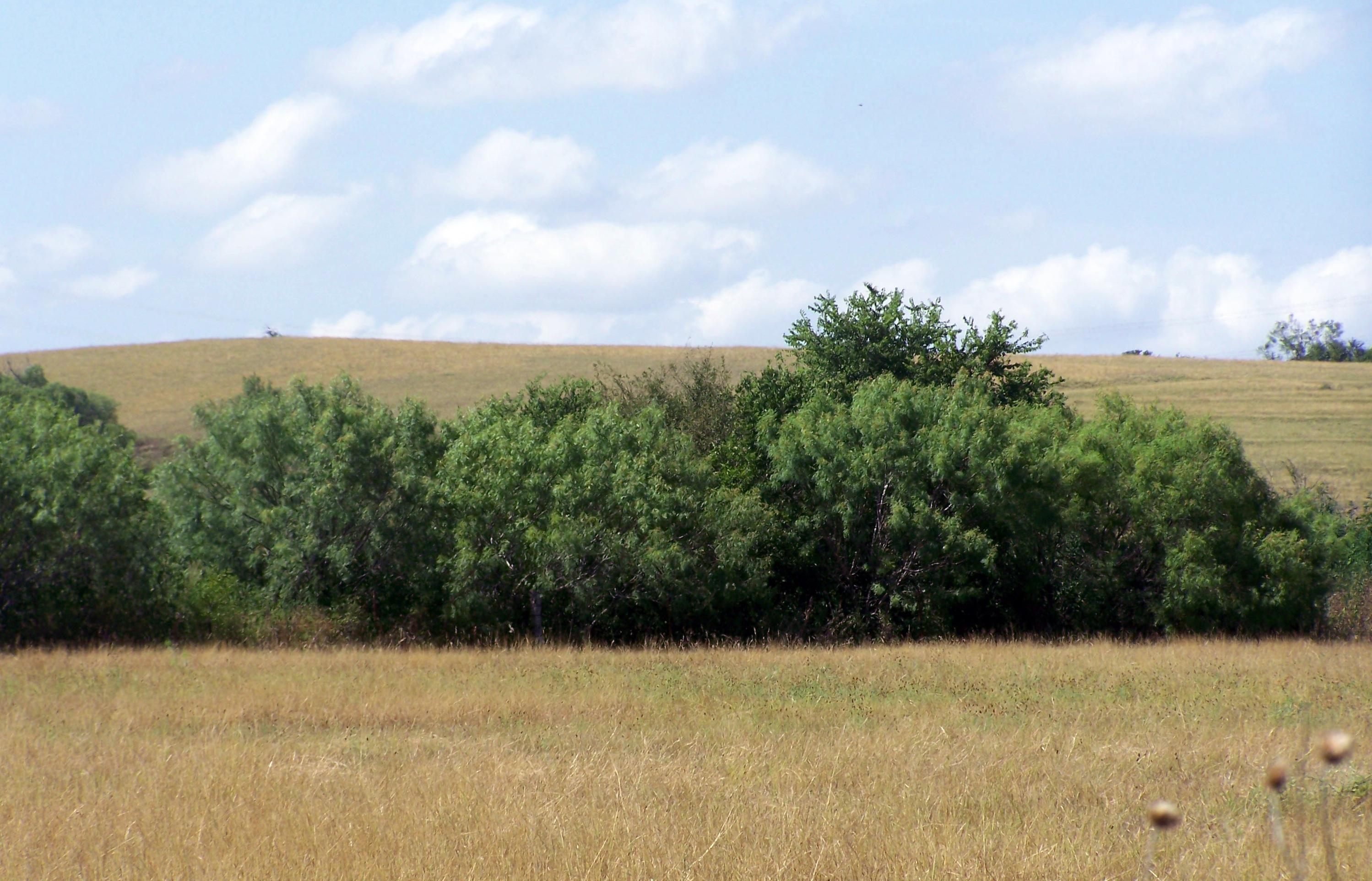
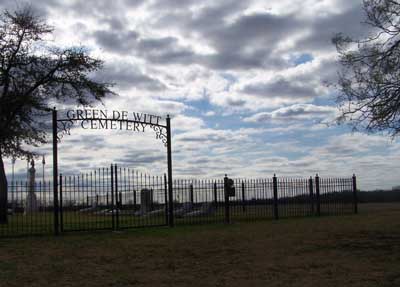
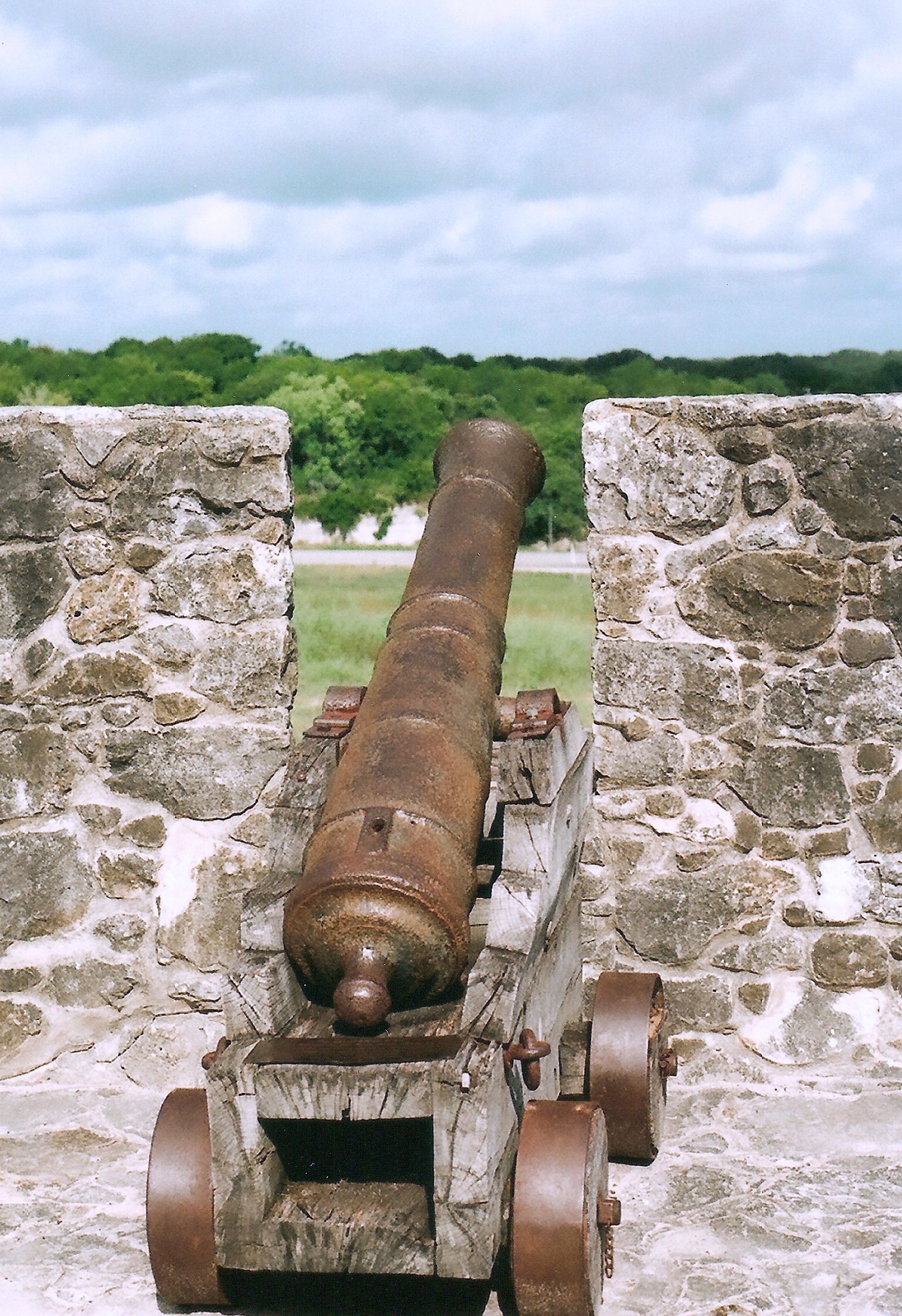
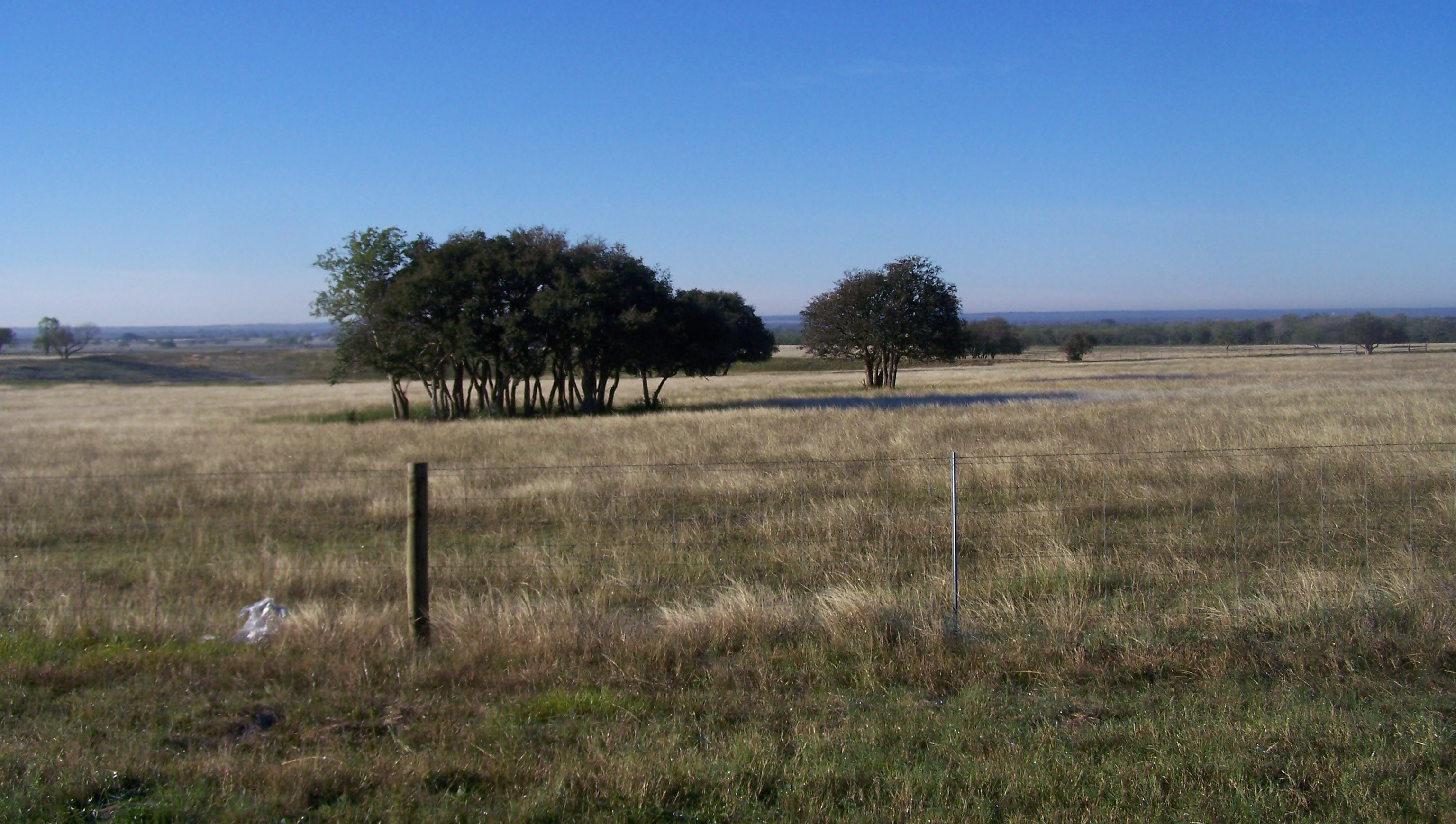
On the principle that a picture is worth a thousand words, I hereby post a scattering of pictures taken by me in various locations around San Antonio, Gonzales and Goliad, as well as some representative landscapes of the coastal more-or-less-flatlands.

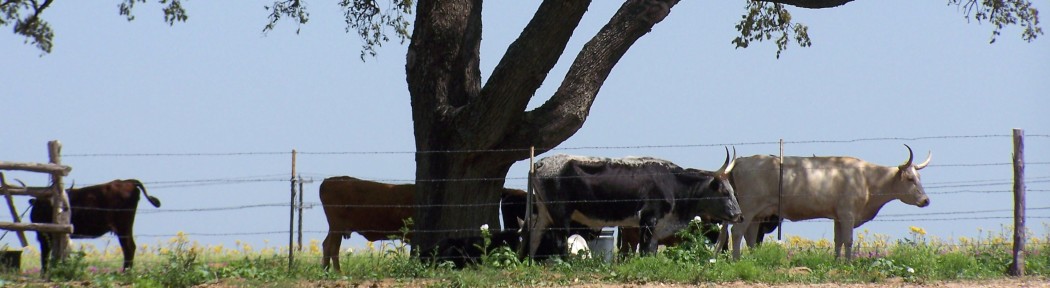
Countryside with oak tree and wildflower meadow - South of San Antonio. No desert.

Countryside with oak tree and wildflower meadow – South of San Antonio. No desert.

Low rolling hills and a line of trees a little north of San Antonio. No desert here.

Low rolling hills and a line of trees a little north of San Antonio. No desert here.

Historical reenactors outside the Goliad Citadel. Trees and green grass, scattered with flowers. No desert here, either.

Historical reenactors outside the Goliad Citadel. Trees and green grass, scattered with flowers. No desert here, either.

Low hill with cemetery, just outside Gonzales. Note absence of steep desert canyons.

Low hill with cemetery, just outside Gonzales. Note absence of steep desert canyons.


From the top of the citadel wall at Goliad. No desert.

From the top of the citadel wall at Goliad. No desert.


Countryside, slightly to the north of Goliad. No desert.

Countryside, slightly to the north of Goliad. No desert.


Hoping that you will take this to heart, upon scouting for appropriate outdoor locations for a drama focusing on the events of 1835-1836 in Texas, and that any particularly dry and desert-appearing locations will be crossed off the list.

I remain as always,

Celia Hayes/ Sgt. Mom

19. May 2015 · Comments Off on From the Latest WIP – Sunset and Steel Rails · Categories: Chapters From the Latest Book

Sunset and Steel Rails Mockup Cover Pics with titles(Escaping from a truly dreadful  family situation and under an assumed name, the proper — and yet adventurous young Bostonian lady Sophia Brewer — has landed a job as a Harvey Girl. The year is 1886, and she has landed up in Newton, Kansa, to be trained in the Harvey method. The Newton Harvey house is a refuge for Sophia – and yet, can she do the kind of work which would be seen by kin and friends back in Boston as demeaning?)

Chapter 10 – Chance Met in Newton

Morning – if not precisely dawn – arrived far too early, in Sophia’s groggy estimation. The first harbinger sounded at first like a storm of blows upon the panels of the door to the room in which she and Laura had slept. She swam up out of as deep a state of sleep as she ever had had under the effect of Dr. Cotton’s disgusting potions, and the storm resolved into a polite tapping, and Jenny Maitland’s voice.

“Miss Teague, Miss Nyland? Wake up – there’s a train due into Newton in half an hour – and we must be ready. We’ll have our breakfast in the interval between that and the next, but you must be downstairs and inspection-ready in twenty minutes. Miss Teague…”

“I’m awake,” Sophia found her voice. From the other bed, she could hear Laura grumbling – probably strong oaths, from the level and passion of her voice. “So is Miss Nyland. We’ll be ready directly.”

There was some little starlight seeping into their room through the thin muslin curtains over the window which they had left open for fresh air. The moon was a small mother-of-pearl circle, just hovering over the buildings opposite – it shed just enough pale light to allow Sophia to light the gas fixture, as Laura heaved the bedclothes aside.

“Time to see to the cows,” she said, with remarkable cheer, and Sophia giggled.

“Not cows, Laura,” she replied, searching in her as-yet-unpacked carpet-bag for her cleanest shift. “But hungry travelers on the railway.”

“They wish to be fed, and will eat of what is put in front of them,” Laura replied. “Men … cows. Little difference that I can see.”

“Except that men don’t expect to be milked, as well.” Sophia said, and was disconcerted by Laura’s knowing chuckle.

“They want their service, just as the bull does,” Laura replied, inscrutably. She had found her stockings, and rolled them up around her pale shins as she sat on the bed. Sophia did not know what to say to that. She and Laura dressed in relative silence; combing out their long hair before the single mirror, and pinning it into plain and serviceable buns.

“We look like nuns,” Laura remarked, looking over Sophia’s shoulder as they stood in front of the small square of mirror over the wash-stand. Sophia regarded herself, and Laura – pale rounded faces reflected in the watery glass; Elsie collar buttoned high and close, plain black dress and narrow sleeves, with the white bibbed apron … it did appear positively nun-like. All that they lacked was a coif and a black veil. “I think that may be the idea,” Sophia replied. She had been considering this, ever since Jenny Maitland had outlined the code of appearance and dress, on the previous night. “You know how ordinary people think of a single woman who must work for a living, away from her family and friends … or at least, I know of how they are seen in respectable Boston society – most usually of the servant class and sometimes no better than they ought to be. It’s very hard, Laura, for a woman alone, without friends or family, to have any kind of respectable life … so Mr. Harvey and his strict rules are a defense, a protection, even – against vicious gossip. Like Caesar’s wife – we must be above suspicion.”

“You are likely right about this,” Laura made a brief moue of distaste. “Still – how very dull for us!”

“We may not flirt with customers, and we must not cultivate particular friendships among our fellow employees within the house … but Miss Maitland said that there was nothing in Mr. Harvey’s rules for us forbidding such attachments to gentlemen employed on the railroad. The telegraphists and engineers and such; they are reputed to be daring and clever young men, skilled and prepared to move up in the world. I might like to be courted by an intelligent and ambitious young man of no particular family background … if, that is – I would like to be courted at all…”

Sophia set down the comb with which she had been taming the last rebellious curls of her hair, bidding them forcefully to go along into the modest bun at the back of her head. “The main thing for me, Laura – I think I should like to work in something associated with the railroad – so new and exciting! You have no idea how boring my life in Boston was … there was not a person I knew, or met, save my great-aunt who had never had a thought or said a word that their farthest ancestors had not already said. I suppose that I have never felt quite so …alive. As if I were a new woman.”

“Me, I am tired of chickens and cows and slaving over a wash-tub,” Laura gave one last look at herself in the mirror. Sophia thought that Laura looked like some magnificent ancient Nordic goddess come to life. “Now – we go be new woman, ya?”

“Modern women,” Sophia echoed. They turned off the gaslight as they left their room. Out in the corridor there were already a bevy of girls in black dresses and white aprons, chirping excitedly or yawning. Sophia and Laura followed them down the staircase, through the kitchen – already a hub-bub of activity, redolent with the odor of baking bread and ham, of bacon and apple pies, muffins and sausages and clamorous with the voices of men shouting at each other in several languages besides English, and clanging iron pans on the tops of stoves – a clamor which diminished slightly at the first appearance of the girls in black and white. The girls went around the edge of the kitchen, into that hallway which led to the larders, the ice-room, the locked liquor store, the manager’s office, the telegraphist’s office, and the parlor set aside for the waitresses. This was a comfortable room, if set about with chairs, settees and tables of rather plain and unadorned make, all around the walls.  The parlor was brilliantly and mercilessly lit, the gas-lamps turned up to their highest extent so that it was nearly as bright as daylight. The girls made a circle, as if for a country-dance; Sophia and Laura followed suit – oh, yes, Jenny Maitland had told them the night before that she would inspect them – all of them and in a most stringent manner before they went on duty today.

Now the senior waitress went around the inside of the circle; each woman holding out her hands, first palm-up and then down for inspection. Jenny looked severely at their hands, their aprons and their hair, each in turn. Just as she began this process, a young man appeared in the doorway of the parlor, a piece of paper in his hand.

“Just come over the telegraph from Florence, Miss Maitland,” he said, with the air of someone bearing an important message. “Thirty-five for the lunchroom, twenty-four for the dining room.”

“Thank you, Mr. Boatwright,” Jenny said over her shoulder, “We’ll be ready.” The young man vanished like a mechanical Jack-in-the-box.   “You have a spot on your cuffs,” she said to the girl standing next to Laura. “Run upstairs and change – quick now.” Another girl had a crumpled apron – she also made a swift departure for upstairs, both of them returning, out of breath within a few minutes. Now all of her attention was on Laura and Sophia.  It appeared to Sophia that they both received a particularly exacting examination – for Jenny made them turn around, and to lift the hems of skirt and apron to show that they had on black shoes and stockings, and that their hair was tied with the plain white ribbon. Was this what it might be like to join the Army, she wondered – and found the supposition rather amusing.

“Miss Nyland, Miss Teague? You will start out in the lunchroom – it is sometimes a bit rowdier than the dining room, but the menu and the arrangements are somewhat simpler.”

“And the boys don’t tip like they do in there, either,” remarked one of the girls who had returned at that last minute. She had a gap between her teeth and wildly curly hair, even curlier than Sophia’s, but still firmly contained in a disciplined bun tied with a white ribbon. “But it’s a start. You follow after me, Miss Teague for the first round – watch what I do. I’m Selina Bennett – this’s my sister Frances. New girls always start in the lunchroom. Do you know the cup code yet?”

“Not well enough to be quick about it,” Sophia replied honestly, and Selina Bennett laughed, frank and honest. She and her sister both wore small round pewter brooches on their pinafores, each with an inset numeral 3.

“You’ll learn quick enough – it’s all very tidy and orderly; a systematical method for every motion, a place for everything, and everything in its proper place, just so. It’s like doing counted stitch needlework,” Selena added, as somewhere outside on the station platform, a whistle shrilled over the metallic shriek and clanging of a train coming into the station and applying the steam brakes.   To that symphony of noise was added the ringing notes of a gong.

“Here they come, girls,” Jenny Maitland swiped an invisible soot-fleck from her white apron. “The first train of the day – to work, now.”

17. May 2015 · Comments Off on It All Comes Down to Chickens · Categories: Domestic

Granny Jessie kept chickens during the Depression – quite a lot of them, if my childhood memories of the huge and by then crumbling and disused chicken-wire enclosure, the adjoining hutch and the nesting boxes are anything to go by.  Some of her neighbors went on keeping backyard livestock well into the 1960s – we occasionally sampled goose eggs at Granny Jessie’s house where we could hear a donkey braying now and again. Mom had to help care for the chickens, as child and teenager – and wound up detesting them so much that this was the one back-yard DIY farm element that we never ventured into when we were growing up. Mom hated chickens, profoundly.


But my daughter and I were considering it over the last couple of years, along with all of our other ventures into suburban self-efficiency – the garden, the cheese-making, the home-brewing and canning, the deep-freeze stocked full, the pantry likewise. It seems to be an on-going thing, especially in periods of economic distress and unrest.  I put off doing anything about chickens until two things happened: we finally encountered the woman in our neighborhood who keeps a small flock of backyard chickens, and she took us to see her flock. She told us that it was not much trouble, really, and the eggs were amazingly flavorful. In comparison, supermarket eggs – even the expensive organic and supposedly free-range kind were insipid and tasteless.

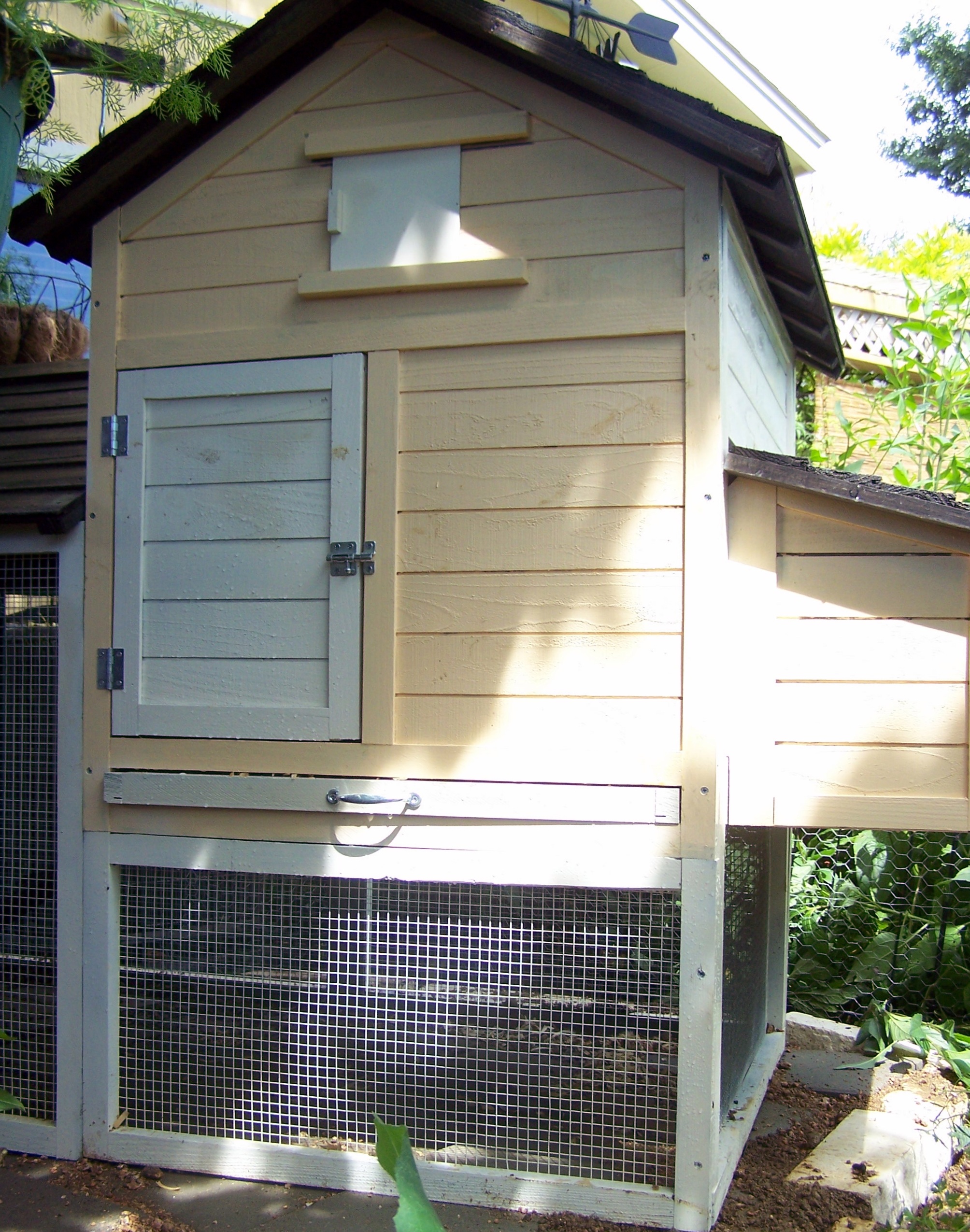
Henhouse - finished

The Henhouse end, entirely finished

The second thing was spotting a ready-made coop at Sam’s Club a good few months ago. We kept going back and looking at it, whenever we made our monthly stock-up. It had a hutch, an attached roofed run with open sides secured with hardware cloth, and an appended nesting box accessed through a removable roof. But still … the price for it was what I considered excessive. Then, at the beginning of the month, the coop was marked down by half. Seeing this, we transferred some money from the household savings account, and with the aid of a husky Sam’s Club box-boy, stuffed all 150 pounds of the box which contained all the necessary flat-packed panels into my daughter’s Montero.

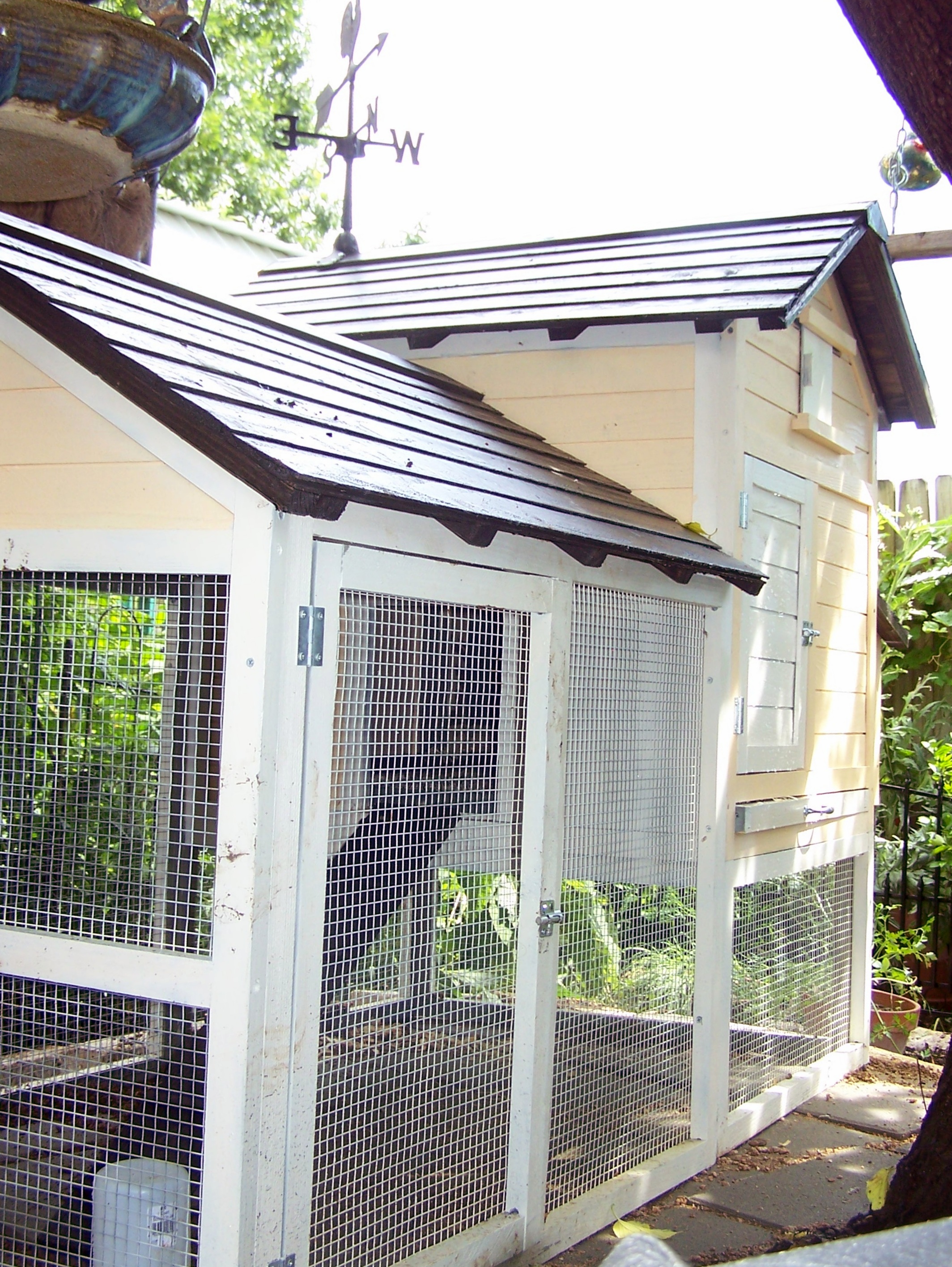
I put it together over Mother’s Day weekend, painting it the same colors as the house: sort of a primrose-peach color with cream trim. The coop and run was constructed of rather soft pine, with some kind of greenish wood-stain slathered over it all, which took two coats of paint to cover entirely. I wish that I had gotten out the electric drill with the screwdriver attachment a little earlier in the game; the side and roof panels were all attached together with 67 2-in and 2 ½ inch Phillips-head screws. Yes, I counted; I did about the first forty by hand … sigh. The remains of half a can of polyurethane spar varnish went on the roof to make it entirely waterproof. We topped it with a wind vane ornamented with a chicken, and it all went together on a bedding of concrete pavers set in decomposed granite, wedged underneath the major shade tree in the back yard. By municipal guidelines we are permitted up to three chickens and two of any other kind of farmyard animal: goat, cow, horse, llama, whatever – as long as their enclosure is at least a hundred feet from your neighbors house. The chicken coop may not, strictly speaking, be 100 feet from the next door neighbor’s house on the near side, but he is the one with the basset hounds, one of whom can hear a mouse fart in a high wind, and can be heard about a block away when he really puts his back into his bark.

The lucky winners in the chicken lottery of life - Loreena, Maureen and Carly.

The lucky winners in the chicken lottery of life – Loreena, Maureen and Carly.

We went out to a feed store in Bracken for feed pellets, bedding chips, a feeder and a water dispenser.  The feed store also had artificial eggs made from heavy plastic, but so cunningly textured they looked very real. The feed store manager said that what they are also used for is as a means of dealing with local snakes that prey on chicken eggs … they slither into the nesting boxes, swallow an egg whole and slither away. If you suspect your nest is being raided in that fashion, you bait the nest with a plastic egg. Snake swallows it, but can’t digest, pass or vomit up the egg and so dies, in the words of one of Blackadder’s foes – “horribly-horribly.”  (Ick-making to consider, but then I’ve gotten quite testy about critters predating on my vegetables, and set out traps for rats and dispose of dead rats without any qualms.) From many different places; Sam’s, our local HEB which now offers stacks of chicken feed in the pet food aisle,  and now the semi-rural feed store – we are getting the notion that keeping back-yard chickens is getting to be a wide-spread thing. I wonder how much Martha Stewart is responsible for this development.

The magnificent coop with chicken windvane

The magnificent coop with chicken windvane

Saturday morning we were off to the south of town, to a small enterprise in Von Ormy for three pullets. We had wanted Orpingtons, but they weren’t available at any of the close-in providers, and the owner recommended Barred Rocks – those are those pretty black and white chickens with bright red combs. My daughter wants to name them Lorena, Maureen and Carly – Larry, Moe and Curly, feminized. They are supposed to start laying when they are mature, in about late summer, according to the owner of the bird-providing enterprise. Our three pullets are about ten weeks old, and somewhat timid yet – little knowing that they have won the grand prize in the chicken lottery of life. Eventually, they will have the run of the garden; we are assured they will brutally diminish bugs of every sort, gratefully fall upon green vegetable scraps, and come to be quite friendly with us. Early days, yet. And that was my week. Yours?