10. May 2016 · Comments Off on The Second Luna City Chronicle! · Categories: Book Event, Chapters From the Latest Book, Luna City

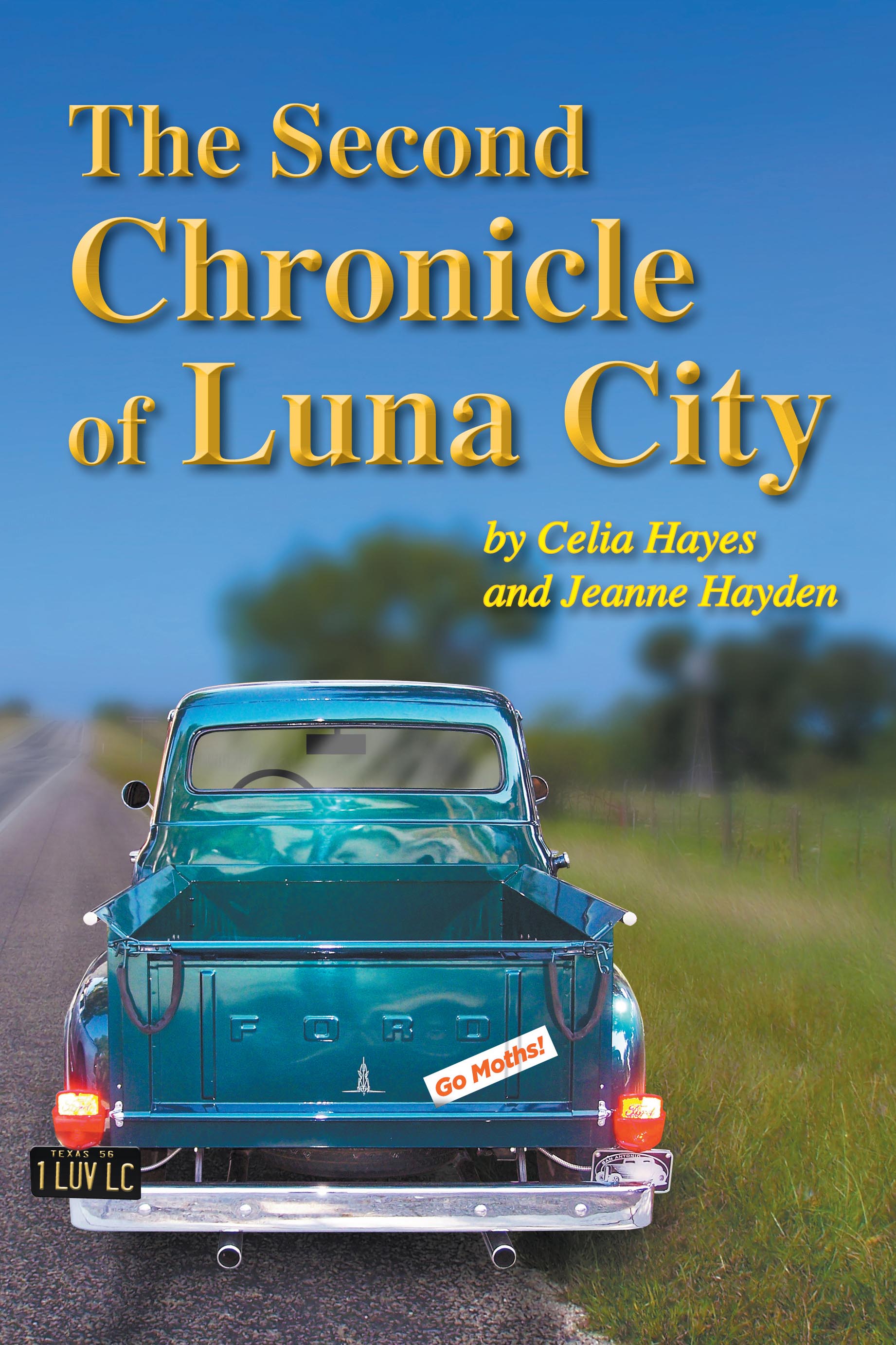
Second_Chronicle_of_LC.inddThe e-book version has gone live on Amazon, and on Barnes and Noble with a release on Friday; the print version will soon be up and available as well. I regret that until it goes officially on sale, there is no look-inside feature yet. Tomorrow, I will set up page for readers who would like to order directly from me – with autograph and a personal message.

But for those readers who have begged to know the identity of Richard’s mysterious visitor – from the first chapter, this excerpt:

That’s Show-biz

In the early morning, before the sun was more than a brief bright apricot rumor along the eastern horizon, Richard Astor-Hall pedaled grimly along the back road from the aged Airstream caravan at the Age of Aquarius Campground and Goat Farm towards the site of his daily labors. At least now the Airstream was beautifully and comfortably-maintained, since he appeared to have been informally adopted by the sprawling and omnipresent Gonzales-Gonzalez clan, on top of paying rent to Sefton and Judy Grant from his income from the Café. This was managed through Jess Abernathy, whose firm hands channeled the financial streams of a myriad of Luna City enterprises, including that of the Café and of the Age of Aquarius Campground and Goat Farm.

“Rent. I manage all of Sefton and Judy’s financials as well as those of the Café,” Jess informed him, some months ago when he asked for an explanation for a certain deduction marked every month in his stipend from the Café paid into a bank account at a bank in Karnesville.

“Why?” Richard had asked. “Can’t they manage for themselves?”

Jess frowned. “They are communists,” she explained, in a patient kind of voice which absolutely rubbed him the wrong way.

“I thought you Yanks disapproved of communists in the most strenuous fashion,” Richard replied, to which Jess snapped, “In the old sense, Richard; the lower case-c sense. Judy and Sefton are the last of an idealistic colony of true believers in a system which is only practical when it involves volunteers who work hard to benefit the collective and when it comes to finance, they don’t have the sense that God gave a goose. But they do good work and a lot of it,” she fixed Richard with a commanding glare. “So – I see to handing the takings from the goats and the campground and their Saturday market. I make certain that their taxes, utilities, health insurance and license fees are all paid … so the Grants can go on with tending their goats and worrying about whether it is ethical to weave with machine-made yarns. Never mind Judy twittering on about all that New Agey crap; she and Sefton show up when anyone needs help, and Judy hasn’t yet met a suffering animal that she doesn’t want to rescue. Who do you think fosters all those cats and dogs dumped out here in the country by idiot former owners? From each according to their abilities,” Jess added with a particularly cutting turn of sarcasm, “And to each, according to their needs. Or as we call it around here, supply and demand. I demand regular supplies of their honey, eggs, and goat-milk rosemary soap in return for economic services rendered and Judy supplies them: a win-win, all the way around.”

“I regret even asking,” Richard said and Jess snorted. On further consideration, though, he had to admit to himself that he rather favored Jess’s system of intelligent budgeting and rigid cost-to-benefit analysis. (‘Can we afford this for the Café?’ ‘No, not until ….’ Or sometimes, ‘Yes, but only up to this amount.’)

In his past life, he had been spectacularly careless with money. I had millions of pounds in income once and blew most on loose women and abuse-worthy substances. The rest I wasted. That recollection led to a dire contemplation of the other recently-arrived element of that old life.

Now he pedaled the bicycle along the verge of one of the unpaved back roads which eventually led into the heart of Main Square, Luna City, still pondering on the unfairness of it all. The bike was a mountain model, which had come to him through the largess of the Gonzales/Gonzalez clan, through one or another the the seniors bashfully admitting that it was a great bike, but the son – or possibly the grandson – had outgrown it or moved on to other and less environmentally-sustainable means of getting around. Hey, Ricardo, it’s a good way to get to work! You want it? Twenty-five dollars; I’ll tell Jess and it’s paid for.

As he came up on Route 123, he saw the lights of an automobile at a distance – ah, one of those grossly over-chromed SUVs. Knowing that drivers were apt to speed, in spite of the efforts of Chief Vaughn’s patrol cars and the much more substantial hazard posed by deer insouciantly wandering into the traffic lanes, Richard braked the bicycle, went onto the narrow gravel-and-weed shoulder of the road and waited for the SUV to pass. Which it did – about fifty yards farther along Route 123, where a number of unaccustomed lumps lay, slightly off the tarmac.

It looked, from where Richard stood, as if a deer had gone mano-a- deero against a mechanized vehicle, with predictable results. Hundred- pound deer, five-thousand-pound motor vehicle – which was going to win that contest? To his mild curiosity, the SUV slowed abruptly and went off into the shoulder. The blinking hazard lights flicked on, and someone emerged from the vehicle … a masculine outline, a male someone followed by a faintly overheard burst of indignant Korean in a familiar and feminine steam-whistle shriek. Ah; Clovis and Sook Walcott. Richard wondered why on earth Clovis should be interested in roadkill – but not for very long. To the tune of a final machine-gun burst of Korean, the shadowy figure of Clovis got back into the driver’s side, the blinking red hazard lights resumed their steady beam and with a roar the SUV pulled back onto the road and vanished around the next bend. Now that the road was empty, Richard remounted the bike and carried on – he had another fifteen minutes before he was due at the Café.

When he got to the place where the Walcotts had pulled off the road he saw that yes – indeed a deer; relatively undamaged from the impact but quite plainly dead; neck at a grotesquely unnatural angle. Nearby lay another roadkill; this one a hulking black bird of the kind he was given to know was called a ‘turkey-buzzard,’ also sprawled on the edge of the pavement with one wing upraised like a small black sail. The turkey- buzzard stank like a charnel-house. Why this unlovely spectacle of vehicular/wildlife mayhem had drawn Clovis Walcott’s intense interest was a mystery indeed. In the seven months or so that Richard had lived in Luna City and bicycled back and forth between the Café and the Age, he had seen it often enough himself … and even more often, the live deer creatures, wandering dainty and long-legged in the open spaces between thickets, or the turkey-vultures soaring on motionless dark wings in the faultless azure midday sky. But – he said to himself, in a grumpy acknowledgement he had made a thousand times in the last six months and would doubtless make a hundred thousand times more – this was Luna City, Texas.

He continued pedaling through the pre-dawn dimness, relishing the welcome chill of it all after the ungodly summer heat, a chill which had left a slight crunch of frost on certain grassy spaces. The sky was the color of mother-of-pearl, an elusive shimmering shade flushed with pink and apricot-orange, evanescent. He passed the bright orange Luna City Independent School District bus, pausing briefly at an intersection on the outskirts of town to collect a gaggle of small children, swathed in their winter coats and burdened with small rucksacks. These children were also burdened with the attention of watchful mothers and the occasional father who went scattering to their own daily devices once the school bus bore their offspring away.

He waved to Patrick Gonzalez, rumpled in his oil-stained coveralls, and sleepy-eyed from a night of driving a tanker truck; it seemed to be his morning to see Angelika and Mateo off to school, while Araceli turned on the lights and the coffee-machines at the Café.

Still ruminating alternately over why Clovis Walcott was  so interested in fresh roadkill and his own predicament with regard to the recent inconvenient visitor to Luna City, Richard turned down the narrow street which ran along the back of that block of buildings. Most of them housed garaging or at least a place to park a car, and in the case of the Café, the rubbish bin, a small weed-grown space and a small loading dock. The Steins, in the next building over, had a garage and a small shed at the very back, with a walled little garden between it and the rear windows of the main shop. As Richard wheeled into the back of the Café, he saw Georg’s bare-bones sedan backing out of their garage. He wondered vaguely what brought out Georg so early; on most mornings, he and Annise were over in the Café at that large table in front of the front window – what Georg jokingly called the ‘stammtisch’ – where the  regular patrons gathered.

He let himself in through the back door into the kitchen, which smelt divinely of fresh coffee and baking cinnamon rolls. Araceli was empting out the dishwasher, stacking plates and mugs with nervous efficiently and a great deal more force than strictly necessary. She glared at Richard, as he shrugged off his winter coat; this was a vintage military field jacket from Marisol Gonzalez’ second-hand shop in Karnesville. Chris Mayall at the Gas & Grocery had already been humorous  about it, but the jacket  was well-made and warm.

“That friend of yours is here,” She said, sounding if she were speaking around a clenched jaw. “The English one.”

“Not a friend,” Richard sighed. “More like an associate … and I regret like hell that it was ever that close.”

“Oh, Rich,” drawled the visitor in tones of tragic disappointment. Alas, Richard’s visitor was leaning picturesquely in the door way to the main room of the Café. “I am cut to the quick. I thought we were best chums, always.”

“Nope.” Richard was inordinately proud of the way that he thought  he had adopted something of the classic western bent towards the taciturn. Besides it was past time to fire up the griddle and start the bacon, then those slivered ham slices that everyone called Canadian bacon, and finally a nice vat of scrambled eggs.

“You’re a brute, Rich; a cold, cold unfeeling brute.”

“All a part of my happy, inconsequent charm,” Richard answered, sternly unmoved.

“I come all the way to this out-of-the way hole,” his visitor protested; tragically wounded as to expression, languid as to posture in the doorway, “I endeavor to make myself pleasant to your friends, rekindle our old relationship, relish the charms of this quaint little village, and this is my reward?”

“We were never friends,” Richard replied, his attention bent upon the griddle, and preparations for the morning rush of breakfast customers. “It was a mutually-advantageous association; friendship had bloody-all to do with it. Are you going to stand in the door all morning, with Araceli and the girls constantly stepping around you? You’ll be trampled underfoot in the morning rush for cinnamon rolls – consider yourself warned.”

“If you truly feel that way, Rich,” there came the deep and wounded sigh. “I’ve tried to reach out to you so many times! You never replied.”

“Life is full of these little tragedies,” Richard brought out a bowl of eggs from the refrigerator and began cracking them with deft and systematic skill into another. After some moments, he looked up from this task.  “’Ere – you still there?”

“I am,” replied the visitor. Araceli took up a tray upon hearing the front door open and close with a musical chime, and interjected, “Well better find another wall to hold up. Your special order is ready. Best eat it before it gets cold, then.”

“You take such good care of me, dear girl,” the visitor answered, without a blush. Richard thought it a testimony to good manners and excellent customer relations training that Araceli refrained from bouncing the tray off the visitor’s skull as she carried the breakfast special order  into the dining room. After a moment, she returned, not visibly fuming, although Richard could read the signs accurately.

“Pip Noel-Barrett was never a bosom chum of mine,” he confessed with a long sigh. “Truly – I have better taste than taking that poser to   my … well, to my confidence, anyway. He is, as practically everyone eventually realizes, an insufferable, inconsiderate, and amoral git; I  deduce that we are in accord in that matter. Ordered off-menu, I take it? Told you to add it to his running tab?”

“Of course,” Araceli snapped. “As always; I do not mind taking the trouble, Chef, I really don’t. What I do mind, is that he picks over it with an expression on his face like Mateo when he doesn’t like what’s for supper, leaving most of it on the plate and never saying a darned thing about what’s wrong with it. If he calls me ‘dear girl’ or ‘Araceli-my- darling’ one more time, I WILL hit him with the heaviest iron skillet in  the Café.”

“No, you won’t,” Richard answered. “It will make a mess on the floor, and assaulting one of Clovis Walcott’s business associates will reflect badly on everyone. Speaking of business, has he done anything about paying?”

“Nope,” Araceli’s expression was thunderous. “It’s always – sorry love, left the card in my room, sorry, bit short of the dosh at the moment, tomorrow, Araceli-my-darling. Jess will be furious.”

“If it comes to that,” Richard sighed. “I will set Miss Abernathy on him. That would give me the greatest pleasure. He owes for more than a fortnight of breakfasts and sandwich luncheons since he took up a room at the Cattleman.”

“A month is more like it. You’d think if he was in the movie business,” Araceli continued grumbling. “He’d be a lot better about paying his bills.” For some reason that Richard couldn’t fathom – save that Araceli was one of the most hard-headed women of his acquaintance and that she was badly offended by a customer pick-pick-picking at the Café’s food offerings like a dyspeptic hen – she was immune to the fabled Noel-Barrett charm.  The front door chimed again and then again almost at once. Yes, the first of the morning regulars. Araceli bustled out with carafes of fresh coffee and hot milk.

(All righty, then – this should hold y’all til Friday!)
01. May 2016 · Comments Off on The Hat Project · Categories: Domestic, Uncategorized

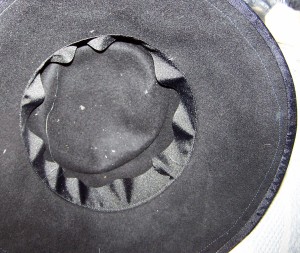
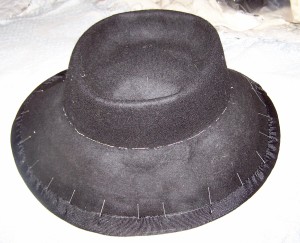
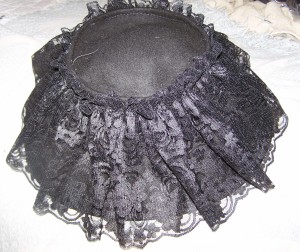
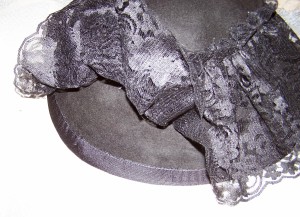
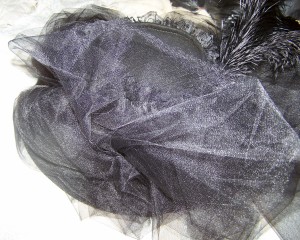
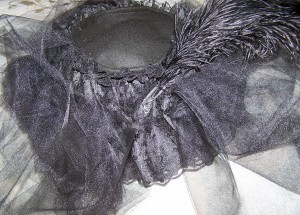
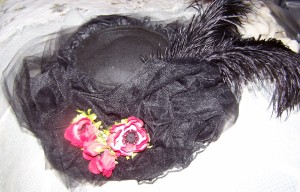
So, having decided to update my author ‘drag’ — that is, a bit of eye-catching something to wear when doing an event — I found a pattern for an Edwardian-style suit; a straight long skirt and jacket at a Hancock Fabric store. Yes, one of those which is going out of business, sadly. Yes, the bargains are nice — but this will put us down to one single chain fabric store, and the limited selections at Hobby Lobby and Michaels . Yes, I am old-school enough to have gone into absolute mourning when a local San Antonio institution, Scrivener’s – which was an eccentric and upscale vendor of hardware, stationary, gifts, hardware, housewares and who knows what else — closed out the fabric department, and then within a year or two, closed down entirely. They had marvelous fabrics, and quality notions and buttons – and oh, heck – I am getting weepy just recalling. No, I couldn’t afford much of their very best – but they had quality, in the old-fashioned way, and I was viewed with affection and respect by their salesladies, as I was one of the very few of their customers who tacked the extremely difficult Vintage Vogue designer patterns. They always did well by me, when I had a sewing project.

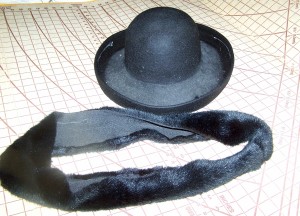
But anyway – the Edwardian-style suit; that will need the appropriate Edwardian hat to go with, and just this weekend I was able to get cracking on that, starting with a wide-brimmed black felt number manufactured in China  that someone must have bought for me a good few years ago; my daughter, possibly, when she was stationed in California. I remember having to wear it on the flight home, where once arrived, it went into the closet to emerge … possibly not until now.

The nice thing about it being wool felt is that it could be re-shaped, with damp and steam. The brim of it was upturned and tripped with a yard of black plush fake-fur. I removed that – oh, I have plans for that narrow strip of plush fake-fur, but that will be another project entirely.


And no – not by any means are these authentic Edwardian lace, tulle or trimmings; this is not meant to be a historical reenactor costume, but something eye-catching and splashy, made with materiel readily available at ordinary retail outlets. It took about two and a half hours, all told. The finished suit itself won’t be anything particularly authentic, either – grey polyester suiting, so as to look good and relatively wrinkle-free on those occasions when we have to set up, and haul tubs of books around.

(Counting down to the release of the second Luna City Chronicles – a short selection from the climax, wherein Richard is tasked with rescuing his frenemy, the actor producer Phillip Noel-Barrett, from temporary imprisonment on the set of the movie which is being shot on location on the Wyler ranch…)

The Charge of the Karnes County Rangers

Narrowly missing being struck by the speeding van, Richard made a fruitlessly obscene gesture at the swiftly-vanishing tail-lights, and pedaled grimly on, down the paved road to the Wyler ranch, marked by a pair of ornamental gates, adorned by sheet-metal silhouettes of longhorns, horses and cowboys in a frieze overhead. He rumbled over the cattle grid. Now on the faint morning breeze, he could hear the distant roar of the electrical generators – not far to go now. The last of the stars winked out, all but the very brightest, Venus lingering coyly just out of reach of the crescent moon’s embrace. Out beyond the huddle of lights, a helicopter rose from the ground, a dragonfly shape hovering in the pearl-colored sky.
He had not been out to the movie encampment before – mostly through having no wish to encounter Phillip Noel-Barrett, but it now looked as if an encounter with the despicable Pip was inevitable. No one stopped him – in fact, everyone seemed to be too busy to take any notion of him. A company of forty extras, in rags of period Mexican uniforms and full zombie makeup were being marshaled at the foot of the hill, with a gold-braid hung officer in a gaudy blue and red uniform just hauling himself into the saddle of a white horse. Richard stared, agog, thinking ‘Stone the bloody crows, this is even worse than I thought it would be!’
Fortunately, the first person he encountered who seemed to take any interest in him at all, when he approached the main pavilion were a pair whom he recognized, with considerable relief: Chris Mayall, lean and saturnine, and Sylvester Gonzales, looking uncommonly smug.
“Hey, man – come to see the fun?” Chris drawled. “They’re about to start rolling on the big scene! Well, you saw the script.”
“I was under the impression that there is some kind of scheme afoot to sabotage the whole thing,” Richard answered, still panting and breathless from the furious pace. “Which I can hardly wait to hear all about. But I actually came all the way out here for Noel-Barrett. He keeps calling the Café, saying that he is locked in the editing van and no one is answering their cellphone.”
“Yeah, we know,” Sylvester replied, without turning a hair. Richard looked upon the conspirators with dawning comprehension, not unmixed with horror as well as envy.
“You did it,” he whispered. “You two … you magnificent conniving bastards. Now get the key and let him out.”
“We can’t,” Chris was entirely unmoved. “We do not, as a matter of fact, have the key in our physical possession.”
“Well then, where is the key and who does have it?” Richard demanded. Sylvester, affecting the retro-nerd look even to the extent of wearing a vintage wristwatch, consulted that watch and replied with nerdish precision. “At this time, and given the legal speed limit between here and Karnesville, Berto is likely at least halfway to that destination with the key in his possession. Chris sent him with the emergency cases,” he added, parenthetically. “Likely, he won’t be back for hours.”
“Well, get a bolt-cutter!” Richard demanded, thinking only of the strips that Araceli would subtly rip off his hide – she being abominably soft-hearted with regard to the suffering of others. Frankly, when it came to Phillip Noel-Barrett suffering, Richard was one inclined to sit back and enjoy, even add a couple of more judicious brands to the flaming spectacle. On the other hand, he had heard Araceli promise to take Noel-Barrett’s calls every five minutes or so – and how could any work be done in the Café under such conditions!
“Sorry, Ricardo; they are about to begin filming the grand scene,” Chris replied, with a perfectly stunning lack of regret. “Likely you won’t find anyone here with a bolt-cutter or the time to go for one until it’s all done. Mega-A** Lydecker is real short of personnel this morning. I can’t think how that could possibly have happened…” At that point, both he and Sylvester exchanged a meaningful look and laughed synchronistically.
Richard looked from one to the other, still torn between horror and envy. “All right, what else did the two of you do?” he asked, fairly certain that he would not welcome hearing the answer.
“What we had to do,” Chris replied. “To sink this movie. Don’t worry, Ricardo; your hands are clean. So are ours, if we have done it right and if Colonel Walcott and his reenactor command do their stuff – which he has promised they will do, come rain or shine. If you want to, come and tell what you see to that friend of yours through the keyhole. I guarantee – it will be the most awesome f**king thing you will ever see!”
“It’s three minutes to rock and roll,” Sylvester said, with another glance at his watch. “As I understand it, our fearless Mega-A** director wants to exceed the record for a single long unbroken tracking shot of a battle scene set by Kenneth Branagh in Henry V. They’ve been setting up the track and choreographing the extras in their moves for a week.”
“Me, I don’t want to miss a single minute. You want to tell Noel-Barret he’d better sit tight for a bit? We can watch it all from the back of the editing van and you can describe it to him through the door.” Chris shouldered the bag that held his First Aid gear and supplies, and Richard followed after; they knew the layout well, after having worked at the site, day and night for three weeks.
A chaos of noise, of movement, three or four young assistant directors with heavy walkie-talkies running around like two-legged sheep-dogs with their ghastly, gore-dripping charges. The helicopter hovering overhead made speech impossible, unless one was right next to the person you were conversing with. Chris and Sylvester led the way, to a hulking 18-wheel truck trailer at the edge of the location encampment. He climbed up the four steps to the door – a solid door, and padlocked on the outside with a fairly substantial lock. He put his head next to the door, and shouted,
“Pip! Damn it, Pip – Noel-Barrett, it’s Rich – can you hear me!”
He thought that he heard someone inside replying, but the racket from the helicopter was so loud that he couldn’t make out the words. Nonetheless, he yelled, “I’m here – but they can’t find the key and they’re about to start shooting! God is my witness, Noel-Barrett, they’ll get you out as soon as they can. Just sit tight … you don’t have to keep calling Araceli, you know! She has bloody work to do!”
At his side, Chris nudged his elbow, and when he saw that Richard’s attention was turned towards them, he made a megaphone with his hands, and shouted, “There they go! See the sun, just above the hill? Watch there!”
The white-hot silver rim of the morning sun touched the crest of the gentle rise just east of location headquarters. It seared the eyes, to look at, as more and more of that blazing orb rose into that breathlessly blue sky. A pale thin mist hovered briefly over the grass, dissipating as the shadows lengthened. Richard flinched at the sound of the blast, as three explosions kicked up gouts of earth and smoke, about a quarter of the way down the hill. The sun floated higher and higher and suddenly silhouetted against it, the figure of a man on horseback. The horse pirouetted and reared, the man lifting a sabre in his right hand, sunlight flashing along it’s brazen length, and it seemed that the horse neighed a challenge ….
Richard had to appreciate the sheer heroic appeal of the image – say what you would about him, and many were eager to say the absolute worst about M.A. Lydecker – he did have skill at creating a heroic spectacle in the old-fashioned wide-screen and cinematic manner. The horse pirouetted once again, and now the ridgeline was lined with advancing shadows, silhouetted as the rider had been, against the bright hot sky – men brandishing flashing knives, with long rifles and glittering bayonets, bearded, burly men, in a long skirmish-line, advancing over the long ridge of that green hill, shouting as they came. Half a dozen riders followed after the first, a purposeful arrow after their leader. But …

(Just have to wait for the book to find out what comes next! Yes, I’m cruel, teasing you all this way.)

25. April 2016 · Comments Off on From The Work in Progress – Another Chapter of The Golden Road · Categories: Chapters From the Latest Book

Chapter 13 – Summer in the Diggings


Not the final for-real cover, but a place-holder for now

Not the final for-real cover, but a place-holder for now

Fredi and his two partners debarked at Yuba City after more than a week of poking along in the slow steamboat. The unsettling interval of the hanging at Sacramento had nearly faded from their minds in the excitement of approaching the fabled diggings – after so long and arduous a journey. Edwin, having soon recovered his spirits after witnessing the hanging, continued to enliven the journey with discourses on searching for gold, and on the most expeditious means of extracting it from wherever it might be – among river gravel, or in the crevices of granite rocks.

“Likely there are many who would say that the North Fork is pretty well mined out, but Pa … Mr. Padgett thought it worth the trouble to winter over, to keep the claim, or to work a new one upstream, rather than just follow the rush to a new strike. He was pretty certain of it – and so am I,” Edwin said, when O’Malley questioned him closely about his intention of returning to the stretch of river at Pine Tree Diggings. “And there was always enough and then some,” he added, with touching earnestness. “At every likely bend. But we may have to pack in by mule beyond Downieville, if the road is no better … and it gets rougher, the farther we go.”

The mountains loomed ahead of them now – piling up in distant blue and lavender slopes, the very topmost still lightly touched the last winter snows. The scent of pine-woods breathed on every errant wind – and to Fredi, every streamlet promised to be paved in gold.

“What will we do with the wagon, then?” He asked – as it turned out, Edwin was right about having to pack in all their supplies and gear, but O’Malley found an Irish storekeeper in Downieville, whom he had never met before, but claimed to have come from Balleymena and fell on O’Malley voluble joy, the Irish coming out so thick in his speech that neither Fredi or Edwin could understand him.

“Likely that Con Reilly and I are cousins, several times removed through our mothers, for his sainted mother and mine were both Kellys from Castledown,” O’Malley said, cheerful as a cricket. “And he has struck a bargain with me on the strength of that relation – for the use of our wagon and mules during the summer, he will see that all our trash an’ traps are packed entire to the Pine Tree Diggings, through the good offices of his friend in the mule-freighting concern … who is likely another cousin.”

“Can you trust this man Reilly?” Fredi asked, warily, and O’Malley chuckled.

“Of course, Fredi-boyo – Con’s my cousin from Ballymena, and a good Catholic, as well.”

Fredi sighed in deep exasperation and looked across at Edwin. “This is the man who unthinkingly accepts invitations to games of change with strangers in saloons – is it no wonder he needs a keeper?”

Edwin grinned back, in delight – almost the first time that Fredi had observed a wholly unguarded expression on the boy’s face. “We’ll do, between us,” Edwin replied, wholly confident. “And we are almost there.” His face lost a certain degree of confidence, as O’Malley went to commiserate with his countrymen and arrange the disposition of the wagon and their own mules. Fredi briefly wondered why; and not for the first time. Edwin sometimes seemed as mysterious and unforthcoming as O’Malley did, when it came to background and personal experience. Was he himself the only honest and forthright person of the three in this partnership? Perhaps, Fredi concluded – but then, he was also the only one of them well-armed and a fair shot, with the sturdy Colt dragoon revolver that he bought in San Francisco when Mr. King had alluded to the fact that distributing the Bulletin newspaper might have some hazards attached. The Colt made a considerable weight in the holster at his side – but not as much as the one looted from him by the bandits on the road from San Bernardino.

They set out from the ramble of a town that was Downieville – a town longer than wide, a ramble of stone-built, log and sawn lumber structures, all crammed into a narrow valley where two streams met, and overlooked by heights from which the trees had been removed, as if by some vast straight-razor. Some of the buildings were very new and fine, for apparently Downieville was of some years’ existence, as towns in the gold country went, and possessed the additional honor of being the county seat. But the territory beyond was increasingly mountainous, and Edwin was right – they could not have taken the wagon all the way to that stretch of the Yuba known as the Pine Tree Diggings. It was not, so O’Malley and Fredi were given to understand, a proper settlement, although if it proved rich enough, there was always that possibility. There was also the possibility of the road being improved, but until that day – a pack-train of mules would make do. There were other hopeful Argonauts on the track towards the higher mountains; men in rough clothes; the poorest of them bearing only a heavy pack on their own bent backs. With a train of eight of Reilly’s mules, every one so fully laden that more of their burden was visible than the mule itself, Fredi, O’Malley and Edwin counted as the most fortunate.

“We should be able to remain all summer, with what we have brought,” Edwin promised. “And into fall – until the first snows fall.”

“And by then, we will all be rich men,” O’Malley promised expansively. Fredi thought again of how he would return to Texas, and pay Carl back the money for the cattle. This was a very agreeable contemplation, and he relished his imagining for the remainder of that day. They camped that night in a small sheltered draw, picketing the mules by the waterside, lulled to sleep by a combination of weariness, the sound of running water, and the gentle tinkling of mule bells. Only Edwin seemed subdued, as if he moved under a private cloud of misery.

Towards the end of the second day, the mountains shouldered in on either side of the river. On the farther side of the ravine, the river described a gentle bend through a level meadow, which surrounded a small eminence which to Fredi somewhat looked like a kneeling woman with her skirts spread around her. A single tall pine tree, half-dead and gone silvery with weathering but still as straight as a ship’s mast crowned the hill. Here the river spread into shallows, and the last of the afternoon sun sparkled upon the running water. A rough oblong of logs notched at the corners – the lower walls of a rough miner’s cabin marked last year’s diggings at Pine Tree. This ramshackle place had been roofed in some previous summer with canvas, which now hung from the rafters in tattered shreds.

“This is the place,” Edwin said, and Fredi noticed that Edwin looked very deliberately away from the ruined structure. “I b’lieve we have arrived in good time, so that we may stake our claim first of all and in the most promising part. This stretch was worked over pretty well last summer, so I doubt if there is much to be found, unless by digging into the hill. We should move a little farther and set up our camp just where the river bends north-east. Tomorrow, I’ll see where color comes up strongest – and that’s where we’ll set the cradle.”

In the night – so dark a night that Fredi could barely see his hand before his face, he was wakened by Edwin; the boy cried out once, so loud that Fredi woke out of profound sleep. They had stretched their plain canvas shelter in a level place between a fallen tree, and a steep bank – it would not do for much longer than a night or two – for they were in haste for some kind of shelter.

“Wake up,” Fredi reached across and shook Edwin’s shoulder. “You’re having a bad dream – d’you want to frighten the mules?” He spoke in German, first – forgetting where he was, and thinking he was a child again, and it was Johann with the bad dream. The younger boy woke with a gasp, and a choked cry of, “Don’t touch me!” and struck out blindly at Fredi with the full force of his fist. That fist landed full on Fredi’s face – it hurt, and Fredi yelled as pain shot though his skull like a lightning-bolt.

“Stop that, you dummy!” Fredi shouted, and launched from his own blankets onto the younger boy, pinning Edwin by the shoulders in his own bedroll with his own weight. Edwin fought him with frantic energy, hampered by the heavy quilts, and it turned into a blind tussle in the pitch-dark, Fredi shouting and Edwin sobbing, until O’Malley struck a patent Lucifer against his boot-sole and lit the single candle in an iron miner’s candlestick driven into the earth bank.

“What’s all this, then?” O’Malley demanded, while Nipper peeked out from under O’Malley’s great-coat, piled at the foot of his bedroll, the dog’s eyes gleaming in the dim candle-light.

“He was having a nightmare,” Fredi replied, regardless of the blood streaming from his nose and Edwin thrashing about, even with Fredi’s full weight braced against the younger boy’s shoulders. “And when I tried waking him, he hit me!”

“Fredi-boyo, it’s the nightmare speaking – let him go,” O’Malley urged him again, and Fredi sat back on his heels with a grunt.

“I didn’t mean to,” Edwin sobbed. “I’m sorry, Freddy … I – I dreamed that someone was trying to kill me.”

“Ach, they say that if you want to wake a sleeper in the midst of a bad dream, you should shake their foot,” O’Malley crooned. “Fredi-boyo – here’s my handkerchief … Edwin, ‘tis lucky you are, then, for our Fredi-boy has a temper when he is roused. Say again that you are sorry – for wakening us all and frightening the poor little doggie. Go to sleep again, and dream of a river of gold – a lovely river, with water as clear as diamonds – and trees by that river, with trunks of ivory – yes, ivory branches, too, and leaves of emeralds …” Fredi, still simmering over the pain of his bleeding nose, took the handkerchief and crawled back into his disarrayed blankets, while Edwin sniffled in misery and O’Malley blew out the candle. But O’Malley kept talking in the dark, weaving with his voice a spell of wonders and marvels, and Fredi drifted away into sleep, only a little rattled in knowing that he and O’Malley were about to spend a summer in the diggings, in the company of a boy who had nightmares about someone trying to kill him. “He hits me again,” Fredi’s last coherent thought before he dropped into billowy grey clouds of sleep, “And I might be tempted to kill him for real. But Nipper likes him, so I suppose that I won’t.”


The next morning proved to be the pattern for many another morning, through that long summer; Edwin went to the river-edge with the broad-brimmed pan, and scooped up a pan of river-gravel, sand and water. Crouching on his heels in the shallow water, he began agitating the pan so that the water and gravel swirled in a circle. He tilted the pan at the water’s surface, as the water continued swirling, allowing water to sweep away a little of the gravel and sand. O’Malley and Fredi watched, breathless with anticipation.

“Gold is heavy,” Edwin said, as earnest as a professor giving a lecture. “It will always settle to the bottom of the pan – don’t ever slop the sand and gravel out – just let the water sweep it off, layer by layer. By the time you have a spoonful of sand left, you ought to see the gold – that is, if there is any color in this stretch. And I am bound and certain there is.”

“How much can we claim of this riverbank?” Fredi asked anxiously.

“Only as much as we can work, the three of us,” Edwin answered. “I think there was someone working this claim around mid-summer, but they abandoned it after a while, upon hearing stories of richer strikes. If you stop working a claim … then it’s up for grabs. So … one of us must always be here on the claim.”

“Aye, that’s enough of a reason to take partners,” O’Malley nodded sagely. “So – if this is promising enough, we set up camp and assemble the cradle?”

“That’s the plan,” Edwin dipped the pan under the water and let the slight motion scoop away all but a trifling smear of sand. “You see – there it is! Gold – and enough to be worth setting up right on this place. I thought I might have to pan up and down this stretch for hours.”

“You have the fortunate eye, boyo,” O’Malley remarked, “And we’ll be rich men, in the twinkling of an eye, that’s for certain!” He and Fredi looked over the boy’s shoulder, hardly daring to believe; but yes, gleaming in the dark sand in the water at the bottom of the pan were half a dozen bright globules, as bright and sunny as the edge of the sun, peeping just now over the shoulder of the hill to the east, and outlining the eldritch shape of the tall, half-dead pine tree upon it.

Edwin grinned at them in triumph and relief. “Perhaps not rich, but at least fortunate,” he allowed – and they went to mark their claim, set up a more permanent camp and assemble the rocker, in happy expectation of a fortune awaiting them, at the edge of a river running out of the mountains of California – where there was perhaps, a single great cliff of gold, crumbling into grains and pebbles of pure gold and scattering into the streams and rivers of California.

18. April 2016 · Comments Off on A Further Chapter: The Golden Road · Categories: Chapters From the Latest Book, Old West
Not the final for-real cover, but a place-holder for now

Not the final for-real cover, but a place-holder for now

(So, I have been able to pick up the story of Fredi Steinmetz, adventuring in Gold-Rush era California, having finished some other projects and the second Chronicle of Luna City. He and his eccentric and slightly mysterious friend O’Malley have spent an eventful two months in San Francisco, waiting for winter to end in the diggings, working at odd jobs, encountering interesting people, and making friends – among them, an apparent orphan boy of about 14, Edwin Barnett … whose history might just be the equal of O’Malley’s for mystery and intrigue. But Edwin knows of a potentially rich dig in the lower Sierras … and so he becomes a third partner …) 

Chapter 12 – To the Mines

The wagon packed high with supplies, a canvas tent and bedrolls, as well as a contraption that Edwin said was a ‘cradle’,  O’Malley and Fredi finally departed from San Francisco on a foggy morning early in May. They took deck passage on a relatively comfort-less and therefore cheap freight steamboat bound to Sacramento and beyond as far as Yuba City for the wagon, mules, and themselves. With some difficulty they urged the mules over a wide gangplank laid between wharf and the blunt prow of the boat, drawing the wagon after, and found an open space between the neat piles of fuel cordwood and bales of goods bound for the mines, which were stacked on the main deck. Edwin Barnett with Nipper in his arms, clung to a high perch on top of the cargo, as the side-wheel steamer threshed out into the bay, heading north towards Vallejo and the old territorial capital at Benicia, and from there into the tangled delta of the American River. It was estimated they would be a week or so at this – a considerable savings in time over driving the wagon all the way. The patchwork heights of San Francisco and the forests of ships’ masts in harbor vanished very soon in a billow of fog. Within a short way, every surface was wetted with condensation, collecting in beads of moisture. The slight vibration of the mighty steam turbine below deck shook rivulets of water from every slanting surface. It felt to Fredi like the beating of a mighty heart. O’Malley, the boys and the dog huddled in blankets, under the dripping wagon cover, and the mules stood miserable with their noses together.
“This is the first time I have ever been on a steam ship,” Fredi’s excitement at this new experience overcame the misery of passage across the open bay.
“I’m glad to be away from there, Fredi-boyo,” O’Malley confessed. “Between the crimps kidnapping men off the street, an’ murdering swine like that devil Cora, not to mention the fires and the constant pestilential weather … I dinna care to stay a moment longer. There’s a feeling in the city like a storm about to break – a dangerous mood, when honest, well-intentioned men are becoming fed to the back-teeth with corruption and vice. There’s murder in the air, an’ I want none of it.”
“Mr. King was always carrying a revolver, there were so many threats against him for what he printed in the Bulletin,” Fredi nodded in agreement. He had been half-appalled, yet tantalized by the chaotic, haphazard life of a large city, the like of which he had never experienced before. The seamy, vice-ridden waterfront district, the haphazard tents and shanties climbing up the sandy slopes of Russian Hill, muddy streets, magnificent gambling halls and theaters, jousting uncomfortably with the respectability of churches and luxurious mansions, all hung over with the smoldering threat of violence … and fire. Sober Yankee businessmen, elbow to elbow with edgy chivalric gentlemen from the South, Chileans and Chinamen, Kanakas from the Islands of Hawaii, sailors from every nation, swaggering thugs, straight off the latest ship from the Australian prison colonies – and madmen in plenty, most of them mad for gold. Nothing in Fredi’s previous life had ever prepared him for this, not the cattle trail from Texas, or the staid and orderly streets of Fredericksburg, back in Gillespie County.
“It’s not like there is any more law in the diggings,” Edwin now said, morosely. “There are brigands and bandits and claim-jumpers a’plenty.”
“For certain there are,” O’Malley said, agreeably. “But they are few and go against the company of righteous men – they have not suborned the law to feather well their own nests. So, tell us, now – there are rich diggings in the hills between … which river is it?”
“Between the middle and north forks of the Yuba River,” Edwin nodded, rubbing the end of his nose with the back of his sleeve. “They called it Coarse Gold Hill, sometimes Pine Tree Diggings … it’s far enough up into the mountains beyond Camptonville, to where the snow closes down the diggings in late fall.”
“And you know of rich diggings because …” O’Malley hinted broadly and Edwin replied, “I had kinfolk with a claim there. A rich one … which still ought to be mine, by right. But it has been left for months …” and Edwin’s pale, peaked face was adult in its adamantine determination. “But I know where the best and most promising part of the diggings lie – and if we are the first to reclaim and stake our own claim … this will be worth the journey. I promise you fellows …” Edwin blushed, boy-like, and embraced Nipper even closer, as if for security, and Nipper, who above all else hated cold and wet with an uncharacteristic passion for a dog, licked the lad’s cheek, and burrowed deeper into the shelter of the blanket wrapped around them both. Edwin continued, “You are both stout fellows and have been good friends to me, so a third each of the gold in this claim; that would be fair, would it not? And we are good friends, aren’t we … three in fortune and friendship, like the royal musketeers in that French novel of M. Dumas … All for one and one for all?”
“We are indade, boyo,” O’Malley answered, comfortably, “Although Fredi-lad and I have been true companions these many months … to admit another to our fellowship – especially a trusty fellow with knowledge of the mines – is a most providential occurrence. You have a skill, complimentary to mine and Fredi’s. So you see, we shall get on very well, I believe. Even more when we get out from this pestilential fog. My oath upon it, lads – there is nothing to equal this fog and misery, not even in old Eire…” More »