 Or … a half a chapter, from the novel that I am writing which includes an account of the adventures of an early Harvey Girl – working title being Sunset and Steel Rails. Earlier chapters posted here, here, and here. But for now …
Chapter 4 – A Prisoner’s Escape
Sophia returned by fits and starts to the painful and pain-filled world of the living. She had no notion of how long it had been since Richard beat her senseless, or even where she lay … although it seemed to be in a comfortable bed. The first time she was even slightly aware, her head swam with pain, to the point where she was afraid she would vomit, if she did not hold very, very still. Somewhere over her head, she heard Great-Aunt Minnie’s voice – she was certain that she did – and someone held her hand.
I must have escaped after all, Sophia thought, and with so deep a relief at such a miraculous deliverance that she gratefully fell back into the black darkness of not-knowing. She was safe with Great-Aunt Minnie … and that was all she cared to know. The next time she came up from the dark, she heard Great-Aunt Minnie and Phelpsie, too … but at a somewhat of a distance, murmuring together. Still, she was reassured yet again … wait, yet – was that Agnes? What was she doing at Great-Aunt Minnie’s? Could Agnes have assisted, conveyed her somehow to safety in the old Vining mansion on Beacon Hill? That must be so indeed, and Sophia took grateful refuge in darkness once again.
In the next essay into communication with the living world, Sophia was actually able to open her eyes. It took some effort, for she was still wracked with pain, in her head and the rest of her body. But she felt somewhat less inclined to vomit, even if her throat was dry and sore, and her mouth tasted if she had bit into something particularly vile. She struggled to interpret where she was, a room lost in the dimness, since it was lit by a single spirit-lamp. It was also a familiar room, familiar in an awful way – for it was her own bedroom in the Brewer mansion; Sophia could have wept in frustration and terror, but that she was so tired. She must have made some slight sound, for someone came rustling around the foot of the bed in which she lay; Great-Aunt Minnie. This Sophia knew from the faint odor of asafetida and lavender which she had associated from earliest childhood with Great-Aunt Minnie.
“Auntie?” she croaked, hardly knowing if she had formed the words aright … but yes, that was Great-Aunt Minnie bending over her, taking her own slack hand in hers. “Auntie … where am I?”
“In your own bed, my dear,” Aunt Minnie replied. Moved from a spirit of deep emotion which Sophia had never associated with her great-aunt, Minnie grasped her own hand and gently stroked her forehead. “Sophia, my dearest child … why ever did you do it? What dreadful impulse moved you to commit such an awful act?”
“Do what?” Still fogged, under whatever potion had been administered to her, Sophia regarded her dear great-aunt. “What did I do?”
“You took a full draught of opium, and flung yourself down the staircase,” Great-aunt Sophie answered. “Suicide is a sin, child – a dreadful, mortal sin. We knew that you were in despair over Mr. Armitage, no matter how bravely and how often you denied it…”
“I didn’t!” Sophia protested in utter horror and indignation – that someone would think so of her! “I cared nothing for Mr. Armitage, save as a friend of old…I would never …” She regarded her aunt – that sensible, practical Aunt Minnie would credit this! But the old woman was already shaking her head.
“Dear child, we came into the house just as Richard found you, lying at the foot of the stairs. We heard a dreadful sort of thumping noise, and Richard shouting your name – Phelpsie and I let ourselves in, and there you were, all crumpled at the foot of the stairs. Your little Agnes found the bottle halfway up the second floor stairs … an empty bottle of syrup of opium – I suppose it had been prescribed for dear Annabelle in her final days… Dr. Cotton knew at once that he must wash out your stomach in order to save your life … it was horrific, Sophia. I have not observed a scene of such dreadful gore since I volunteered as a hospital nurse in the late War!”
“But I didn’t drink anything of the sort, Auntie!” Sophia protested. The waves of darkness threatened to overtake her again. She must make it plain to Aunt Minnie, she must. “Not willingly … he forced it down my throat …” Those words had no effect on Aunt Minnie, who patted her hand, and smoothed the covers over her. “You are over-tired, child, and you are not yourself…”
“Richard forced me to drink it,” Sophia whispered, with the last of her strength and conscious thought, but Great-Aunt Minnie had already gone from the bedside, leaving the faint and soothing scent of asafetida and lavender. With the last awareness in her, she thought she heard Minnie open the door and say, “Agnes – she was just awake, very briefly … mind you go tell Richard.”
There was a disputatious exchange of whispers at the door, which she could not quite hear, until Great-Aunt Minnie’s was raised in indignation.
“… that is a vile accusation, my girl! And one without any foundation! He is her brother!”
No, Sophia was still in Hell. And everyone she loved and trusted was conspiring to put and keep her there. Best for her to be unaware, blissfully drink the potion and be out of this world of cruelties, until she was stronger, and could think of a means of escape. The grief of betrayal, by all whom she had thought to love her, or at least hold her in affection was more than she could endure for the moment. Richard, Great-aunt Minnie, Lucius Armitage, Emma Chase … everyone. But she would escape. A single tiny flame of defiance; Sophia took that with her into the dark of unknowing.
When she came up from it once again – she still was unmistakably lying in her own bed. There was a light beyond her eyelids, which she kept closed as long as possible. There was someone moving about the room … by the rustle of skirts, another woman.
“Can ye hear me, Miss?” Agnes’s voice in a surreptitious whisper. “Open your eyes, if ye can … I’ve something t’say to ye.”
“Don’t upbraid me, Agnes. I can’t bear it…” Sophia’s eyes leaked tears … oh, that she was crying like a child! Such humiliation was unbearable. Now Agnes would tell her that suicide was sinful, too – and that she was damned to the fires of Hell.
“Why should I?” Agnes forgot to whisper. “I know that the Master, he was putting summat in that tonic of yours. I saw him … the very day that the doctor’s boy delivered those bottles the second time. I am certain he did so, ever since it was first sent for ye. But if he makes ye drink it again … do not fear to do so, since I have poured out ivery drop in ivery bottle, and filled them again w’ molasses and water, to look like what that Dr. Cotton sent.” Agnes’ voice lowered. She settled herself into the chair at Sophia’s bedside, and took her hand in her own tiny, work-worn one. “Ye not fear to drink it. Make a pretense. Miss Sophia … lest he lock you in the strong-room again. I knew he did it to ye – the whole household knew – me, and Mrs. Garrett, an’ Declan, too – for I told him. That’s why Miss Phoebe an’ the lads went to stay with her mither. She did not care to know what was happenin’ to ye.”
“She did not care to prevent it,” Sophia replied. Yes, she thought Fee was a desperately silly woman – but for all these years she had been Fee’s sister-in-law, her housekeeper and governess to her children. No, now she owed no more loyalty to Fee than Fee did – by this showing – to her.
“I have to get away, Agnes,” Sophia’s eyes overflowed again, running back into her hair and dampening the pillow which lay underneath her head. “I did not throw myself down the stairs, either. My brother beat me, most savagely … and then he forced me to drink that dose. But no one believes me, not even my great-aunt. My brother has been telling her …”
“I know what he has been telling poor Miss Vining,” Agnes’ voice dropped again. “Poor lady – she an’ Miss Phelps, they were there, y’see. Miss Phelps nearly swooned on th’ doorstep, an’ Miss Vining, she turned as white as a linen sheet. She thought ye were dyin’ ye see, if not dead already. Mrs. Garrett an’ meself, we came from the kitchen when we heard the shoutin’ … Mr. Richard carried you upstairs, and then – he went himself for Dr. Cotton; M’self an’ Mrs. Garrett an’ Miss Vining, we took off your things … Oh, Miss Sophia, you are all covered w’ blood and bruises. Black and blue fr’ head to toe … it must hurt dreadful … and Mrs. Garrett said …” Agnes hesitated, her pleasant childish face contorted with puzzlement.
“It does,” Sophia replied in a whisper. She did hurt, all over – even in places where she had never thought that one could feel pain. Her heart within her suddenly chilled – that was Richard’s voice at some distance in the house – on the stairs by the sound of it, with Great-aunt Minnie, sounding like a furious bird, chirping at a marauding cat. “Agnes … I must escape from here. You are the only one in the household who believes me, or has witnessed what my brother has tried to do…”
“Aye, ye must,” Agnes bobbed her head in solemn acknowledgement. “There was a muddle o’ blood left on the carpet in the study, for a’ that Mr. Richard tried to sponge it away hisself … but it is he who pays m’ wages, Miss Sophia. An’ I do fear him, for he …” and poor terrified Agnes hurriedly crossed herself in the Papist fashion. The Irish in her voice became ever more marked, as Richard’s heavy tread on the stair and landing became unmistakable. “He has an evil spirit within him, ma’am. ‘Tis plain to see, for those that have eyes; for a’ his foine clothes an’ manner, the de’il has possessed him… if he could hurt ye in the way he has, what could he ha’ done to me…”
“Then you must leave, if you think yourself in danger from my brother,” Sophia whispered, although knowing that this would leave her alone in the house. Agnes was little more than a child, a servant girl of the lowest class in Boston. She was altogether right to fear Richard Brewer, with his friends among the rich and powerful. But Agnes was already shaking her head,
“Nay – for how could I live w’ meself, knowing you were alone …”
The door to Sophia’s room opened. Sophia hastily closed her eyes, as Agnes rose from the chair, letting Sophia’s had fall from hers as if lifeless; that was Richard’s irritable voice, speaking over his shoulder – again to Aunt Minnie.
“… Cotton says that she is on the mend. The girl can look after her, better than you and that fussy old spinster companion of yours. Get back to your own household and cease disrupting mine.”
“Mrs. Garrett has given her notice!” That was Great-Aunt Minnie, distant but no less indignant, and Sophia’s blood ran suddenly cold. “Who will do the cooking, prepare the meals, then, if Phelpsie and I leave?” Now she wished that she were still so ill that she could sink down into that blissful dark unknowing again. She closed her eyes and made a pretense, all the same, willing her muscles to go limp and and without response. Mrs. Garrett, gone from the Brewer household? She had only been their cook for the last few years, a slatternly widow and not a very good cook, but cheerful, willing and agreeable to working very hard for a relatively parsimonious wage, for which Sophia had often thought that the Brewer household should consider extremely themselves fortunate.
“The agency has sent around a list of likely candidates,” Richard’s voice was bored, dismissive. “In the mean time, Agnes will cook such invalid fare as required – you will, Agnes, won’t you? For myself, I’ll dine at the nearest chophouse. Mrs. Brewer shall conduct interviews with them, upon her return. You presume too much on my good-will, Aunt Minnie. I insist on being allowed to conduct the affairs of my own household as I see fit … and that includes the welfare of my little sister. Your presence is no longer required, or welcomed … yours and that abominably moronic leech of a companion.” The door thudded closed. With her eyes closed, Sophia guessed that Great Aunt Minnie was on the other side of it.
Her brother was within the room – and the thought of his maniacal countenance in her last moments of consciousness rendered her paralyzed with horror. Desperately, she wished that the darkness take her down into unknowingness again.

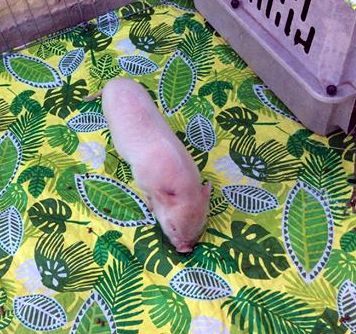 Really, though – I think the biggest hit of the whole book event was a kid’s book author, Tina Mollie Fisher – her book is called Pig’s Big Adventure … and she brought a tiny, very young piglet as part of her table … well, table and enclosure display. The piglet’s name was Princess, but I wouldn’t have been able to resist naming it Bacobit, or Wilburina. I can see why people get them as pets, and then are totally appalled when they grow to three hundred pounds or so. And that was my Saturday ….



Recent Comments