10. December 2015 · Comments Off on Another Toby and Jim Story! · Categories: Chapters From the Latest Book, Old West, Uncategorized

(All righty then — the beginning of the second set of Lone Star Sons stories! Attend, then – for here I will post another set of adventures over the next few months as the Tiny Publishing Bidness and the other WIP allow…)

Murder Being Once Done

“Something eating at you, hoss – since you got that letter from Galveston?” Jack asked, on a bitter-cold winter evening. Out in the Plaza at the heart of old Bexar, the ice-chilled north winds had swept those tables set up by the most enterprising of the red-pepper stew vendors clear of hungry diners, and all but the most desperate of them had gone home. Every citizen of that town who had a hearth to call their own – no matter how plain, tiny or humble, had retreated to the warmth of a good fire of sweet-smelling mesquite logs. Between missions, as assigned by their captain, Jim and Toby roomed in the small adobe house at the edge of the plaza, near the squat stone tower of San Fernando – the tallest building in town – and stabled their horses in the ramshackle building behind it. Jack, sometime commander of Texas Rangers was not an exception to the general rule on this winter evening. Jim Reade and his blood-brother, Toby Shaw of the Delaware people, shared his dislike of the cold on this evening; between them, they had spent all too many cold nights, shivering and shelter-less on various journeys and campaigns.

“Only puzzlement,” Jim replied, closing the volume of Blackstone’s Commentaries which lay open on his knee. The fire burning on the tiny plastered hearth and the tin candle-sconce between them barely put out sufficient light for him to make sense of the tiny print. “The letter is from my father … he has been asked by an acquaintance in Galveston for advice on a deeply personal matter, and he in turn has asked my advice – having none other to confide in, other than my dear mother. She is interested as the matter concerns the death of a woman, a woman that she knew – but not well, since the woman in question was much younger and resident in Galveston only for a year or so. It is not a matter of interest for the Rangers, or the State,” he added hastily, seeing Jack begin to frown. “A matter of law and conscience … and doubts.”

“There are always doubts, my Brother, when it concerns a matter of concern to women,” Toby added, from where he sat on the shabby hearth-rug, cross-legged in Indian fashion, leaning against the side of the box which held more wood for the hearth. “And what does this woman herself say of the matter?”

“Nothing much, since she is dead and laid in her grave this last half-year,” Jim replied. “The matter – as my father outlined it to me – is that her widower wishes to marry again, having settled upon a likely candidate for matrimony. The young lady so honored is not yet completely invested in the prospect of matrimony – at least, not with the man who has asked for her hand. Her guardians are even less eager to see their ward hand-fasted to him … hence their consultation with my father.”

“So, what is the problem, precisely?” Jack puffed on his pipe in a desultory manner, and laying it aside, looked into the fire; small orange and gold flames, dancing along the logs, bright spurts appearing as brilliant sparks.

“Certain remarks made to their ward by the man who courts her have cast considerable doubt on his fitness as a husband in their minds,” Jim replied, and frowned. He had spent some hours considering his father’s letter, teasing out from those brief words some sense of the puzzling reality hinted at, and from what he recalled of reports of a certain trial published in the Telegraph & Texas Register some months previous. It was not any surprise that Jack would have noticed his abstracted state of mind – Jack was like that. Not much got past him.

Now Jack drawled, “For the love of the almighty, Jim – don’t tell me that Johnathon Knightley is going courting again, after being acquitted from a charge of murdering his wife on the grounds of self-defense?”

“The very same,” Jim sighed. No curious event occurring the length and breadth of the Republic escaped Jack’s attention for very long. On those shreds of information made, Jack had divined the very essence of the matter. “It was a terrific to-do among the folk in Galveston,” he added for Toby’s benefit, as the latter looked extremely puzzled. “There was this man and his wife, who kept a tavern and let rooms to travelers – they were new-come to town, from … where was it?”

More »

30. November 2015 · Comments Off on The Judge, His Bowie Knife, the Duel and the Femme Fatale · Categories: Old West
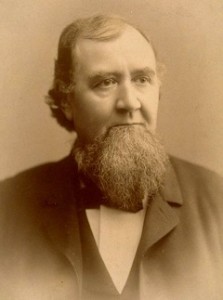
Judge David Smith Terry

Judge David Smith Terry

David Smith Terry was truly a man of his time and place – Texas and California in the early to mid-19th century. He possessed a large portion of the same intelligence, ambition, and physical courage which distinguished many of his contemporaries, as young men in tumultuous times. Alas, such qualities were offset by a pig-headed conviction of his own righteousness, a boiling-hot temper readily provoked to violence, and one more weakness, which would eventually prove fatal to David Smith Terry; he was all too ready to act on impulse without regard for consequence.

He was of a generation born into a relatively new country, with no memory of colonial rule by Britain, or the revolution itself, save perhaps for passed-down recollections of his maternal and paternal grandfathers, who had both fought in it with distinction. David S. Terry was the second of four sons of Clinton Terry and Sarah Smith Terry. The Terry marriage does not appear to have been a particularly successful one; they separated in 1835, when David Terry would have been about eight years old. Sarah Terry must have been a woman of spirit and determination, for she moved with her four sons to Texas in that same year, apparently hoping to retrieve some portion of respectability and income which had been lost through her husband’s mismanagement – mismanagement which must have been on a fairly epic scale to leave her in possession of their remaining property and custody of their sons. She and her sons established a plantation west of the present-day city of Houston, where they planted cotton and waited for prosperity to bless them once more. Instead, Sarah Terry died, shortly thereafter, leaving her sons – the oldest, Benjamin being fifteen, and David thirteen – essentially orphaned in the war and rebellion which followed.

David, large for his age and already impetuous, enlisted in Sam Houston’s army of Texans at Gonzales, following the fall of the Alamo. Reputedly, he fought at San Jacinto with considerable distinction. When Texas won a shaky independence by Houston’s victory, David S. Terry returned home to the cotton plantation – but not for long. He took up the study of law in the office of a relative by marriage, was admitted to the bar and practiced in Galveston for some years. He was described as a tall, handsome gentleman, solidly built, with steel-grey eyes under heavy brows, and sandy hair brushed back from a high forehead. He sported chin-whiskers but no mustache. Naturally rather reserved, he could be animated in conversation when the topic interested him, and very good company. He identified passionately as a man of Southern sympathies and as a Texan; to that end, he usually carried a sheathed hunting knife of the design made popular by Jim Bowie.

He went soldiering again, in the Mexican-American war, serving in Colonel Jack Hays’ regiment of Rangers. He participated in the battle before Monterrey, and upon returning to Galveston at the end of that war, became interested in politics. In 1847, he ran for the office of district attorney for Galveston and lost. This defeat may have been felt in a stinging fashion; two years later, he joined together with some of his Ranger comrades and followed the Gold Rush to California. He tried gold-mining for a brief time, didn’t care for the experience, (as did most men with a more readily-profitable trade who did not immediately strike it rich)   and set up practicing as a lawyer again in Stockton, California. There he dabbled in running for local office, this time as mayor. Just as before, in Galveston, he was defeated, and thereafter for a time returned to the practice of law. He prospered sufficiently over the next few years that he could afford to return east and marry a distant cousin-by-marriage, a Miss Cornelia Runnels. She was educated, well-mannered; the perfect gentle Southern belle, twenty-three to her husband’s twenty-seven. She is supposed to have influenced him greatly, and as the decade progressed, David Smith Terry went from success to success. Sadly, of their six children – all sons – only three survived to adulthood; of those, one died as a teenager in a hunting accident and the other at the age of thirty or so.

As for David S. Terry’s professional prospects, in 1855 the laurels of high political office finally descended on his noble brow in the form of a position on the California Supreme Court.  But controversy dogged his footsteps; in a tense interlude during San Francisco’s second bout of organized Vigilante activity, he lost his temper. He was not a supporter of the Vigilance Committee, which had been created by otherwise sober and law-abiding citizens in the wake of what appeared to be flagrant abuse of the law by elected and appointed authorities. Being one of those elected and appointed authorities – although personally incorruptible – Judge Terry did not approve of other parties interfering. An altercation ensued, when he and others who objected to amateurs taking the law into their own hands paid a visit on the Vigilance Committee. When a posse of Vigilance Committee members led by Sterling Hopkins attempted to arrest two members of Judge Terry’s group, Judge Terry most intemperately stabbed Hopkins in the throat with his Bowie knife. Arrested in turn himself, he must have had a nervous couple of days, waiting to hear if Sterling Hopkins’ wounds were mortal. Fortunately for both men – they were not. Alas, in coming years, Judge Terry’s temper remained as uncontrolled as ever.

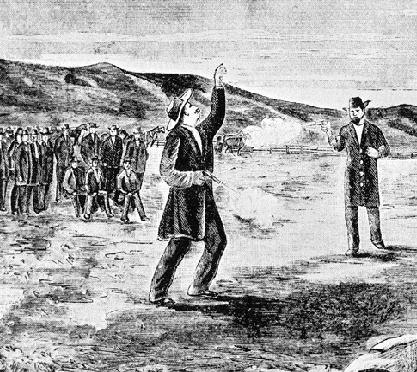
The matter of slavery – whether it was to be allowed in prospective new states of the Union and under what conditions if any – roiled California every bit as deeply and violently as it did elsewhere. There, the established Democrat party in California split into pro and anti-slavery factions. Not entirely unexpectedly given his origins and background, Judge Terry was vociferously on the pro-slavery side. Given that, and his intemperate nature, he was bound to clash with the anti-slavery side, personalized by his former friend and now US Senator David C. Broderick. Inflammatory accusations were exchanged, deep offense was taken … and a formal duel agreed on by the aggrieved parties. On September 12, 1859, they met in a place which is now a city park, but which then was outside San Francisco’s city limits. Judge Terry won the coin toss, allowing him to select a set of dueling pistols … which had hair triggers. Supposedly, Senator Broderick was warned of this by the neutral party who examined the pistols – but as the two men squared off, Broderick’s pistol accidently discharged. This left Judge Terry to take his own sweet time in taking aim at Broderick.
The famous duel

The famous duel

Mortally wounded, Senator Broderick fell; he died three days later – a martyr to the anti-slavery cause. Judge Terry was charged, but acquitted. His career in public office – although not his profession as a lawyer – being pretty well trashed, in the eyes of indignant anti-slavery partisans and perhaps those who disapproved of dueling, or of a duelist taking savage and unsporting advantage of a hair-trigger misfire – remained relatively untarnished. He returned to that practice for a time, but on the outbreak of the Civil War, picked up his sometime occupation as a soldier, in which practice an affinity for dealing out sudden fatal violence was – if not more acceptable – conceded to be more generally useful.

Returning to Texas, he proceeded to join the Confederate Army – for which his older brother Benjamin had raised a swashbuckling cavalry regiment official known as the 8th Texas Cavalry, and popularly as Terry’s Texas Rangers, which served valiantly throughout  the war in the west of the Appalachian theater. Benjamin Terry was killed in nearly their first skirmish, late in 1861, another Terry brother perished at Shiloh and David Terry was wounded at Chickamauga. He finished the war as a colonel, lay low for a time in Mexico, as did certain other die-hard Confederates … but in 1865, he returned to California and the practice of law as if nothing had ever happened. Time and experience appeared to have chastened him, or at least taught him to rein in the temper, for by the end of a decade after his return, he was a respected member of the California Constitutional Convention, revising the original state constitution.

And then, fate played the femme fatale card on David Terry, jurist, judge, colonel of cavalry and man of the world. He took on a client of the type usually termed as an ‘adventuress’  in the 19th century and a gold-digger in the early 20th, terms which usually hint at a degree of daring and amorality – a woman bent on playing high-stakes poker in the grand game of life. She was Sarah Althea Hill, an orphan of a respectable and prosperous family in Cape Girardeau, Missouri. In 1871, when she was twenty-one, Sarah Althea and her older brother came to San Francisco to live with relatives. Sarah, in the parlance of the time, was ‘fast’ and in the next decade, she burned through the inheritance from her parents of $20,000 dollars. (From modern calculations, this would have been anywhere from a quarter to over half a million.) Sometime around 1880, Sarah Althea made the acquaintance of a very, very rich man – William Sharon, a ‘49er, financier, silver-mine magnate, real-estate tycoon, hotelier, and for two terms, US Senator representing Nevada. He was at that time in his sixties, a widower … and as noted, filthy rich. They became attached, to which precise degree became a matter for spectacular and scandalous legal wrangling in various courts for the next five years.
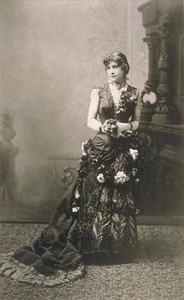
The Notorious Lady Herself

The Notorious Lady Herself

Seriously, the courtroom antics would have made a spectacularly tacky real-world TV series, beginning when Sarah Althea Hall had William Sharon arrested on charges of adultery, and proceeded to sue him for divorce, demanding alimony and a generous share of his property due her as an aggrieved ex-spouse. The resulting legal wrangling enthralled the readers of tabloids across the nation. Sarah Althea insisted they had been secretly married and she had a signed contract to prove it – secrecy necessary because he was running for reelection at the time, and wished to keep it all quiet lest his other mistress hear about it and create an embarrassing scandal. William Sharon insisted, indignantly, that Sarah Althea had merely been his generously compensated mistress and any such contract alluding to a marriage between them was a forgery. After a year of bitter legal wrangling, a judge ruled in favor of Sarah Althea, declaring her to have been William Sharon’s legal wife, and to have a right to such of his wealth accumulated since their presumed marriage. Coincidentally, Cornelia Terry, David Terry’s long-suffering wife died at the same time.

The appeals and countersuits commenced immediately, continued by William Sharon’s son and son-in-law after his death a year after the judgement. Meanwhile, the presumed Mrs. Sharon married her now-widowed and very much older lawyer, and together they zestfully embarked on another round of legal hearings on whether William Sharon and Sarah Althea Hill had been truly and legally man and wife … only the next time, the circuit judge hearing the case – Associate Justice Stephen Johnson Field, of the US Supreme Court – appeared distinctly unsympathetic. Sarah Althea, in a breach of court etiquette, loudly accused Judge Field of having been “bought” by the Sharon interests in the case. A fracas ensued, with David Terry drawing his Bowie knife in her defense. Both Terrys scuffled with US marshals, were forcibly removed from the courtroom, arrested and slapped with jail sentences by Judge Field, who thereafter earned the bitter enmity of the pair. The threats against him by the Terrys were taken so seriously, that when next Judge Field ventured to California in the late summer of 1889, he was accompanied by a US marshal as his dedicated body-guard.

Whether it was coincidental or not, Judge Field and his body-guard, David Neagle, were traveling from Los Angeles to San Francisco train, on August 14th, 1889.  Coincidentally, the Terrys had also boarded that train, somewhere along the way.  When the train stopped for breakfast at the station restaurant in Lathrop (a town a little south of Stockton), the Terrys discovered the presence of the judge … although perhaps not his bodyguard; a fatal omission, considering subsequent events. But given the hot and irrational tempers displayed throughout the lives of both David Terry and Sarah Althea, this was absolutely guaranteed not to end well or without bloodshed. David Terry approached Judge Field, peacefully eating breakfast, and without warning, slapped him across the face.
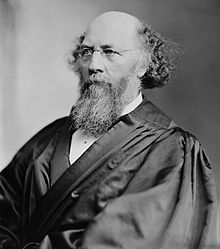
Stephen_Johnson_Field,_photo_half_length_seated,_1875

Justice Stephen J. Field

Marshal Neagle – who had previously been a town marshal and deputy sheriff in the rowdy municipality of Tombstone, Arizona, during it’s the wildest and most wooly stage – leapt to his feet and drew his own weapon as David Terry reached inside his own coat. Marshal Neagle shot David Terry twice – dropping the former judge dead in the middle of the railroad restaurant. So ended the life of a man who otherwise might have been better known for nobler things – save that he had a wicked and impulsive temper, and fell for a woman who had even more problems with violence and impulse-control than his own.

The post-script? There was a resulting US Supreme Court case, which decided that yes, the Attorney Genera of the US did have the authority to appoint US Marshals as bodyguards to Supreme Court Justices. Sarah Althea Hill (Sharon) Terry – who it might be inferred – had substantial mental health issues, was eventually confined to an institution, where she died of natural causes some forty years later. She was buried in the Terry family plot, in a cemetery in Stockton, California. A granddaughter of David S. Terry came forward and approved, at the time of her death.



So, here we go, full-tilt at a dead run into the traditional holiday season. I rejoice to confess that a client for the Tiny Publishing Bidness sent a check for a print run of his books, from which profit allowed Blondie and I to knock off our family gift obligations, all ship-shape and Bristol-fashion, to use an aged metaphor from the days in which the city of Bristol did indeed have a sailing-ship industry. This was performed at my computer, through various websites, and not requiring us to go out anywhere, on a particularly dreary and rainy day. So, yes – observe the power of this fully-functional internet! Neither of us has any motivation to sally out at the crack of dawn, stand in line, and engage in brutal wrestling matches for the privilege of purchasing tacky and excessively marked-down Chinese-manufactured electronic tat. Not even would we stand in line at the crack of dawn to combat for American-manufactured tat … which is why I am grateful for the aforementioned fully-functional internet. Our gifts are edible and/or readable – Fischer and Weiser sauces from Fredericksburg for my sister and bro-in-law, a fruitcake from Corsicana for my brother and his wife, and books for his kidlets ordered from Amazon, which if I know my publishing sources (and I think I do) are also printed and bound in the U S of A.

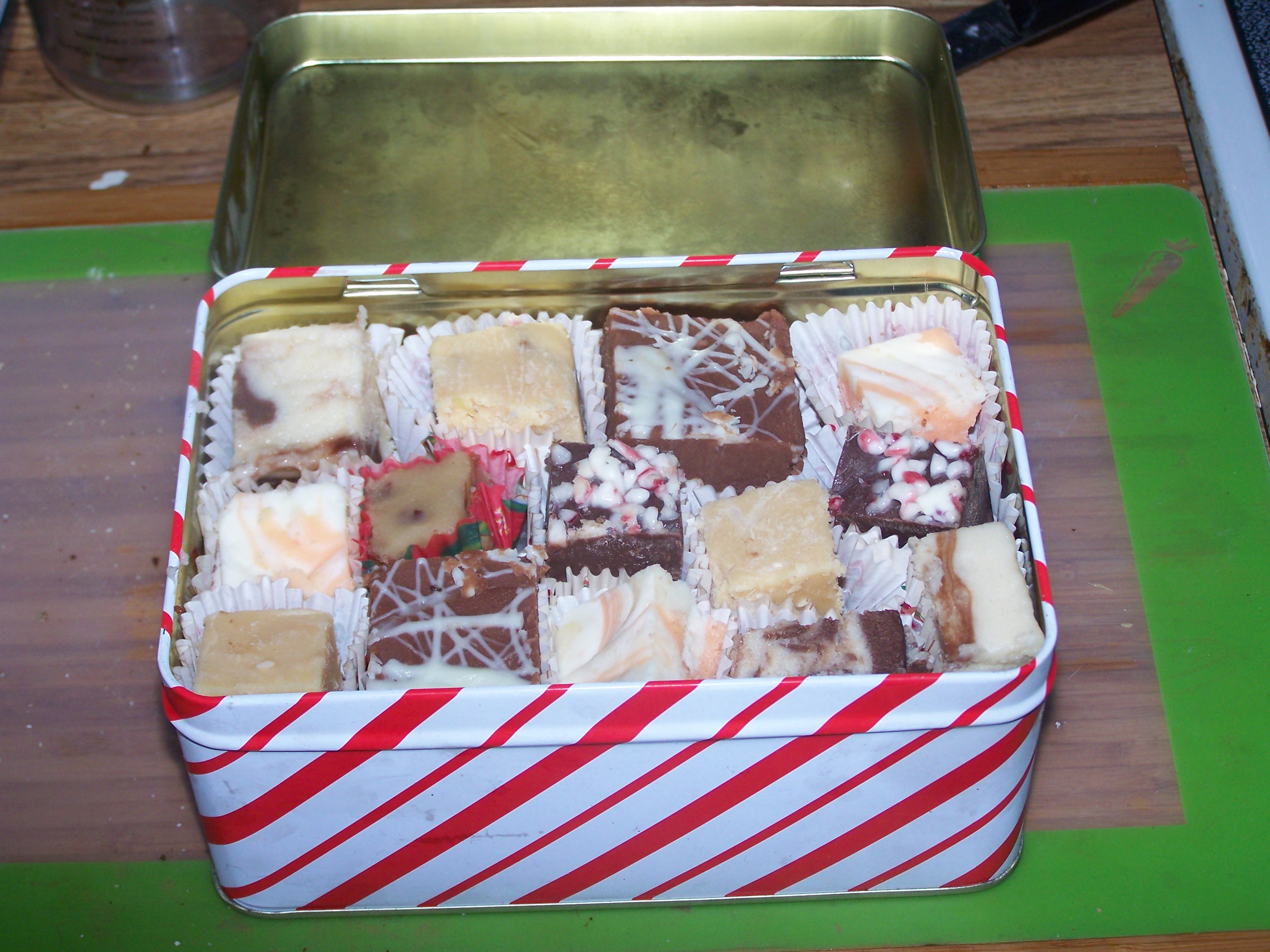
That fortunate client check also permitted us to sally forth to Sam’s and the local HEB for the final ingredients for the Christmas neighborhood treat; gourmet fudges. Last fall – I think when I did the book-club meeting and walking tour of significant places pertaining to the Adelsverein Trilogy, my daughter was inspired by a visit to a candy-maker in Fredericksburg. Cookies are passé, we’ve explored other avenues in holiday neighborhood gift-giving like homemade bread and cheese, home-brewed herb vinegars and oils … and so my daughter suggested various flavors of home-made fudge, as was available in that Fredericksburg candy shop. We spared no expense in making small batches – real butter, cream, top-market chocolate – and the reception of it all was rapturous.

From last year - a representative sample of our neighborhood Christmas gift

From last year – a representative sample of our neighborhood Christmas gift

Of course, it didn’t really hurt that we doubled some of the recipes gleaned from the internet – which resulted in so much assorted fudge that we were handing it out not just to immediate neighbors and those whom we were on regularly friendly and affectionate terms with … but also forcing it on those whom we had barely a nodding acquaintance. “Hey, we’ve seem you around the neighborhood – here’s a box of fudge! Merry Christmas!” We also had tins of fudge – very nicely presented in tidy paper cups – like the nicer grade of cookies and candy – for the postman, the guys on the garbage truck, the local police, a huge Christmas gift-platter for the local fire-house … you get the idea. In the last couple of weeks, when we’ve been discussing neighborhood Christmas gift obligations, certain neighbors have been hinting rather broadly at their preferences … “Say, y’all going to do that fudge again? That was really good…” So, our duty was obviously clear, aided by the bag full of pretty Christmas tins picked up for a song at the local Super-HEB clearance shelves last year. Yes, we shop strategically with a eye towards long-term requirements – got a problem with that?

This afternoon, we cleared the counters, donned aprons, put Christmas music on the stereo, washed the medium-sized sheet pans, and set to work, making six sorts of fudge – two more batches to go, as soon as we get another bag of walnuts and another of white confectioner’s chocolate tomorrow. We’re looking to distribute it by the end of the week – as next weekend begins the massive Christmas marketing season for us, and we have an event every weekend until Christmas.

So – that’s my Thanksgiving/Black Friday weekend – yours?


27. November 2015 · Comments Off on Eternal Turkey, Strong to Save · Categories: Domestic

It was automatic, the family ritual for disposing of the post-Thanksgiving left-over turkey – and all the other dishes. On the day after, warmed-up everything. On the day after that, hot turkey sandwiches. On the day after that – when the stuffing, mashed potatoes and gravy had usually been completely consumed – then cold turkey sandwiches. Followed on subsequent evenings by turkey ala king, turkey loaf and turkey croquettes. Finally, when the turkey carcass had been substantially reduced to small scraps and bones, it all went into the stock-pot and we had turkey stew for another two weeks. Generally, by the time we polished off the Thanksgiving turkey, we would only have had a weeks’ grace before commencing on the Christmas turkey. These days, if I have prepared one for Thanksgiving (not a guarantee, actually – for some years I have been by myself and fixed something small and non-traditional) I have usually been so sick of leftover turkey that for Christmas we have fixed just about anything else as a main dish for Christmas dinner.

But leftovers, like the poor, and the Christmas shopping rush – will always be with us. This recipe, for a pot-pie with a cheddar-biscuit crust is especially tasty, for the chief reason that it doesn’t look, or taste like an obvious leftover. This is one of those recipes that I copied by hand from a magazine, or a newspaper, into my own little collection.

 Turkey Pot-pie with a Cheddar Crust

Simmer until just tender in 3 cups water – 1 lb peeled, cubed butternut squash. Turn off heat, and add to hot water and cubed squash – 1 cup frozen lima beans. Allow to sit a moment, before draining and reserving cooked vegetables, and 1 cup of the cooking water.

In a large skillet, melt 3 Tbsp. butter, and make a roux with 2 Tbsp. flour. Wisk in the 1 cup cooking water from the vegetables and 1 cup chicken or turkey broth, with 2 Tbsp minced fresh sage, 5 oz. pealed pearl onions. Simmer for 10 minutes and add 3 cups cubed cooked turkey, and the lima beans and squash. Pour into a 1 ½ quart shallow baking dish’

Combine in another bowl: 1 ¼ cup flour and 1 ½ tsp. baking powder. Stir in 1 Tbsp cold butter, 1 ½ cups grated sharp cheddar, 4 slices crisp and crumbled cooked bacon. Stir ½ to 2/3 cup cold milk to make a loose dough, and pipe around the edge of the baking dish. Bake at 425 for 20-25 minutes. This will not appear anything like leftovers. Trust me.

26. November 2015 · Comments Off on A Reminiscence: Thanksgiving in the Barracks,1978 · Categories: Domestic

(A re-run from my original military blog, and I thought I had included this in Air Force Daze, but it seems I put it in my first book, Our Grandpa Was an Alien, without the stuffing recipe.)

The women-only barracks was the only one that contained a working kitchen. Once upon a time, all the female troops were assigned to a WAF squadron, and lived in the WAF barracks. The WAF separate command was long gone by my first year in Japan, but all the females, no matter if they were assigned to the hospital, CE (Civil Engineering), SPS (Security Police Squadron), CBPO (Consolidated Base Personnel Office) , the Hill (Shussh! You can’t talk about The Hill!!!) – we all lived in the one building. This had several advantages, notably in the efficient base-wide transmission of gossip, and in letting us scamper between our rooms and the gang latrines dressed in little more than a towel or underwear, but possession of a kitchen was most highly prized.

Besides that, the dining hall was a good bit away, and the aesthetics of the Japanese cooks led them to unsettling practices like adorning the meatloaf with maraschino cherries. God knows, it might be rather attractive in theory, but it was still very disconcerting to be eating your meatloaf and two veg and discovering the maraschinos. Eventually, a group of us began taking turns fixing something on a Sunday afternoon, and sharing it out with anyone without dinner plans: “Just bring your plate and a fork, and a chair down to the common room” we said. A girl from Georgia fixed real Southern fried chicken one week, the next weekend the resident vegetarian baked a vat of eggplant parmigana. So when fall came around, and Thanksgiving drew closer, it seemed only logical to do our own Thanksgiving dinner. Most of the traditional dishes are fairly simple, after all. We took up a fund for groceries, did a headcount of who wouldn’t be going to their supervisors’ houses and immediately hit a snag:

“Who’s going to do the turkey?” was the main question, followed by “Well, who helped enough at home to stuff and bake a 20lb turkey without giving anyone food poisoning?” (This has always been stressed on the AFRTS spots at that time of year.)

I had helped Mom and Granny Jessie with the Thanksgiving and Christmas turkeys since… well, I was unwary enough to admit it. Before I could come up with a plausible way to wiggle out, I was rushing to the commissary with a pocket full of crumpled notes and change on the Wednesday afternoon, with just fifteen minutes before I had to be up the hill and on-shift at the TV station.

Turkey, 20+ pounds, frozen solid: OK, I would leave it to defrost outside in my car during the shift; Northern Japan in November was slightly chillier than the inside of most refrigerators anyway. Onionscelerysagesausage…bread. Mom always bought a loaf of bakery wheat bread, tore each slice into clunks and dried them on a sheet-cake pan in the closet where the hot water heater lived. I zigged down the bakery aisle, threw a loaf into the basket and headed for the quick-checkout register, making it to work with about a half-minute to spare.

Didn’t even notice until I got back to the barracks that night, and took out the bread that I had a loaf of rye. Damn and blast! There was no way to get a loaf of wheat bread, no way at all. What the hell— I tore up the rye loaf, reasoning that with all the other stuff and a ladle of gravy on top, who the heck would ever notice a few caraway seeds or not.
It worked— made the best bread stuffing ever! I’ve done it with rye bread ever since. (Unless I do the Rock Cornish hen with wild rice stuffing instead) So without further ado:

Sgt. Mom’s Rye Stuffing

Tear apart or cut into cubes one loaf rye bread. Dry until crisp in a warm area, or an oven set to the lowest temperature available.
Heat to simmering 2-4 cups unsalted vegetable or chicken broth.
Rinse inside and out, and pat dry with paper towels one turkey. Remove the bag with giblets and set aside. Do not forget these; you will use them for the gravy base.
In a large frying pan, brown 1/2 to 1 lb bulk sausage. When done, drain off fat, and set sausage to drain on paper towels. Add 1/4 to 1/2 cup butter to frying pan, and sauté until translucent:
1 onion, chopped finely
2-3 stalks celery, sliced finely
Add:
Handful of celery leaves, also chopped
2 to 4 Tbsp. fresh parsley, chopped
Sage to taste, either fresh and sliced, or dried and crumbled
Pepper to taste
8-ox box of mushrooms, cleaned and sliced
Empty the dried bread into the largest bowl you have, add the cooked sausage, the sautéed vegetables, and moisten with the broth. You can add chopped cooked chestnuts at this point. The stuffing should not be soggy. Stuff the turkey according to custom. Whatever stuffing does not fit in the bird can be baked in a covered casserole for the last hour or so. Generally its 15-20 minutes per pound for a smaller bird, 13-15 minutes per pound for larger, or so sayeth “Joy Of Cooking”.
While the bird bakes, take the giblets and the neck and simmer them in a heavy saucepan in the leftover broth and enough water to make about 3 cups of liquid. Finely chop the giblets and neck meat when thoroughly cooked, and mix a little water with flour to thicken it all, and there’s your gravy.
With luck, there will be no leftovers.