13. May 2016 · Comments Off on Tah- Dah! · Categories: Book Event, Chapters From the Latest Book

9780989782241-Perfect.2.indd

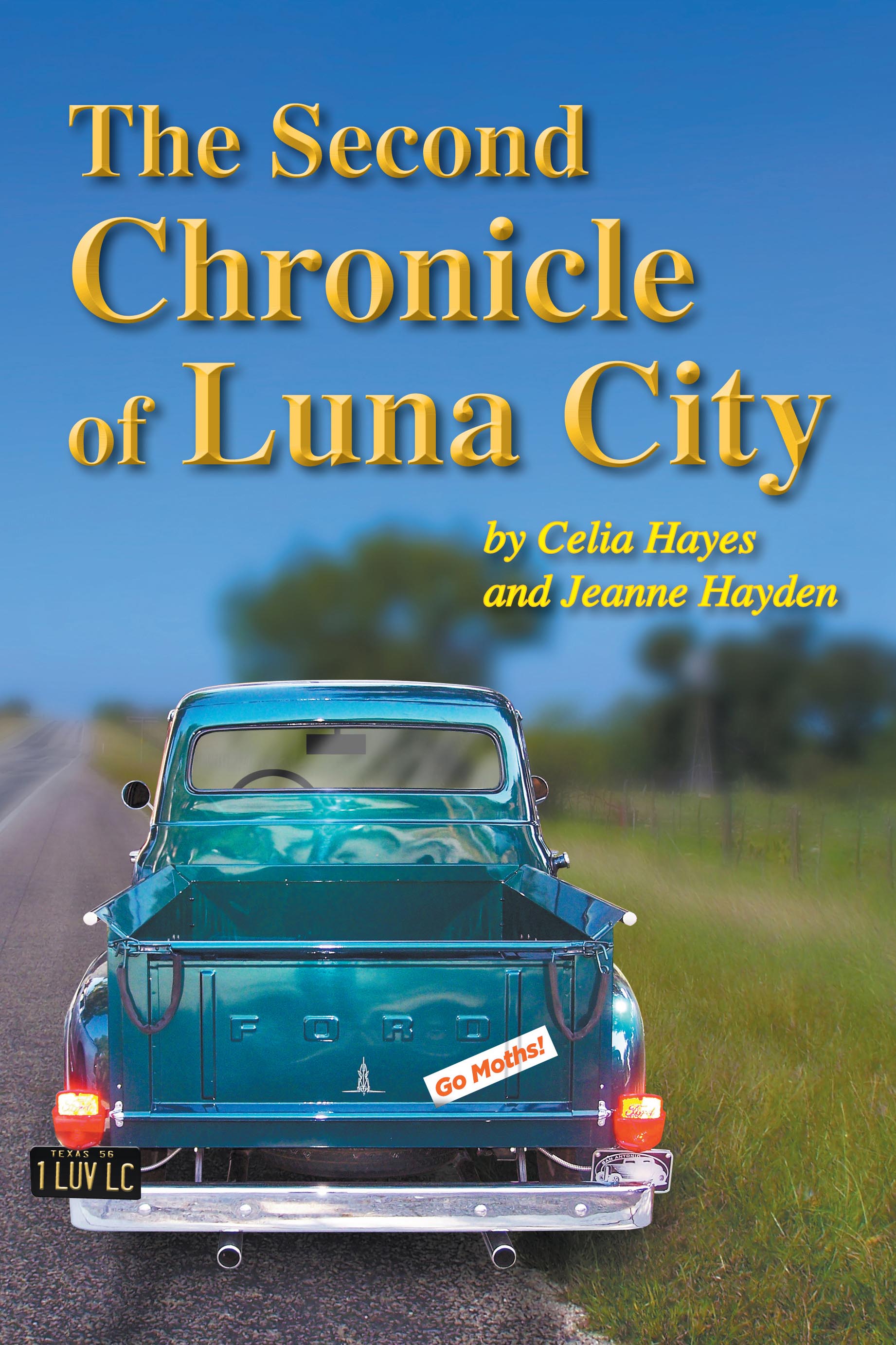
Second_Chronicle_of_LC.indd

AVAILABLE DIRECT FROM THE AUTHORS

AUTOGRAPHED WITH A PERSONAL MESSAGE

Each $13.25 + S/H and Texas Sales Tax

Or Both together for $24.00 + S/H and Texas Sales Tax


Celia Hayes Books


The Chronicles of Luna City – Available also through Amazon – in print and Kindle

And at  Barnes & Noble

The Second Chronicle of Luna City

In print and Kindle on Amazon

And at Barnes & Noble

Sample Chapter from The Second Chronicle of Luna City

Things That Go Bump in the Night

It gratified Richard no end, to discover that there were a number of weeks – months, even – during which it was possible to be comfortable in the little Airstream without running the air conditioning or heating. It seemed at first, that Texas had only two temperature settings; Broil/Roast and Blazingly Hot. To someone accustomed to the fairly mild summers of Northern Europe, alternated with the occasional frigid winter blast, it had all come very much as a shock, especially when such extremes could sometimes be experienced within a single day. However, once he discovered that autumn, winter, and spring were very much like an  English summer, he was prepared to be more philosophical about it. The only bad thing about leaving the windows of the Airstream open at night, for the fresh air was the occasional scream of a pea-fowl who preferred to roost in a nearby tree, (until he took steps to discourage the blasted creature), the distant crowing of the Grant’s half a dozen roosters, and now and again something that sounded like a dog suffering from fits of nervous laughter.

“Coyote,” Sefton Grant explained to him, the morning that Richard first mentioned this. Sefton, who was lean and stringy and looked like a slightly younger, fitter and less run-to-seed Willie Nelson, was putting out morning feed for the goats, clad in his usual working attire of battered cowboy boots, a pair of baggy cut-off jeans and a wide-brimmed ‘boonie’ hat which had once been military green but was now weathered to no particular color at all, and nothing much else besides. “Yeah, there’re are coyotes all over in the brush. You won’t see them in the daytime, though.”

“Do they present any danger?” Richard asked, nervously – since he had coyotes and wolves rather muddled in his own mind.

“Only if you are a housecat, or a chicken,” Sefton replied, grinning. “That’s why we lock up them both at night, and give the dogs free run. Judikens says that the coyotes gotta live, too … but not on our damned chickens.”

The dogs – a couple of houndish-looking mutts and one which looked rather like a standard poodle – were usually to be found lazing in any convenient patch of sunshine in the Grant’s yurt-centered compound, where they had all found a happy refuge. Richard didn’t think any of the three were energetic enough to be effective guard dogs, but you never knew. The Grants hadn’t selected the dogs for particular guarding-skills in any case; it was more a case of the dogs – all strays or cruelly dumped in the countryside by irresponsible owners – selecting the Grants as their chosen humans.

“The goats now,” Sefton added, with some satisfaction. “They look after each other. Don’t worry about anything you hear at night, Richard – the dogs are on guard.”

This conversation was the first thing to come to Richard’s mind – actually the second thing, after, “What the hell was that?” – when something woke him in the middle of the night. Something; he sat up in the dark, trying to recollect what it was, or might be. Yes, a sudden kind

of ‘whumping’ noise, as of something heavy hitting the ground. Without turning on any of the interior lights, he slid out of bed and padded through to the front of the caravan, where the larger windows offered views of the goat pastures, and the lumpy meadow leading down to the river, with the forlorn campground bathhouse and lavatory, standing foursquare with moonlight silvering the white-washed walls and tin roof. The moon drifted, a milk-pale orb, above the tree line at the water’s edge, where mist tangled like shredded gauze among the distant shrubs and stands of rushes. Was there something moving, there among the brush? Something white; Richard was not certain of what, exactly. Could it be Azúcar, the Grant’s infamously bad-tempered pet llama?

He shrugged – likely it was. Well, no matter to him; and Azúcar was big enough and sufficiently aggressive to look after himself very well. Richard would have thought no more about it – and then he recalled what Araceli had said about ghost riders, along the bank of the river at full moon. Nope – didn’t look anything like ghost riders on spectral horses at all.

But something woke him the following night; not the ‘whump!’ noise that he had heard before. This was more like a regular squeaking sound, like a supermarket trolley with a bad wheel. It went on for about fifteen minutes, finally diminishing into silence, and Richard went back to sleep, muzzily thinking to himself that it was someone passing in the street below … only to recall upon waking very early – that there was no street and no ‘below’ from an Airstream caravan parked in a deserted campground. This was curious at the very least. He could not be certain that it wasn’t a dream anyway.

He mentioned it to Araceli, about mid-morning, when the breakfast rush was over.

“I’ve been wakened in the early morning, a couple of times,” he ventured. “The place is usually so quiet that I sleep like a log … but there is something queer going on.”

“Not that,” Araceli said, in much alarm. “Judy and Sefton are nudists… and totally against any kind of exploitation in any form!”

“No, not that,” Richard sighed. “Not the way that it sounded. It’s just

… odd. The place is quiet as a tomb, when the old commune or Founder’s Day isn’t in session. But I can’t help thinking that something strange is going on. Two nights in a row, and something waking me up in the wee hours.”

“Not the ghost riders, is it?” Araceli ventured. “That’s a tale told by teenagers to frighten each other or by the abuelitas to frighten disobedient children.”

“The ghost riders?” Richard raised a skeptical eyebrow. “Pull the other one, Araceli my sweet country innocent. Britain is haunted several times over every inch by the ghosts of two thousand years. I doubt that there is a square inch of the place completely un-haunted. Spectral riders, of a mere hundred and fifty years’ provenance? Please.”

“Well, you’re living there, you figure out a way to put up with them,” Araceli replied smartly and then their conversation wandered on, perforce, to more immediate topics.

But on the next night, Richard was wakened again. This night was a one where a storm front had blown through, dropping quantities of rain, and now the warmer temperatures were bringing moisture up from the ground and the water. The entire campground was shrouded in mist. It was not quite solid enough to be called a ‘fog’ – but it did wrap the low- lying area adjacent to the river-bottom in a silvery-white veil. And there came that same squeaky-wheel sound again. Only this time, he recognized it for what it undoubtedly was – the hand-cart that Sefton hauled heavy things like goat-fodder and straw bedding from the yurt compound to the series of ramshackle sheds which sheltered the goats in bad weather.

“I wonder what the old berk is up to?” he wondered. Well, nothing much could startle him with regard to Judy and Sefton, but why they were doing it in the middle of the night was a puzzlement. On that note, he rolled over and went back to sleep. He did make mention of it, the following afternoon, after bicycling home from the Café. He stopped at the yurt to ask for half a dozen eggs for himself.

Judy beamed at him, saying, “Sure – let me see what the girls have produced! Can’t get any fresher than straight from the hen’s butt, can we?”

“No, I think not,” Richard replied, slightly unnerved by Judy’s way  of putting it and also by a sudden mental vision of a hen on a gynecologist’s examining table, with feet in the stirrups. She bustled off towards the henhouse, as Sefton came around from the main shed, rolling the wheeled cart before him.

“’Lo, Rich,” he said. “How’s it goin’, man?”

“Pretty well,” Richard answered. “Getting ready for the mid-summer solstice?”

“Yep. We’re hoping for a good turn-out this year. The weather’s gonna be nice.” Sefton scratched his slightly bristly cheek with a faint scratching sound, and Richard suddenly recollected the sound of the cart, from the previous night.

“You might want to lock up that cart,” he said. “I could swear that someone has been using it at night. I keep hearing someone or something out in the campground in the wee hours.”

“Do ya?” Sefton shrugged, as if this was of little concern. “No one locks up anything around here. Mebbe ya heard the ghost riders, ‘r something like that.”

“Maybe,” Richard agreed. There were large bottles of something in the cart, large, opaque plastic bottles, mostly covered by other bags of wood-shavings used for bedding the hens and goats. But not quite … and he did wonder why Sefton headed off to the goat pasture as soon as Judy emerged from the henhouse with a wire basket of eggs.

And that night, he was wakened again – this time, not by a squeaking wheel, but by a strange kind of ‘chuff-chuff-chuffing’ sound. Without turning on any lights, Richard padded silently to the banquette end of the caravan and looked out into a world of fog and mist, an eldritch world in which a single small light flared and bobbed. Up and down across the length of the deserted campground, bobbing as a man might walk with a small light affixed to his forehead, the regular ‘chuff-chuff’ noise now close, now distant and nearly inaudible.

“Good night, nurse!” Richard said to himself, having finally realized what he was seeing. He watched for a bit longer; until the figure in white, the small light bobbing in the fog passed close enough to the caravan for him to be absolutely certain. And then he went back to bed, and slept the sleep of a man with a completely unworried mind.

In the morning, before the sun was more than a brief bright line on the eastern horizon, he went to the nearest goat shed with a battery torch in his hand. The small goats nuzzled at him in mild curiosity, and Che the now full-grown Nubian goat butted his thigh as if demanding the caress that was only his due.

Buried deep in the goat’s bedding in the second ramshackle shed were some very curious items. And when Richard returned home that afternoon – how very strange to think of the Airstream as home! – with small shreds of bread dough still clinging to his hands, a dusting of flour on his shirt and in his hair from the weekly preparation of an enormous batch of cinnamon rolls, he put up his bicycle and wandered over towards the yurt. He was exhausted from the day of work, which had begun before dawn, and from pedaling the bike, for the summer heat was merciless, but he had just enough energy to look for Sefton.

He found him shoveling the latest accumulation of chicken dung into the serried rows of reeking piles that were the Grant’s compost heaps. (Used and reused wooden pallets, strung together in fours to make individual compost containers.)

“Hard at work, I see,” Richard observed, and Sefton hesitated and grinned –  an expression which vanished completely from his bronzed countenance as soon as Richard added, “Near to twenty hours a day, that I can see, after last night.”

“Er …” Sefton went several shades paler under his tan. “What did you … it was foggy last night. That’s when people see the ghost riders! Judikens says that …”

“Likely she could see the whole mounted parade of Horse Guards, given the right encouragement,” Richard drawled. “But what I saw was someone in a white cover-all, walking around fogging the whole place with insect-killer and the whole lot of bug-killer and fogger is presently hidden under the goat’s bedding materiel in the second shed where you  left it in the wee hours.”

Sefton recovered something of his composure, squinting at Richard. “There hasn’t been anyone living in the trailer long-term since the commune broke up, so there ain’t no way that anyone took note before. Well, you know how Judikens makes such a big thing about natural remedies, and chemicals. She’s been big on it for years, tell the truth. But the truth of it is that folk that are not used to the outdoors much; they can get sort of over-exposed, real easily. You know; mosquitoes. Fire ants…”

“Yes, I recollect that, very clearly,” Richard answered with a reminiscent shudder. On his very first morning in Luna City, he had awakened from drunken slumber, lying naked on top of a large fire-ant hill on the riverbank, with predictable results. It had taken nearly two weeks for the small pustules left wherever they stung him to heal entirely. “So, the usual environmentally-sensitive stuff that Judy wants us to

use doesn’t make a dent,” Sefton looked at Richard – not quite imploring, but inviting comprehension. “And we can’t have our guests, our old friends bitten six ways from Sunday. I do what needs to be done – been doing it for years, without her knowing. Hell, she was raised in the suburbs, had no idea of what farming and raising stuff really meant when we first came here. I did; I grew up on a ranch, outside of a little burg called Noodle … ever hear of it?”

“Can’t say I have,” Richard managed to swallow his astonishment. “Really – there’s a place in Texas called Noodle?”

“You betcha,” Sefton nodded. Richard thought about it some more, wondering for almost the first time how Sefton and Judy became a pair. A more oddly-assorted couple was hard to imagine.

Sefton answered the unasked question. “We were at UT, together. A thing, ya know? Turn on, tune in, drop out. Summer of Love, and all that. My folks were almighty pissed – hers’ too. I was supposed to be studying agronomy. But Judikens had a way with her. Crook her little finger, guys come running. Goddess-power, ya know?” Sefton leaned against his shovel and sighed, reminiscently. “It seemed like the world was on fire, falling apart. We had to get back to the garden, get in touch with nature, withdraw from the materiel world an’ all. So, Judikens had this little piece of worthless, overgrown land she inherited, and we had the notion to set up a commune on it.” Sefton chuckled, wryly. “Yep – buncha college kids with a load of airy-fairy notions. Took most of the summer to kick that nonsense out of them. But us two – we stuck to it. No, it ain’t much to look at, and I’m the first to admit it. But we don’t owe nothin’ to the man, and we don’t call anyone boss. We’re off the grid, got plenty to eat, a roof over our head. We get by – you know what they say ‘bout how country boys can survive? Heck, I wish that Judikens was a better cook, but I’ll  bet there are folks like Mister Clovis Walcott who might live under a better roof’n ours, but aren’t any happier. You don’t wanna give me away, do ya?”

“My lips are sealed,” Richard replied, with perfect contentment. “I promise, I will say nothing to cause domestic dissention between yourself and your good lady. I have no great love for either mosquitoes or fire ants.”

“Thanks, Richard,” Sefton beamed at him. “It ain’t much, but it’s home … an’ you’re a part of the family.”

“Looks like we’re going to get another member of it, by extension,” Richard observed. From where they stood, by the henhouse and the compost enclosures, they could see a battered RV crawling carefully down the rutted dirt road which led from Route 123 towards the campground enclosure. “Is this anyone you know?” he added, for Sefton had mumbled something uncomplimentary under his breath, upon noting the large logo applied, as a banner across the side of the RV. “Treasure Hunters, International” it read, in ornate letters, with a website in slightly smaller letters underneath and a portrait representation of a beaming, bearded gentleman alongside the logo.

“Yep,” Sefton replied, and spat into the weeds which fringed the compost piles. “Xavier Gunnison Penn, the world-champion treasure- hunter as he calls himself. He’s been coming here for years, looking for Charley Mills’ treasure hoard. I’ll bet that Araceli Gonzales’ little boy finding a gold coin in the Easter Egg hunt has fired him up all over again.”

“He’s been here before?” Richard was frankly astonished; the only regular visitors to the Age of Aquarius were either members of the old commune on their regular mid-summer pilgrimage, or out-of-town residents returning for Founders’ Day – in either case, visitors knowing well what fresh hell awaited. He had yet to see a casual traveler pull off the main road and find their way to the overgrown meadow; if they did, turning around and driving away as soon as they saw the place, as fast as they could risk their tires and shock absorbers on the rutted unpaved track. Now Sefton nodded glumly. “Yep. And aside from being about six kinds of nut, he’s a cheap bastard. Guess I’d better call Joe Vaughn and let him know.”

“He’s not some kind of criminal, is he?”

“No, not that you’d notice so much,” Sefton hesitated. In the campground, the RV trundled slowly across to the far edge where the single row of electric hook-ups was situated, several spaces down from the Airstream. The RV halted, then backed slowly into the space. “It’s just that he’s one of these enthusiasts. No discretion. Some crazy notion pops into his head, he’s going with it three seconds later.”

The driver-side door of the RV opened, and a man emerged; short, stocky and bearded. He saw the two of them and waved, not with any urgency. As the driver – presumably the impulsive Mr. Penn – went around settling the RV hook-ups, Sefton continued, “You ever hear how he got banned for life from the Smithsonian? I’ll tell ya; I know it’s a fact because he told me the story himself. He got it in his head that there was a map to a treasure, etched on the inside of one of those big dinosaur bones. And nothing would do but that he had to look at it, right that very moment. So, he jumped over the rope and shinnied up into the exhibit. You know – into it! One of those big bastards in the main exhibit hall. You gotta know that everything and everybody all around went all kinda ape. He got into a fist-fight with a nice lady docent, right on the spot, and that was when they banned him forever.”

Sefton shook his head, sadly. “You know, any real sensible person woulda asked permission, written a letter asking real nice, pretty please. So, if he gets some sorta notion to pop over to the Wyler’s or to Mills Farm with his metal detector and a coupla shovels, try to talk some sense into him. And if you can’t manage that, then don’t let him talk you inta going with him.”

“I will keep your wise advice in mind,” Richard replied. “Consider me warned. And thank you once more for the midnight mosquito- slaughter.  Judy might not approve, but I do, most enthusiastically.”

“No problem,” Sefton grinned, revealing a most unexpectedly healthy set of good teeth. “Say, I know you’re a two-fisted drinking man. I got a good batch of mustang grape wine made a couple years ago – k’n I bring you a coupla bottles, as a token of my esteem?”

“Certainly,” Richard answered – really, considering some of the swill he had pounded down in his time, how bad could mustang grape wine really be – and what was a mustang grape anyway? He devoutly hoped that it wasn’t some kind of rural slang, like road apples for horse droppings.

“Great!” Sefton replied. “Soon as I get finished with this, I’ll bring it over.” He looked over at the RV with the Treasure Hunters banner across the side, and sighed, his features returning to their usual expression of lugubrious gloom. “Guess you’ll be seeing how long it takes for Gunnison Penn to come over and make friends, Rich. Inside-outside, about two minutes is my bet. Sorry ‘bout that. But as Judikens says, it’s our sacred obligation to make strangers welcome at the Age of Aquarius.”

“A concept to be heartily embraced by all in the business of providing hospitality to the public,” Richard answered, unable to think of anything else to say. He bade farewell to Sefton and strolled down the gentle slope to what he had begun to think of as home. Over the past fifteen years of his life, he thought – the old Airstream was the one place in which he had remained in residence for the longest unbroken period of time – a straight eighteen months. On that account alone, good reason to think of it as home. All the better reason to defend it – and by extension, the Grants, eccentric as they were, and as inconvenient as Che the goat and the unbearably noisy pea-fowl – that beast which had taken to roosting nightly in the tree adjacent to the Airstream and rousing Richard at ungodly hours with its’ incessant screaming. Still … if he had his old income at his command, he could purchase the Airstream from the Grants, and move it to … no. To change anything about his situation was to make it something less than what he had become comfortable in.

He opened the door and closed it behind him, relishing as always the cool air inside which came to meet him, the tiny, tidy and comfortable interior; a quiet place to eat, sleep, and read Larousse Gastronome, to sit in the banquette seat, or in one of the patio chairs outside and watch the sun go down, after a long and rewarding day of work in the Café. Yes, he was a self-centered bastard. Never mind about the subjugation of enemies and listening to the lamentations of their women – life’s greatest pleasure to him was watching the sun set on a day of honorable and rewarding  work … oh stone the bloody crows, was that someone tapping on the door?

He opened the rounded-corner trailer door – yes, of course; there stood the driver of the Treasure Hunter RV. He was a gentleman of late middle age, balding above, and extraordinarily hirsute below the nose – which organ was large and curved like a parrot’s beak. He was clad in khaki shorts and an eye-wincingly multi-colored Hawaiian-style shirt patterned in palm-trees and electric pink canoes, alligators and hula-skirt clad dancing girls.

“Hi, neighbor,” this person said. “Do you have a pint of milk to spare?”

10. May 2016 · Comments Off on The Second Luna City Chronicle! · Categories: Book Event, Chapters From the Latest Book, Luna City

Second_Chronicle_of_LC.inddThe e-book version has gone live on Amazon, and on Barnes and Noble with a release on Friday; the print version will soon be up and available as well. I regret that until it goes officially on sale, there is no look-inside feature yet. Tomorrow, I will set up page for readers who would like to order directly from me – with autograph and a personal message.

But for those readers who have begged to know the identity of Richard’s mysterious visitor – from the first chapter, this excerpt:

That’s Show-biz

In the early morning, before the sun was more than a brief bright apricot rumor along the eastern horizon, Richard Astor-Hall pedaled grimly along the back road from the aged Airstream caravan at the Age of Aquarius Campground and Goat Farm towards the site of his daily labors. At least now the Airstream was beautifully and comfortably-maintained, since he appeared to have been informally adopted by the sprawling and omnipresent Gonzales-Gonzalez clan, on top of paying rent to Sefton and Judy Grant from his income from the Café. This was managed through Jess Abernathy, whose firm hands channeled the financial streams of a myriad of Luna City enterprises, including that of the Café and of the Age of Aquarius Campground and Goat Farm.

“Rent. I manage all of Sefton and Judy’s financials as well as those of the Café,” Jess informed him, some months ago when he asked for an explanation for a certain deduction marked every month in his stipend from the Café paid into a bank account at a bank in Karnesville.

“Why?” Richard had asked. “Can’t they manage for themselves?”

Jess frowned. “They are communists,” she explained, in a patient kind of voice which absolutely rubbed him the wrong way.

“I thought you Yanks disapproved of communists in the most strenuous fashion,” Richard replied, to which Jess snapped, “In the old sense, Richard; the lower case-c sense. Judy and Sefton are the last of an idealistic colony of true believers in a system which is only practical when it involves volunteers who work hard to benefit the collective and when it comes to finance, they don’t have the sense that God gave a goose. But they do good work and a lot of it,” she fixed Richard with a commanding glare. “So – I see to handing the takings from the goats and the campground and their Saturday market. I make certain that their taxes, utilities, health insurance and license fees are all paid … so the Grants can go on with tending their goats and worrying about whether it is ethical to weave with machine-made yarns. Never mind Judy twittering on about all that New Agey crap; she and Sefton show up when anyone needs help, and Judy hasn’t yet met a suffering animal that she doesn’t want to rescue. Who do you think fosters all those cats and dogs dumped out here in the country by idiot former owners? From each according to their abilities,” Jess added with a particularly cutting turn of sarcasm, “And to each, according to their needs. Or as we call it around here, supply and demand. I demand regular supplies of their honey, eggs, and goat-milk rosemary soap in return for economic services rendered and Judy supplies them: a win-win, all the way around.”

“I regret even asking,” Richard said and Jess snorted. On further consideration, though, he had to admit to himself that he rather favored Jess’s system of intelligent budgeting and rigid cost-to-benefit analysis. (‘Can we afford this for the Café?’ ‘No, not until ….’ Or sometimes, ‘Yes, but only up to this amount.’)

In his past life, he had been spectacularly careless with money. I had millions of pounds in income once and blew most on loose women and abuse-worthy substances. The rest I wasted. That recollection led to a dire contemplation of the other recently-arrived element of that old life.

Now he pedaled the bicycle along the verge of one of the unpaved back roads which eventually led into the heart of Main Square, Luna City, still pondering on the unfairness of it all. The bike was a mountain model, which had come to him through the largess of the Gonzales/Gonzalez clan, through one or another the the seniors bashfully admitting that it was a great bike, but the son – or possibly the grandson – had outgrown it or moved on to other and less environmentally-sustainable means of getting around. Hey, Ricardo, it’s a good way to get to work! You want it? Twenty-five dollars; I’ll tell Jess and it’s paid for.

As he came up on Route 123, he saw the lights of an automobile at a distance – ah, one of those grossly over-chromed SUVs. Knowing that drivers were apt to speed, in spite of the efforts of Chief Vaughn’s patrol cars and the much more substantial hazard posed by deer insouciantly wandering into the traffic lanes, Richard braked the bicycle, went onto the narrow gravel-and-weed shoulder of the road and waited for the SUV to pass. Which it did – about fifty yards farther along Route 123, where a number of unaccustomed lumps lay, slightly off the tarmac.

It looked, from where Richard stood, as if a deer had gone mano-a- deero against a mechanized vehicle, with predictable results. Hundred- pound deer, five-thousand-pound motor vehicle – which was going to win that contest? To his mild curiosity, the SUV slowed abruptly and went off into the shoulder. The blinking hazard lights flicked on, and someone emerged from the vehicle … a masculine outline, a male someone followed by a faintly overheard burst of indignant Korean in a familiar and feminine steam-whistle shriek. Ah; Clovis and Sook Walcott. Richard wondered why on earth Clovis should be interested in roadkill – but not for very long. To the tune of a final machine-gun burst of Korean, the shadowy figure of Clovis got back into the driver’s side, the blinking red hazard lights resumed their steady beam and with a roar the SUV pulled back onto the road and vanished around the next bend. Now that the road was empty, Richard remounted the bike and carried on – he had another fifteen minutes before he was due at the Café.

When he got to the place where the Walcotts had pulled off the road he saw that yes – indeed a deer; relatively undamaged from the impact but quite plainly dead; neck at a grotesquely unnatural angle. Nearby lay another roadkill; this one a hulking black bird of the kind he was given to know was called a ‘turkey-buzzard,’ also sprawled on the edge of the pavement with one wing upraised like a small black sail. The turkey- buzzard stank like a charnel-house. Why this unlovely spectacle of vehicular/wildlife mayhem had drawn Clovis Walcott’s intense interest was a mystery indeed. In the seven months or so that Richard had lived in Luna City and bicycled back and forth between the Café and the Age, he had seen it often enough himself … and even more often, the live deer creatures, wandering dainty and long-legged in the open spaces between thickets, or the turkey-vultures soaring on motionless dark wings in the faultless azure midday sky. But – he said to himself, in a grumpy acknowledgement he had made a thousand times in the last six months and would doubtless make a hundred thousand times more – this was Luna City, Texas.

He continued pedaling through the pre-dawn dimness, relishing the welcome chill of it all after the ungodly summer heat, a chill which had left a slight crunch of frost on certain grassy spaces. The sky was the color of mother-of-pearl, an elusive shimmering shade flushed with pink and apricot-orange, evanescent. He passed the bright orange Luna City Independent School District bus, pausing briefly at an intersection on the outskirts of town to collect a gaggle of small children, swathed in their winter coats and burdened with small rucksacks. These children were also burdened with the attention of watchful mothers and the occasional father who went scattering to their own daily devices once the school bus bore their offspring away.

He waved to Patrick Gonzalez, rumpled in his oil-stained coveralls, and sleepy-eyed from a night of driving a tanker truck; it seemed to be his morning to see Angelika and Mateo off to school, while Araceli turned on the lights and the coffee-machines at the Café.

Still ruminating alternately over why Clovis Walcott was  so interested in fresh roadkill and his own predicament with regard to the recent inconvenient visitor to Luna City, Richard turned down the narrow street which ran along the back of that block of buildings. Most of them housed garaging or at least a place to park a car, and in the case of the Café, the rubbish bin, a small weed-grown space and a small loading dock. The Steins, in the next building over, had a garage and a small shed at the very back, with a walled little garden between it and the rear windows of the main shop. As Richard wheeled into the back of the Café, he saw Georg’s bare-bones sedan backing out of their garage. He wondered vaguely what brought out Georg so early; on most mornings, he and Annise were over in the Café at that large table in front of the front window – what Georg jokingly called the ‘stammtisch’ – where the  regular patrons gathered.

He let himself in through the back door into the kitchen, which smelt divinely of fresh coffee and baking cinnamon rolls. Araceli was empting out the dishwasher, stacking plates and mugs with nervous efficiently and a great deal more force than strictly necessary. She glared at Richard, as he shrugged off his winter coat; this was a vintage military field jacket from Marisol Gonzalez’ second-hand shop in Karnesville. Chris Mayall at the Gas & Grocery had already been humorous  about it, but the jacket  was well-made and warm.

“That friend of yours is here,” She said, sounding if she were speaking around a clenched jaw. “The English one.”

“Not a friend,” Richard sighed. “More like an associate … and I regret like hell that it was ever that close.”

“Oh, Rich,” drawled the visitor in tones of tragic disappointment. Alas, Richard’s visitor was leaning picturesquely in the door way to the main room of the Café. “I am cut to the quick. I thought we were best chums, always.”

“Nope.” Richard was inordinately proud of the way that he thought  he had adopted something of the classic western bent towards the taciturn. Besides it was past time to fire up the griddle and start the bacon, then those slivered ham slices that everyone called Canadian bacon, and finally a nice vat of scrambled eggs.

“You’re a brute, Rich; a cold, cold unfeeling brute.”

“All a part of my happy, inconsequent charm,” Richard answered, sternly unmoved.

“I come all the way to this out-of-the way hole,” his visitor protested; tragically wounded as to expression, languid as to posture in the doorway, “I endeavor to make myself pleasant to your friends, rekindle our old relationship, relish the charms of this quaint little village, and this is my reward?”

“We were never friends,” Richard replied, his attention bent upon the griddle, and preparations for the morning rush of breakfast customers. “It was a mutually-advantageous association; friendship had bloody-all to do with it. Are you going to stand in the door all morning, with Araceli and the girls constantly stepping around you? You’ll be trampled underfoot in the morning rush for cinnamon rolls – consider yourself warned.”

“If you truly feel that way, Rich,” there came the deep and wounded sigh. “I’ve tried to reach out to you so many times! You never replied.”

“Life is full of these little tragedies,” Richard brought out a bowl of eggs from the refrigerator and began cracking them with deft and systematic skill into another. After some moments, he looked up from this task.  “’Ere – you still there?”

“I am,” replied the visitor. Araceli took up a tray upon hearing the front door open and close with a musical chime, and interjected, “Well better find another wall to hold up. Your special order is ready. Best eat it before it gets cold, then.”

“You take such good care of me, dear girl,” the visitor answered, without a blush. Richard thought it a testimony to good manners and excellent customer relations training that Araceli refrained from bouncing the tray off the visitor’s skull as she carried the breakfast special order  into the dining room. After a moment, she returned, not visibly fuming, although Richard could read the signs accurately.

“Pip Noel-Barrett was never a bosom chum of mine,” he confessed with a long sigh. “Truly – I have better taste than taking that poser to   my … well, to my confidence, anyway. He is, as practically everyone eventually realizes, an insufferable, inconsiderate, and amoral git; I  deduce that we are in accord in that matter. Ordered off-menu, I take it? Told you to add it to his running tab?”

“Of course,” Araceli snapped. “As always; I do not mind taking the trouble, Chef, I really don’t. What I do mind, is that he picks over it with an expression on his face like Mateo when he doesn’t like what’s for supper, leaving most of it on the plate and never saying a darned thing about what’s wrong with it. If he calls me ‘dear girl’ or ‘Araceli-my- darling’ one more time, I WILL hit him with the heaviest iron skillet in  the Café.”

“No, you won’t,” Richard answered. “It will make a mess on the floor, and assaulting one of Clovis Walcott’s business associates will reflect badly on everyone. Speaking of business, has he done anything about paying?”

“Nope,” Araceli’s expression was thunderous. “It’s always – sorry love, left the card in my room, sorry, bit short of the dosh at the moment, tomorrow, Araceli-my-darling. Jess will be furious.”

“If it comes to that,” Richard sighed. “I will set Miss Abernathy on him. That would give me the greatest pleasure. He owes for more than a fortnight of breakfasts and sandwich luncheons since he took up a room at the Cattleman.”

“A month is more like it. You’d think if he was in the movie business,” Araceli continued grumbling. “He’d be a lot better about paying his bills.” For some reason that Richard couldn’t fathom – save that Araceli was one of the most hard-headed women of his acquaintance and that she was badly offended by a customer pick-pick-picking at the Café’s food offerings like a dyspeptic hen – she was immune to the fabled Noel-Barrett charm.  The front door chimed again and then again almost at once. Yes, the first of the morning regulars. Araceli bustled out with carafes of fresh coffee and hot milk.

(All righty, then – this should hold y’all til Friday!)

We went to a Hancock Fabric outlet this last weekend – my daughter wanted to take advantage of the going-out-of-business bargains. She has developed an interest in needlework and embroidery of all sorts, and since we try to live rather frugally – well, sales prices do have their appeal at all times. But it is with sorrow that we visit the Hancock Fabric outlet within our neighborhood. We have both worked in a going-out-of-business-enterprise, so we can comprehend the absolute sorrow and shock of the employees. Upon my retirement from the military, I took on a temporary sales job in the Marshall Field’s outlet in San Antonio, which was closing – and part of that was that a fur-coat concession took up a small part of the retail outlet. Which experience gave me no end of insight into the whole ambiance of high-end department store retail sales… and yes, I sold fur coats, for a basic wage plus a small commission on sales. Which did mount up, as the months wore on, towards closing of the Marshall Field’s store. We lived on the paychecks from that job for simply months, as Blondie joined me on the fur salon sales force … but never mind. I can wholly and deeply sympathize with the employees of the Hancock Fabrics store, even past the point of merely apologizing as a customer for their situation. No, I do not want to say anything about how the sales floor will contract and contract again, the shelves will empty out, as the discounts grow deeper and deeper. The store will become a bare husk of what it was – and at the end, locked doors with a pile of pathetic and picked-over goods. So sad, so sad … since I do not have to put on the whole office-work skirt suit and all, every day, I have kind of gotten away from the sewing and tailoring that I used to do for myself then, and with my nieces both well beyond the age of wanting cute little dress-up outfits … but I will miss Hancock Fabrics anyway.

In grey, with a black velveteen collar...

In grey, with a black velveteen collar…

The only time I really have to make an effort these days is for author events, where one simply has to make a splash, especially if there are other authors there. And depending on the genre or book, some authors do dress to impress and attract the eye. Another member of the on-line author circle I belonged to early on had a couple of books set in 19th century China. He had a full set of Mandarin robes with suitable accessories and that always made a bit of a splash at signings. On his advice, I have tried to do something with a sort of movie cowgirl look for book events. Lately I’ve been thinking that straight period 19th century might work better. But since we usually have to set up, and haul heavy boxes of books back and forth, the full crinoline, bonnet, bustle and trained gown is absolutely out. But there was a possibility in the Butterick Patterns costume section; an Edwardian walking suit; slim skirt, tailored jacket over a high-necked blouse. So, I bought the pattern, and there was some grey polyester suiting going for practically nothing – not that I am a fan of polyester, or that it will be in the least period-accurate. It will look nice and wrinkle-free without a lot of pressing and steaming.

I have some high-laced shoes already, a wide-brimmed hat which can be dressed up with lace, netting, plumes and whatever to match, and a replica ladies’ pocket watch on a fob; voila – new look for me on the very busy author scene for the rest of the year. Since I am going to try and bring out the second Luna City Chronicle, another Lone Star Sons book, and finish The Golden Road all in time for Christmas, I will simply have to have something smashing to wear …

16. November 2015 · Comments Off on So, Here We Go … · Categories: Book Event

This was a lovely and profitable Saturday in Bulverde, where we had a table (actually a pair of tables facing in opposite directions in the center of one of the exhibit halls in the Community Center) for the first event on our season of book and craft market events. This is the first on our schedule for this season, which will see us on most weekends until Christmas. Last year at this event was … eh, not very promising at all, but this time around – yes. My daughter had a nice round of sales for her origami-based and bead-weaving based adornments, which she had at a fairly reasonable and appealing price.

The sad thing was – we went up to Bulverde late Saturday afternoon to set up, since her stock in trade is kind of finicky to put on display, we spent a while at it – and returned home and to internet access to hear all about the Moslem terrorist strikes in Paris. Yes, I said it – Moslem Terrorists. Terrorists – deal with it. In the 1980s, I lived with the possibilities of anti-American terrorism in Greece – around the corner always; assassinations, explosions, sudden random gunfire, sabotage and all that. These are on the schedule to be happening here, apparently, if the loonies of ISIS/ISIL are to be believed. Whether they can pull off something like that here in Texas … well, it didn’t end at all well for the pair of Moslem loonies who tried to shoot up the Draw Mohammed contest in Garland. They didn’t make it past security at the pull-in for the parking lot. Never assume that you will out-gun the locals at an art show in Texas.

The show itself proved to be a pretty good day for us both; I suspect that my daughter has now shown up at enough of these local shows to attract repeat attention. Her origami earrings and beaded bracelets are original, and rather reasonably priced … a perfect, inexpensive, original and charming gift, something that a teenager can afford to purchase with pocket money. This was also my first outing with print copies of Sunset and Steel Rails, which went also very well. So did Quivera Trail, saleswise. Here is hoping that this particular event is a good omen for the next few. We have added an event the second weekend in December in Helotes, which will be a new one for both of us. Next Friday and Saturday, I’ll be bringing more copies of Sunset & Steel Rails, and the first shipment of Chronicles of Luna City to the New Braunfels Convention Center – so, hope to see you there.

12. November 2015 · Comments Off on Christmas is a-Coming … · Categories: Book Event, Domestic

And the goose is getting fat … time to put a penny in the poor author’s hat … yep, much appreciated, as the household account was depleted yesterday by the death of the Whirlpool dryer. Which, as the darned thing was twenty years old, was hardly unexpected; this was the last of the three household appliances that I purchased at the Base Exchange when I bought my house and moved into it in 1995. The washer was replaced two years ago, the refrigerator about 18 months ago, so the dryer was surviving on borrowed time, and becoming increasingly inefficient. This, in spite of having applied the business end of the shop-vac to the house dryer vent and cleared out all the lint … and seriously, the shop-vac could – in a colorful and slightly off-color simile – suck the paint off a car fender.

Anyway – off to the friendly neighborhood Scratch and Dent Super-Store, where amazing bargains are to be had, as the various large household appliances are available for quite good and readily negotiable prices (with delivery, installation and haul-away of the old appliance for an additional reasonable charge) since the items on hand are either slightly dinged, surplus to requirements at the original retailer, overages from the manufacturer, special-orders not redeemed at the last minute, et cetera. It’s a mixed bag, usually limited to what they have on hand at any given minute … but they will bargain, and we promptly had discounts on a suitable model which 9780989782050-Perfect.inddwas a good match for the washer – discounts for being repeat customers, veterans and referring neighbors right and left. We like this place – the sales staff have the authority to negotiate; so very rare in a top-down corporate enterprise world. Even with tax and delivery, the cost of a replacement dryer still came out to about two-thirds what it would have been new, from any other retailer. It was promptly delivered today … but in the meantime … the other schedule. The seasonal crush of market events begins for both my daughter and I, even before Thanksgiving. We have a full schedule of events, beginning this weekend and running nearly up to Christmas itself. I usually try and time my book releases for this season; this year it is different because a) two books are in play, and my daughter has co-author credit for one of them. She came up with the characters and the general plot, and I write the rest; fine-tune the plot, the conversations, and descriptions.

This Saturday is a craft fair in Bulverde, at the Bulverde Spring Branch Activity Center, 30280 Cougar Bend. Then, on next Friday and Saturday, the 20th and 21st, it’s the New Braunfels Weihnachtsmarkt, in the New Braunfels Civic Center. This is the planned launch event for both of the new books: Sunset and Steel Rails, and The Chronicles of Luna City. The New Braunfels Civic Center is at 375 S Castell Ave – which is the main street running east from IH 35 into the old downtown part of New Braunfels.

Then – we will be in Miss Ruby’s Author Corral, somewhere about Goliad’s downtown square on the 5th of December — sometimes the Author Corral is in one of the shop-fronts along Courthouse Square. We are tentatively set for an event in Helotes on December 13th, and we might still have the stamina for a final pre-Christmas market in Boerne on the following weekend.

9780989782241-Perfect.2.inddOf the two books, Sunset and Steel Rails is a historical novel, set between 1884 and 1900, following the experiences of a young woman who comes west as a Harvey Girl. She is, all unknowing, related to the Vining and Becker families through her grandfather, who had a family in Boston … and another one in Texas, four decades previously. It overlaps with The Quivera Trail – and a fair number of characters from that book, and the Trilogy generally make appearances – but again, it is an independently-standing narration.

The Chronicles of Luna City is something quite different – an exploration of a little town in South Texas, through short stories, blog-posts and news stories. I’ve posted some of them here; sometime in mid-summer we were struck by an inspiration — what Cicely, Alaska, might be like, if it were in South Texas. Or Lake Woebegon, if the author was fond of and respected the people written about. Luna City is completely mythical, of course … but the characters and situations are based on real events, and some real people, whose identities … well, never mind. The Chronicles are enlivened by chapter-head illustrations derived from photographs I have taken, and it may amuse people to try and deduce where those buildings are really located. Both Sunset and Steel Rails, and Chronicles of Luna City are available in Kindle and Nook ebook forms, as well as in print, although the print version of Luna City may not post to Amazon and Barnes & Noble until next week, and the ‘look inside’ feature has not yet been activated.